How we compared AI planner apps
An AI planner can now mean three very different products.
One product automatically moves tasks around your calendar. Another guides you through a morning planning ritual. A third turns a brain dump into a visual day. Comparing them by the number of AI features hides the decision you actually need to make.
We reviewed current first-party feature pages, help centers, platform listings, and pricing pages. We scored each app on five questions:
- What planning work does it remove?
- Does the output become scheduled time or stay a list?
- Can the plan recover when the day changes?
- How much setup and maintenance does it require?
- Who controls the final plan?
We did not count a chat box as planning by itself. We looked for a concrete change to capture, prioritization, task breakdown, scheduling, or follow-through.
If your main need is project and task structure rather than the shape of the day, start with our AI task manager comparison. If time visibility and task initiation are tied to ADHD, use the AI planner for ADHD guide alongside this list.
AI planner apps at a glance
| App | Best for | Planning style | Price checked July 30, 2026 |
|---|---|---|---|
| TaskCoach | Goals, habits, and follow-through in one system | AI drafts three day-plan intensities for review | Free core; Premium starts at only $8 per month |
| Motion | Automatic work scheduling | Continuously places and reshuffles tasks | From $19 per seat monthly when billed yearly |
| Reclaim | Protecting focus and habits on an existing calendar | Flexible calendar optimization | Free; paid plans from $12 per seat monthly |
| Sunsama | A guided daily planning ritual | Manual planning with prompts and workload feedback | $22 monthly or $17 monthly when billed yearly |
| Akiflow | Fast capture and time blocking across work tools | Command-driven daily planning | $34 monthly or $19 monthly when billed yearly |
| Tiimo | Visual, neurodivergent-friendly planning | Visual timeline plus AI task breakdown | Free; Pro has a 7-day trial and regional pricing |
| Structured | A simple visual day timeline | Manual timeline with optional AI assistance | Free; Pro pricing varies by region |
Prices can change, and mobile storefront totals vary by country and tax. Check the checkout screen before subscribing.
1. TaskCoach: best for planning tied to goals and habits
TaskCoach treats the day plan as one layer in a larger system. Tasks, habits, goals, scheduled commitments, focus work, notes, and journals share context. Plan Day turns the current workload into three proposed intensities: Recover, Steady, and Push. You can move blocks before accepting the plan.
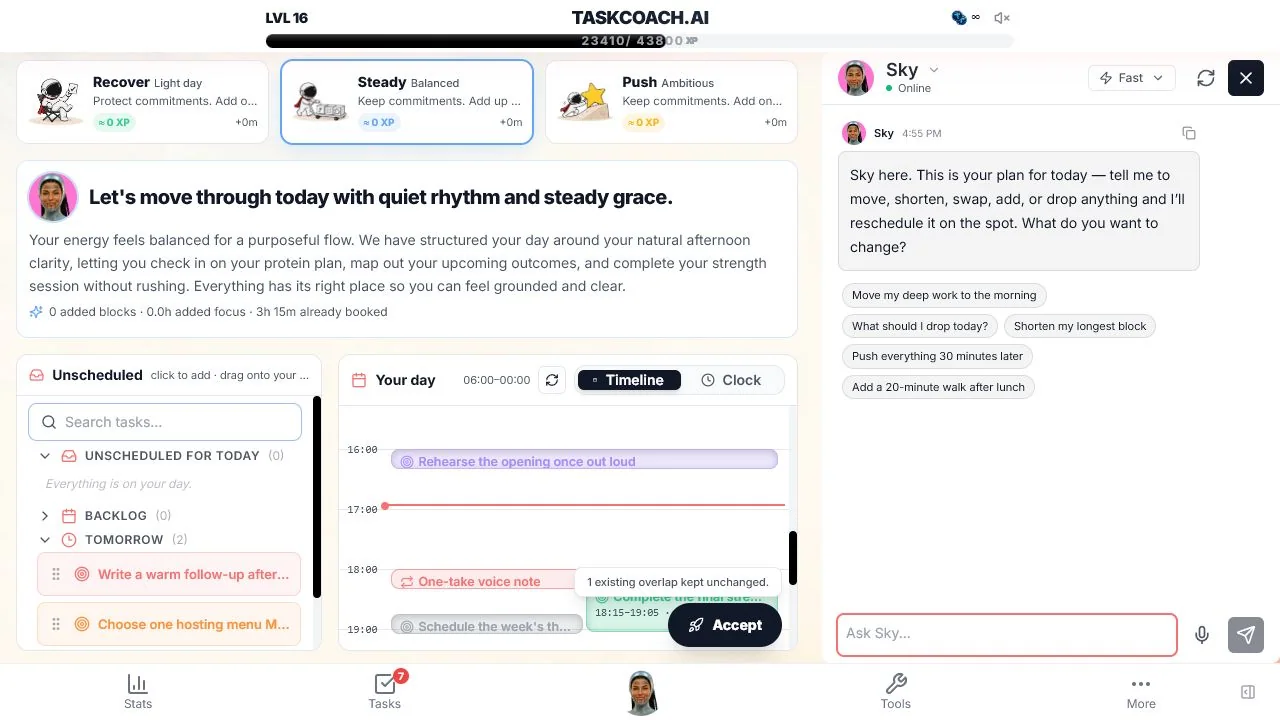
That structure suits someone whose problem starts before the calendar. If you often complete urgent tasks while larger goals drift, the connection between goals and daily work is useful. The coach can also see the same context instead of asking you to restate your situation in every conversation.
The tradeoff is setup. A connected system asks you to add enough goals, habits, and tasks for the context to become useful. People who want a pure work calendar may prefer Motion or Reclaim. We also publish TaskCoach, so treat this selection as a transparent product recommendation rather than an independent award.
Choose TaskCoach if: your daily plan needs to reflect goals, habits, and patterns across life.
Skip it if: you only want automatic scheduling for a work task list.
2. Motion: best for automatic scheduling
Motion makes the most scheduling decisions in this group. You give each task a duration, deadline, priority, and availability window. Its scheduling engine places the task on your calendar and recalculates when meetings or higher-priority work intervene.
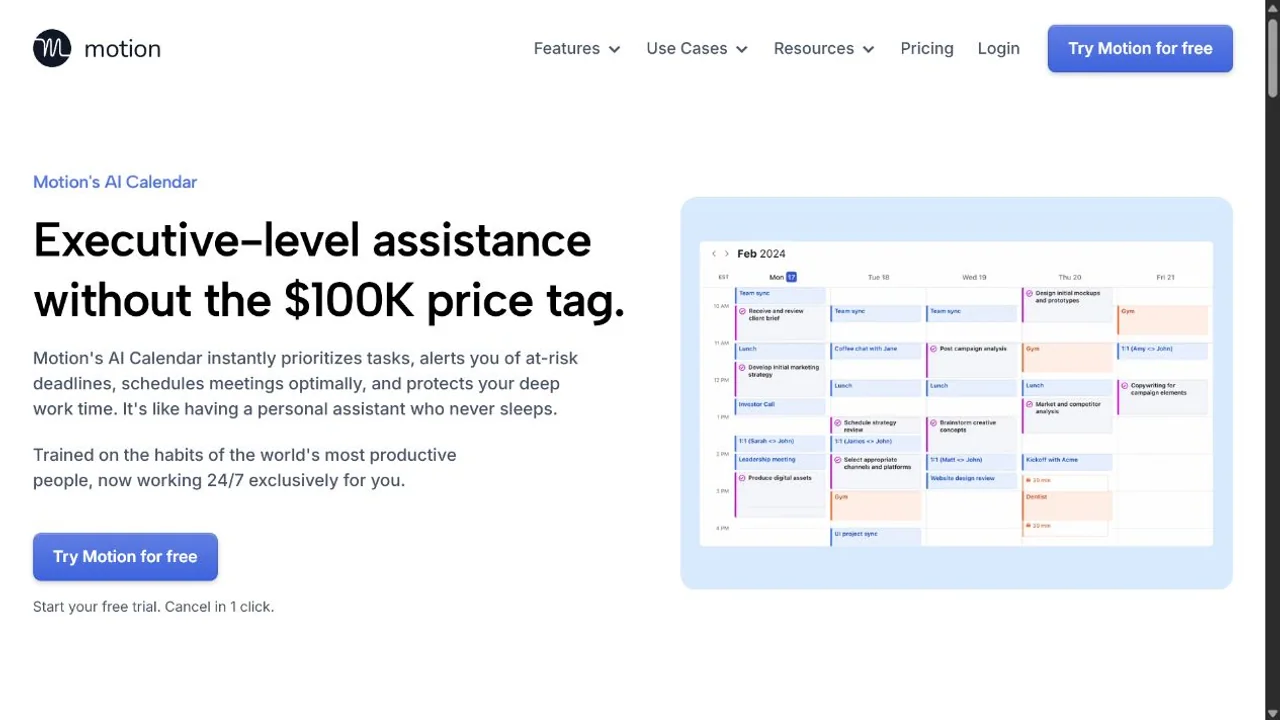
This is valuable when manual calendar repair is the recurring cost. Motion can also flag capacity problems before a deadline arrives. The current product extends beyond personal planning into projects, docs, meeting support, and team capacity, which makes the price easier to justify for work use than for a light personal list.
Automation still depends on inputs. Inflated priorities and optimistic durations produce a polished version of an unrealistic plan. Motion also asks you to trust frequent schedule movement, which can feel noisy if you prefer to decide where each block belongs.
For a closer look at the calendar mechanism, see Motion vs Reclaim vs TaskCoach.
Choose Motion if: you want the calendar to keep rebuilding itself around changing work.
Skip it if: you enjoy choosing your own time blocks or mainly plan personal routines.
3. Reclaim: best for protecting focus and habits
Reclaim works as an optimization layer across Google and Outlook calendars. Its agents defend focus time, habits, buffers, and flexible meetings while fixed events remain anchors. The free plan is unusually capable for an individual who wants to test automated calendar protection.
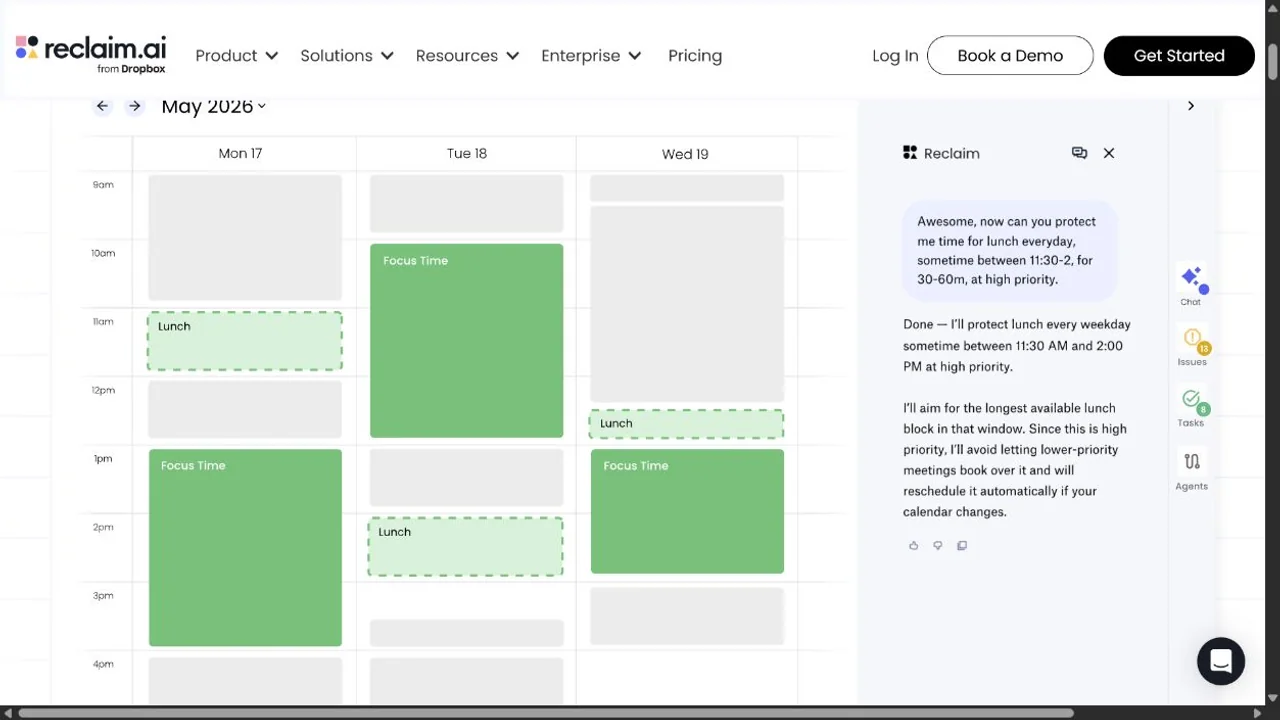
Reclaim feels less like a new task system than Motion. That is a strength if your tasks already live in Google Tasks or another connected product. It can place flexible work and preserve availability without asking you to migrate every project into a new workspace.
The tradeoff is depth outside the calendar. Reclaim is strongest at time allocation and meeting coordination. If your main problem is turning a vague goal into a sequence of tasks, another app should probably own that layer.
Choose Reclaim if: your calendar is already the source of truth and focus time keeps disappearing.
Skip it if: you need a richer personal task, goal, or coaching system.
4. Sunsama: best guided daily planning ritual
Sunsama deliberately keeps you involved. Its daily planning flow asks you to review tasks, decide what matters, estimate effort, and place work on the calendar. It also pulls tasks from tools such as Asana, ClickUp, Jira, Notion, and Todoist so you can plan without rebuilding those projects.
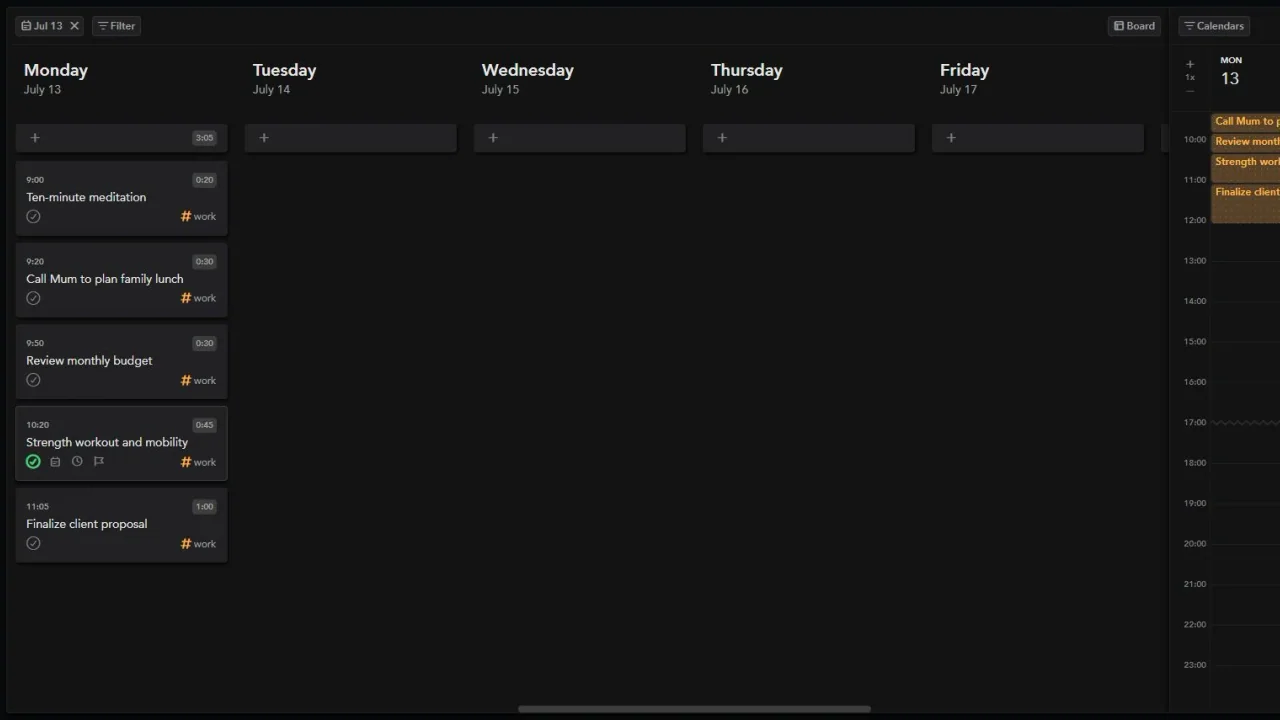
That slower approach can be a feature. If automatic scheduling makes you feel managed by an algorithm, Sunsama gives you workload feedback while leaving the judgment with you. The shutdown ritual also helps close the day instead of letting unfinished work stay mentally open.
The drawback is price and participation. Sunsama costs more than many task managers, and its value depends on showing up for the ritual. It will not continuously rearrange the day with Motion's level of automation.
Our TaskCoach vs Sunsama comparison goes deeper on guided planning versus connected coaching.
Choose Sunsama if: a calm, deliberate planning practice helps you make better commitments.
Skip it if: you want the app to make most scheduling decisions automatically.
5. Akiflow: best for fast capture and time blocking
Akiflow is built around speed. Its universal inbox gathers tasks from connected work tools, while keyboard shortcuts, natural-language capture, and the Aki assistant help turn incoming work into a daily plan. Tasks and calendar blocks live on the same surface.
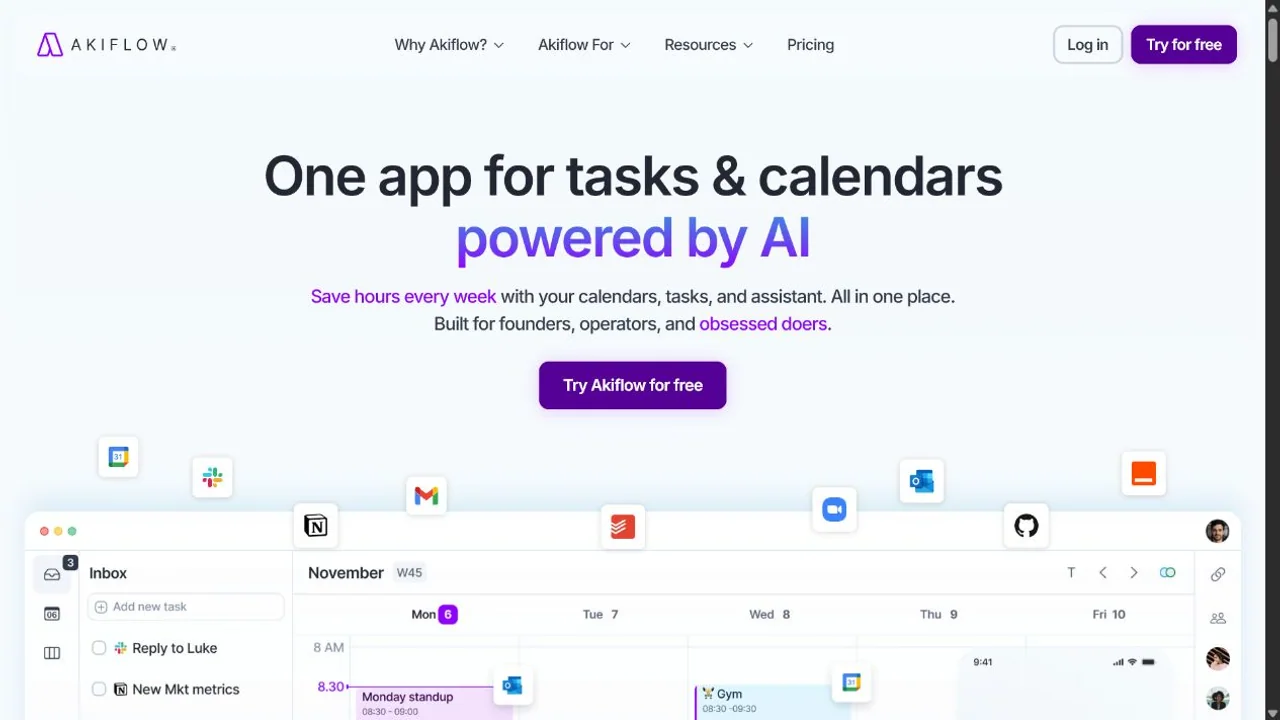
This fits professionals whose work arrives through Slack, email, project tools, and quick ideas. Instead of replacing every source, Akiflow gives you one place to decide when the work will happen. Its command-driven interface rewards people who like keyboard-first software.
The downside resembles Sunsama's: you are paying a meaningful subscription for a personal planning layer, and you still participate in the plan. People who want a gentler mobile visual timeline may find it dense.
Choose Akiflow if: capture speed and cross-tool consolidation are your biggest planning costs.
Skip it if: you want a low-cost visual planner or fully automatic scheduling.
6. Tiimo: best visual AI planner for neurodivergent adults
Tiimo combines a visual schedule, to-do lists, focus tools, reminders, mood check-ins, and AI planning. Its AI can turn typed or spoken thoughts into steps, estimate duration, and arrange them into a day. The product was built with neurodivergent users in mind and works across mobile, web, tablet, and watch.

The visual timeline makes time easier to inspect than a list of due dates. Tiimo is also a strong choice when tone matters. Its prompts and interface aim to reduce pressure rather than frame every missed block as a productivity failure.
Some of the most useful features sit in Pro, including AI task breakdown and advanced scheduling. If you mainly plan complex professional projects, Motion, Sunsama, or Akiflow offers more work-oriented depth.
Choose Tiimo if: you want a visual day, gentle prompts, and help breaking down a brain dump.
Skip it if: team projects and automatic work-calendar optimization are central.
7. Structured: best simple visual timeline
Structured turns tasks and appointments into one vertical timeline. It imports calendar events, supports weekly and monthly views, and lets you plan on mobile or web. Structured AI can help create and adjust tasks, though the product still feels like a visual planner first.
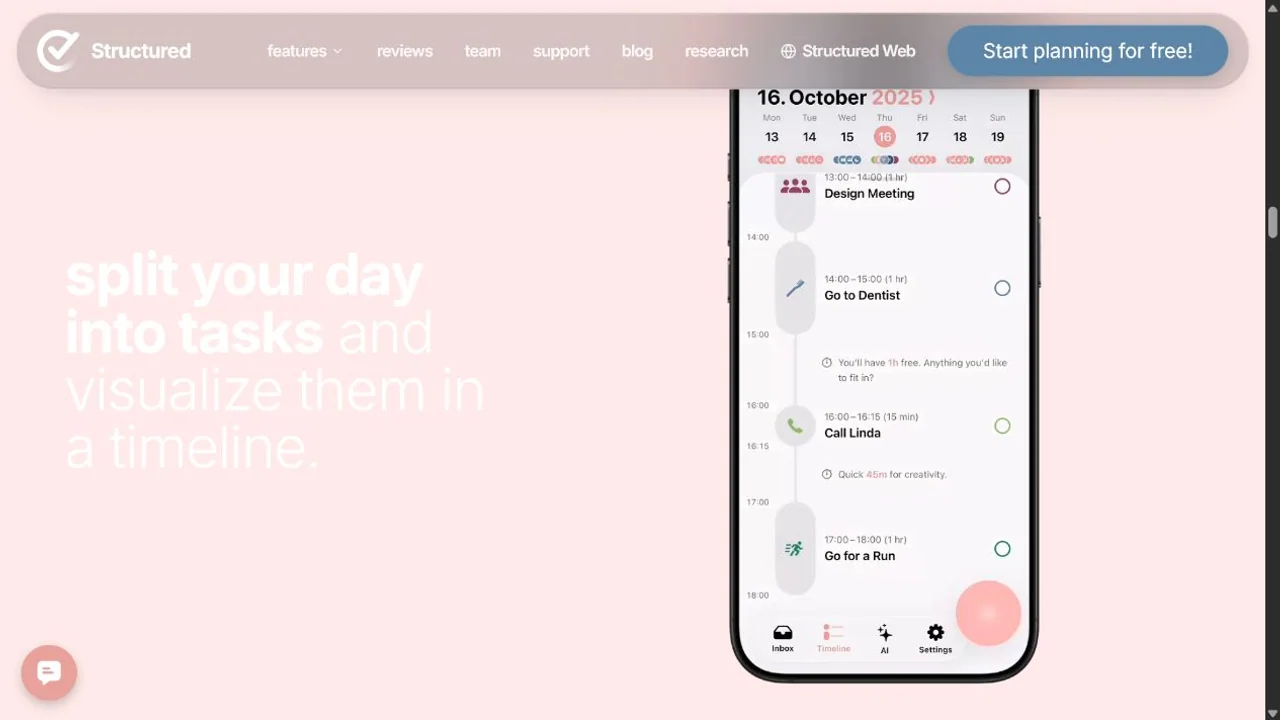
Its restraint is the appeal. A person who becomes overwhelmed by project hierarchies, dashboards, and dense settings may get more value from one readable day. The free version is enough to test the central idea before deciding whether Pro features matter.
Structured offers less context than TaskCoach and less automation than Motion. It is also less explicitly designed around neurodivergence than Tiimo, even though many people may appreciate the same visual structure.
Choose Structured if: you want a clean timeline with a low learning curve.
Skip it if: you need goals, project depth, or continuous auto-scheduling.
Which planning mechanism fits you?
Use the failure point you can observe:
- Your calendar changes all day: start with Motion.
- Meetings consume focus and recovery time: start with Reclaim.
- You overcommit because you skip planning: start with Sunsama.
- Tasks arrive from too many work tools: start with Akiflow.
- Time feels abstract and lists feel flat: start with Tiimo or Structured.
- Your plan loses contact with your goals and habits: start with TaskCoach.
This choice matters more than the longest feature list. An app can be excellent at solving a problem you do not have.
What AI planning can and cannot do
AI is good at preparing a first draft. It can split a vague task, estimate a plausible duration, find open time, and recompute a schedule faster than you can drag twenty blocks.
Your judgment still sets the constraints. An AI cannot know that a low-priority family commitment matters more than a high-priority work item unless the system has that context and you confirm the tradeoff. It also cannot recover hours that do not exist.
Research supports the value of turning intentions into specific cues and actions. Gollwitzer and Sheeran's meta-analysis of 94 tests found a medium-to-large effect for implementation intentions, plans that specify when, where, and how action will happen. A 2026 randomized trial of AI-assisted goal setting also found higher short-term goal progress than a no-support control, while structured written reflection performed similarly overall. The accountability effect appeared to be the more distinctive contribution of the AI coach.
That is a useful boundary for buyers. Pay for a planning loop that changes your behavior or removes repeated work. Do not pay merely because a familiar calendar now has a chat field.
A seven-day buying test
Before you subscribe:
- Add one week of real meetings and commitments.
- Import the tasks you are currently avoiding.
- Estimate duration before the app suggests one.
- Let one task run late.
- Change one deadline.
- Check how the app repairs the day.
- Review whether the final schedule still reflects what matters to you.
The winner is the planner you still trust after step six.
Where TaskCoach fits
TaskCoach is the fit when you want the plan to draw from more than a work calendar. Plan Day reads the current tasks, habits, goals, schedule, history, and saved context, then prepares Recover, Steady, and Push drafts. You choose a draft, adjust it, and accept the schedule. Ordinary AI changes elsewhere appear as proposed changes you can accept or reject.
The core goals, habits, tasks, calendar, notes, focus, and journal tools are free, with AI assistance available inside selected features. Premium adds two-way Google and Outlook calendar sync, the standalone Brain Chat, and broader cross-context AI tools.
If that sounds closer to your planning problem than a calendar optimizer, you can try TaskCoach free and run the seven-day test with your own week.
The bottom line
Choose Motion for automatic work scheduling, Reclaim for calendar protection, Sunsama for a guided ritual, Akiflow for fast cross-tool planning, Tiimo for a neurodivergent-friendly visual day, Structured for simplicity, and TaskCoach for planning connected to goals, habits, and coaching.
The best AI planner is the one that removes your repeated planning failure while leaving the final judgment with you.