The statistics were not calibrated for you
Until 1994, the official diagnostic criteria for ADHD were built almost entirely from observations of school-age boys in classrooms. The image that stuck in the cultural imagination through the eighties and nineties was an eight-year-old boy bouncing off the walls, and if you didn't look like that kid, the odds of anyone connecting your struggles to ADHD dropped fast.
The cost of that narrow starting point is still being paid. The current best estimate is that adult women get diagnosed with ADHD years later than men with equally severe symptoms, and a large share of women with clinical ADHD are never diagnosed at all.
If you got your diagnosis in your late twenties, your thirties, your forties, or later, you're not an outlier. You're the pattern the system actually produces.
The reasons behind that are reasonably well understood at this point. The path forward after diagnosis is increasingly well mapped too.
Why women get missed
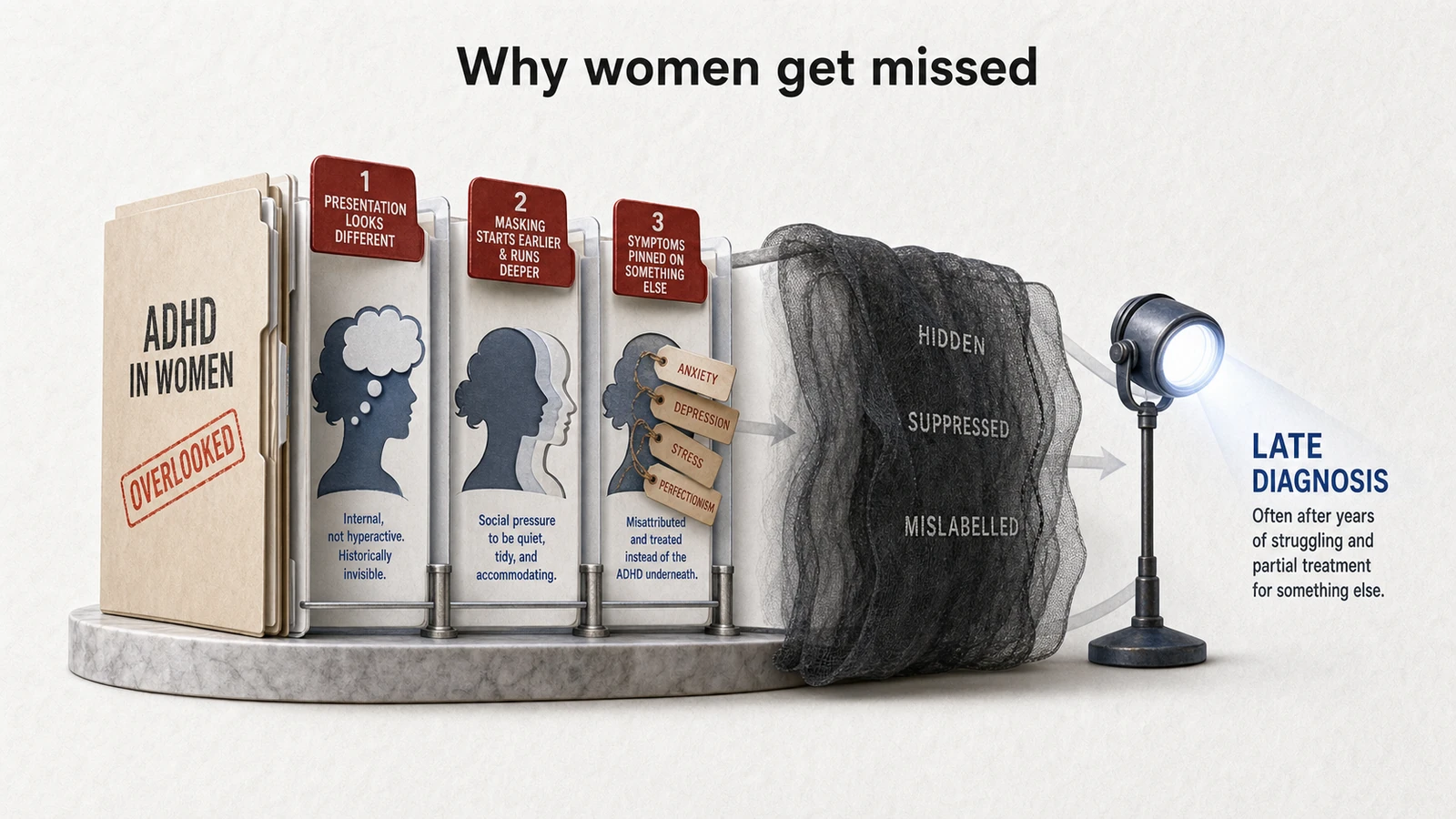
Three mechanisms, drawn from decades of work by researchers like Patricia Quinn, Stephen Faraone, and Ellen Littman, explain most of the late-diagnosis pattern.
The presentation looks different. The classic male-coded picture of ADHD is hyperactive and impulsive: physically restless, blurting things out, visibly unable to sit still. The pattern that shows up more often in women runs quieter: mind-wandering, daydreaming, chronic disorganization with none of the visible hyperactivity. That internal version was historically invisible to the teachers and parents who only ever flagged the loud one.
Masking starts earlier and runs deeper. Girls pick up heavier social pressure to be quiet, tidy, and accommodating from a much younger age than boys do. The masking behavior that results compounds the invisibility problem. By the time that girl is an adult, she's been running the suppression so long that the ADHD underneath it is buried under decades of coping.
Symptoms get pinned on something else. Plenty of women get an earlier diagnosis of anxiety, depression, or generic "stress" long before anyone raises ADHD. Those comorbidities are often real, but the underlying ADHD driving part of them goes untreated. The actual ADHD diagnosis frequently only shows up after years of partial treatment for whatever got misdiagnosed first.
Put it together and you get a woman with textbook inattentive ADHD who reaches adulthood having been told she's anxious, or a perfectionist, or lazy around the house, or simply "a bit absent-minded." The ADHD itself stays invisible until something finally breaks.
What usually triggers the late diagnosis
The pattern across thousands of clinical cases is remarkably consistent. Women who get diagnosed late usually arrive at that conversation through one of four doors.
A life transition outstrips the compensation system. Childbirth, especially the postpartum period. A demanding new job. A divorce. Eldercare. Whatever coping system carried someone through their twenties simply gives out under the new load.
A child gets diagnosed first. ADHD runs heavily in families (heritability estimates land around 74%, per Stephen Faraone's research), so a mother researching her child's new diagnosis often recognizes herself in the same criteria.
Hormonal shifts turn the volume up. Perimenopausal drops in estrogen frequently reveal ADHD that hormone-driven changes in dopamine had been quietly masking for years. It's a well-documented pattern that still doesn't get talked about much.
Recognition arrives from outside the medical system. A video, a podcast episode, a friend's own diagnosis. The spark comes from somewhere other than a doctor's office, and the woman brings the question to her doctor herself instead of the other way around.
"I'm just now learning I have ADHD at 38" isn't a strange story. It's close to the median one.
The roadmap after diagnosis
A late diagnosis creates its own emotional and practical workload. The roadmap below draws on adult-ADHD coaching practice and on the reframing work of Tracy Otsuka and Sari Solden, two of the most prominent voices on adult-female ADHD.
Phase 1: grieve the time
This sounds dramatic. It's also accurate. Most women diagnosed late go through a real grief cycle for the years they spent believing they were broken or lazy, when what they actually had was a treatable neurological condition. That grief is legitimate, and skipping it tends to just convert it into anger or numbness down the line.
Give yourself four to eight weeks of permission to actually feel this. Journal about it. Talk to a therapist who understands adult ADHD. Read what other women have written about it. The grief eventually turns into recognition, and recognition turns into direction.
Phase 2: audit the compensations
Write down every workaround you've built over the past couple of decades. The over-prepared meeting notes. The elaborate calendar discipline. The masking behaviors. The systems you've hidden from coworkers. The strategies you use just to make it through a normal day.
Most women are shocked by how long this list turns out to be. The audit isn't just venting, it's data. It shows you exactly where your energy has actually been going.
Phase 3: decide on the medical path
Stimulant medication helps somewhere around 70 to 80% of clinically diagnosed ADHD adults. Whether to medicate is a conversation to have with a psychiatrist who actually specializes in adult ADHD, not a primary care doctor working from a fifteen-minute appointment slot.
Some women find stimulant medication genuinely life-changing. Others find the side effects aren't worth it and go a different route: non-stimulant medication, or no medication paired with heavier architectural support. Both are legitimate paths, and neither is the "correct" one for everybody.
Phase 4: rebuild the architecture for the brain you actually have
The compensations from Phase 2 were built for a brain you thought you needed to fix. The new architecture gets built for the brain you actually have, and that includes:
- Externalized memory, covered in our piece on the ADHD tax
- Less masking in the spaces where it's safe to drop it, covered in our piece on ADHD masking
- Real sleep restoration, covered in our piece on ADHD sleep
- Body doubling, covered in our piece on body doubling
- Coaching calibrated to how you think, since female-presenting ADHD often pairs with a strongly feeling-oriented cognitive style, covered in our piece on MBTI calibration
The architecture is the actual work. The diagnosis is just what opens the door to it.
Where algorithmic coaching plays a part
For a lot of women diagnosed late, that moment brings both relief and a wave of overwhelm. The relief is real. The overwhelm comes from suddenly seeing every system that needs to be rebuilt at once.
TaskCoach.AI was designed to be a starting scaffold that doesn't require you to design the system yourself. Sky, the more humanistic of the coach personas, is calibrated for feeling-oriented cognitive styles. Morning task pre-loading removes a chunk of the decision load before your day even starts. The pillar dashboard makes any imbalance visible instead of leaving it to guesswork.
The product wasn't built specifically for women. It just happens that the architecture maps closely onto what the research on female-presenting ADHD actually recommends.
The bottom line
You weren't late to your own diagnosis. The diagnostic system was late to you. The years before your diagnosis weren't wasted. They were the years you got through while working from the wrong instructions.
The new instructions are more accurate. The path forward is real, and the architecture for it is buildable.
You were always running real software on a system that wasn't calibrated for you. The calibration is just the next chapter.