The tax nobody adds up
There's a real bill attached to having an ADHD brain, and almost nobody tallies it out loud. Researchers have started calling it the "ADHD tax": late fees, missed flights, subscriptions you forgot to cancel, groceries you bought twice, a passport you had to rush-renew, and the promotion that quietly went to someone else because the follow-up email never got sent.
Dr. Russell Barkley, one of the most cited ADHD researchers alive, has estimated that adults with untreated ADHD lose a significant share of their lifetime earnings, somewhere around a quarter, to executive-function shortfall: the bridge between knowing and doing is structurally narrower for these brains.
The first step is dropping the word "lazy" from the conversation. The second is actually itemizing the bill.
The seven recurring charges
1. The restart tax. You build a system, abandon it, and rebuild it three weeks later. Each rebuild eats four to eight hours of executive function, and ADHD brains tend to run this loop three to five times a year. That's something like 20 to 40 productive hours gone annually, just reinventing the wheel.
2. The reminder tax. The membership renewal you missed. The prescription you let lapse. The parking permit that expired without you noticing. Late fees and replacement costs add up to real money every year for the average ADHD adult.
3. The switching tax. Every time you get interrupted and have to switch tasks, it costs you about 23 minutes to fully refocus, according to research out of UC Irvine. Neurotypical adults switch tasks maybe 8 to 12 times a day. ADHD adults switch 40-plus times. Multiply that out and you're looking at hundreds of lost hours of deep work a year.
4. The object tax. You bought a replacement because you couldn't find the one you already owned. Object permanence works differently in the ADHD brain: out of sight tends to mean genuinely out of mind, and the replacement purchases add up fast.
5. The window tax. You knew you needed to send the email. The window to do it opened. You didn't act. The window closed, and now the email is three weeks overdue and four times harder to write. We cover this one in depth in our piece on ADHD paralysis and task initiation.
6. The shame tax. Every missed deadline, late bill, and forgotten birthday piles up into a low, chronic hum of self-blame. That stress response shortens your focus window even further, and research on shame (Brené Brown's work is the most well known) has found it actually degrades your ability to act next time, not just how bad you feel about it.
7. The decision tax. Every unmade decision sits in your working memory, taking up space. Working-memory research puts real capacity at around four items, give or take one. Carry three unresolved decisions into your morning and you've burned through most of your executive budget before lunch even starts.
The 90-day repayment plan
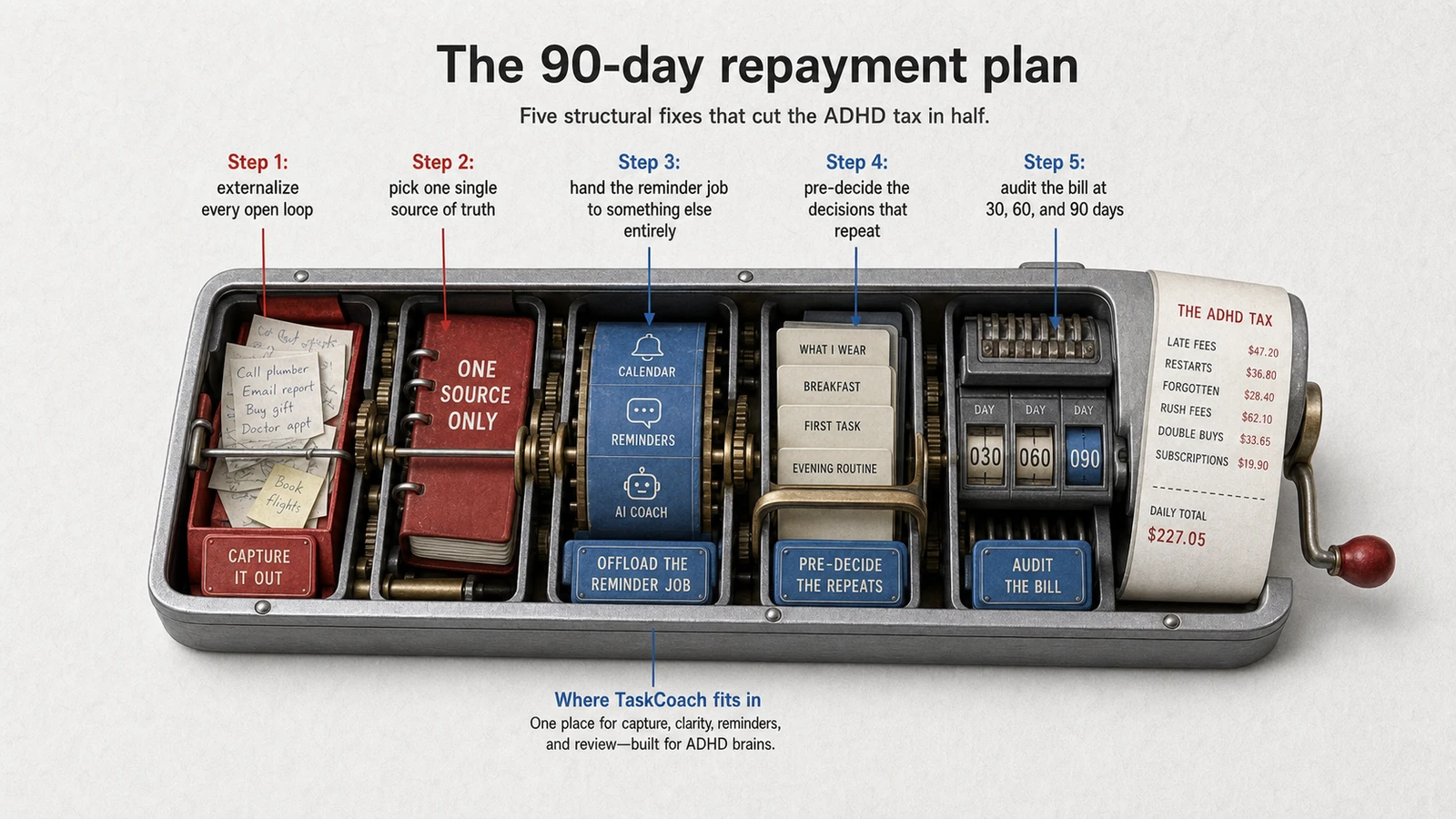
The tax itself isn't refundable. But the recurring charges can be cut by roughly half to two-thirds with the right structural changes. What follows draws on Barkley's work on externalizing executive function and decades of research on how reinforcement actually shapes behavior.
Step 1: externalize every open loop
David Allen's Getting Things Done rests on one insight that hits ADHD brains harder than anyone else: anything you're holding in working memory is actively taxing you. So get it out, the moment it shows up. Voice memo, app, sticky note, doesn't matter which. It costs you one second now instead of 23 minutes of recovery later.
Step 2: pick one single source of truth
The restart tax exists because you keep building new systems from scratch. The fix is picking whatever you already have today and committing to it for 90 days without migrating to something shinier, not finding the perfect system.
Step 3: hand the reminder job to something else entirely
Reminders are a memory problem, not a discipline problem. Your phone, your calendar, or an AI coach can hold that cue with total reliability. Trying to remember it yourself has something like a 30% success rate after 24 hours. It's not a close contest.
Step 4: pre-decide the decisions that repeat
The decision tax compounds because every decision, big or small, draws from the same limited fuel. So pre-decide the ones that repeat: what you wear, what you eat for breakfast, what you tackle first. Steve Jobs wore the same outfit every day for exactly this reason. The same principle scales down beautifully to an ADHD household.
Step 5: audit the bill at 30, 60, and 90 days
Most ADHD productivity efforts quietly die around the 30-day mark because nobody's actually measuring whether they're working. Track the real line items: late fees, restarts, replaced objects, missed windows. The numbers are usually uncomfortable and genuinely useful.
Where TaskCoach fits in
TaskCoach.AI exists because the founder, who has ADHD, watched five different productivity systems fail by week three, every single time, not because the market needed one more tool for neurotypical operators. The architecture reflects that: external cues instead of memory, pre-sequenced daily tasks, low-friction micro-commitments, and a streak system that uses loss aversion in your favor to counter the window tax. The seven-pillar dashboard surfaces where the imbalances are within about 30 seconds of opening it.
It was built around ADHD brains from the start, not adapted for them afterward.
The bottom line
You're paying the ADHD tax because the world is built for brains that hold open loops easily, and yours doesn't work that way, not because you're broken. Externalize aggressively. Pre-decide ruthlessly. Hand off the reminder job. Audit the bill every quarter.
The tax never hits zero. But for anyone who actually runs this protocol, it drops by roughly half within a single quarter.
That's the repayment schedule.