Working twice as hard for half the reward
A meeting ends. Everyone else walks out already thinking about lunch. You walk out and spend the next ninety minutes replaying it: were your facial expressions okay, did you talk too much, did anyone notice you clicking your pen, did that joke actually land.
If that's familiar, you've been masking, probably for so long you don't remember when it started.
ADHD masking is the conscious or unconscious suppression of natural ADHD behavior to fit neurotypical expectations. It's one of the most exhausting, least-discussed parts of adult ADHD, and the cost of doing it for decades is genuinely severe.
The research on this is getting clearer by the year. Unmasking isn't a luxury. It's closer to a necessity.
What masking actually looks like
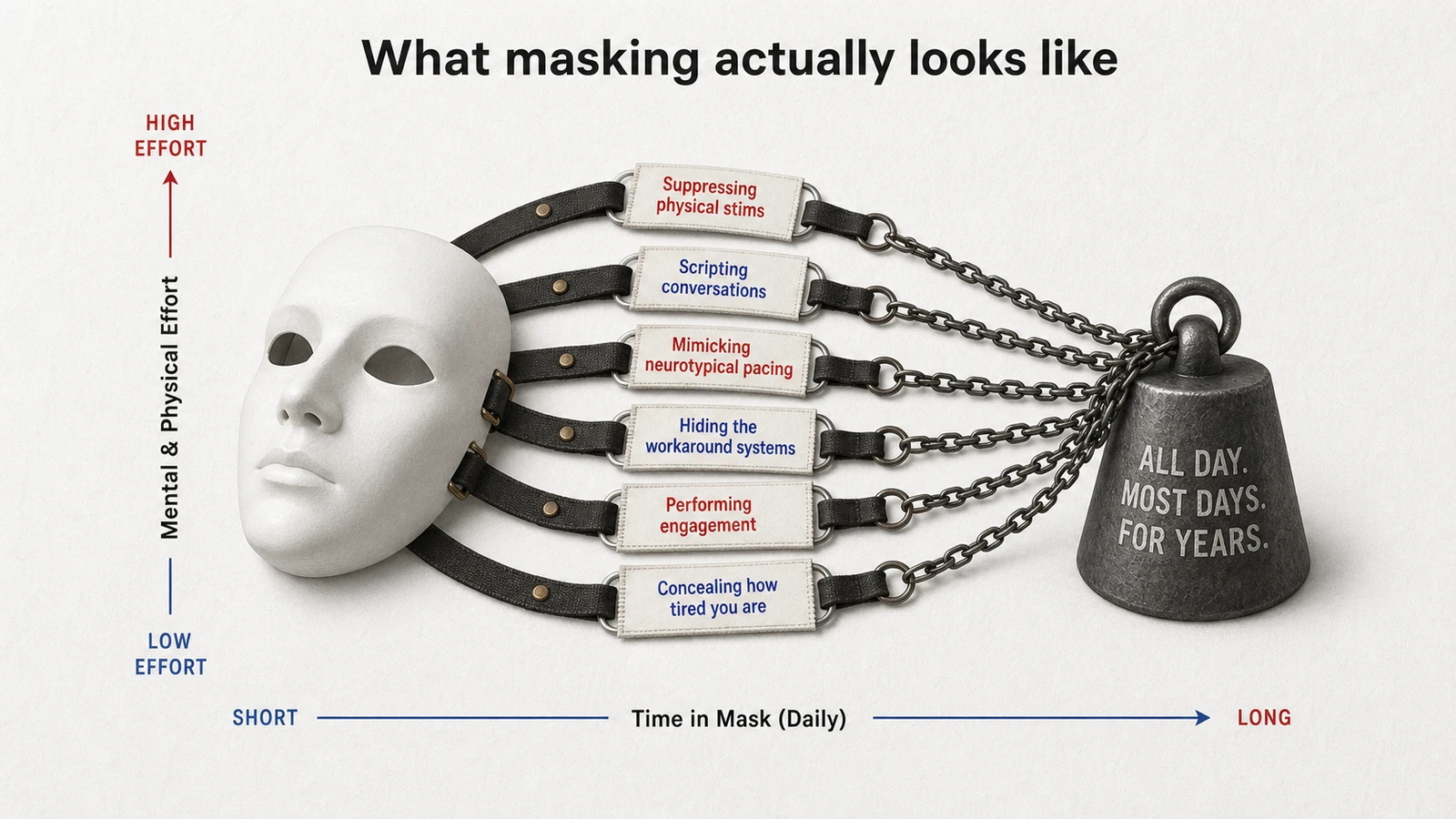
Masking in ADHD adults usually shows up as some combination of the following:
- Suppressing physical stims: pen clicking, leg bouncing, hair twisting, foot tapping, all held back on purpose
- Scripting conversations: pre-planning what to say so you don't blurt something out, interrupt, or go off on a tangent
- Mimicking neurotypical pacing: slowing your speech down, dialing your energy back, forcing yourself into single-task mode when your brain wants to run three threads at once
- Hiding the workaround systems: not letting coworkers see the elaborate calendar, the color-coded notes, the four separate reminders for one meeting
- Performing engagement: visible nodding, steady eye contact, "yes, following along" signals during long meetings while your actual attention is scattered somewhere else
- Concealing how tired you are: pretending you're fine at 3 p.m. when your dopamine has already crashed for the day
None of these behaviors are a problem on their own. The cost is running all of them at once, for eight-plus hours a day, five to seven days a week, for years at a stretch.
What the research says about masking
Most of the early masking research came out of autism studies, including work by Sarah Cassidy's group at the University of Nottingham, whose research has linked camouflaging directly to worse mental-health outcomes in autistic adults. Hannah Belcher, who holds a PhD in this exact area, has written extensively about camouflaging, late diagnosis, and what it costs. The ADHD-specific literature on masking is newer and still catching up, but a few patterns already show up consistently.
Masking tracks with anxiety and depression. People who report masking heavily also report meaningfully higher rates of anxiety and depression, independent of how severe their ADHD looks on paper. That correlation shows up again and again across the emerging research on camouflaging in both autism and ADHD.
Masking spends your executive function. Every act of suppression draws on the same mental resource that powers task initiation, working memory, and emotional regulation. By 3 p.m., masking has already spent the budget that was supposed to fund the actual work. Our piece on the ego depletion model covers this depletion mechanism in more detail.
Masking feeds rejection sensitivity. The constant social monitoring that high-effort masking requires runs on the same hypervigilance that drives rejection sensitive dysphoria. The two feed each other in a loop that's hard to break from the inside.
Masking runs heavier in women. Several studies have found ADHD masking levels are higher in women than in men, which is one of the mechanisms behind the well-documented pattern of late diagnosis in women.
Why the masking started in the first place
Most adult ADHD masking wasn't a choice. It was installed, usually before age twelve.
The mechanism is straightforward enough. ADHD traits, impulsivity, tangents, restlessness, intense narrow interests, get negatively reinforced by teachers, peers, parents, and later by supervisors. Some of that reinforcement is direct, like criticism or exclusion. Some of it is indirect, like a raised eyebrow, a missed promotion, a friendship that quietly faded. The brain learns to suppress the behavior to avoid the reinforcement, and it learns that lesson fast.
By adulthood, the suppression runs on autopilot. You're not consciously deciding to mask in most moments. You're running a trained response that happens to be exhausting. That's the bug. The fact that it works, at least on the surface, is the feature keeping it switched on.
This is exactly why "just stop masking" fails as advice. The behavior was never fully under conscious control to begin with.
The 4-step unmasking protocol
Built from clinical adult-ADHD coaching practice and from self-compassion research, most notably Kristin Neff's work at UT Austin. The approach here is gradual on purpose. Unmasking all at once tends to cause real social damage, which usually just reinforces the masking harder than before.
Step 1: audit what you currently mask
List five to ten specific things you suppress on a daily basis: stimming, conversation scripting, energy moderation, hiding your workaround systems. Write the actual list. Most ADHD adults have never done this and are surprised by how long it gets.
Step 2: find the spaces where dropping it is safe
Not your workplace. Not your in-laws. Specific people and places where unmasking won't cost you anything real: a partner, a sibling, a close friend, an ADHD community, a therapist's office. Pick one or two to start.
In those spaces, deliberately let one or two suppressed behaviors show. Bounce your leg. Make the offbeat joke. Show someone the spreadsheet system you'd normally hide. Notice what that actually feels like.
Step 3: extend some compassion to the mask itself
This step gets skipped constantly, and it matters. The mask isn't a flaw you need to eliminate. It's a coping strategy that kept you safe in places that weren't safe. Give it some credit. Then start easing it off where it's no longer needed.
This is also where rewriting your self-talk intersects directly. The inner critic driving most of the masking is exactly the voice that needs retraining.
Step 4: decide what to selectively disclose at work
The last step, and often the hardest one. Decide what you're comfortable sharing at work, and with whom. You don't need to disclose an ADHD diagnosis to everyone in the building. You might choose to tell one trusted colleague, or one manager. Disclosure often opens the door to accommodations, longer deadlines, different meeting formats, written follow-ups, that weren't available while you were masking.
Disclosure is a choice you get to make on your own timeline, not an obligation.
The long compounding effect
ADHD adults who gradually reduce their masking over twelve to twenty-four months consistently report a similar set of changes: energy returning to a baseline they haven't felt in years, anxiety dropping noticeably, better sleep, stronger relationships with the people who actually know the unmasked version of them, and sometimes a career change toward environments that don't demand the mask in the first place.
Decades of masking don't get undone in a single quarter. But the trajectory usually turns within thirty to sixty days of actually starting the work.
Where TaskCoach fits
The unmasking work itself isn't really productivity work. It's identity work. But the energy that gets freed up by dropping unnecessary masking shows up almost immediately as available cognitive budget for actual life. TaskCoach.AI doesn't unmask you. What it does is take over the workaround systems you'd otherwise have to mask and maintain by hand, because the AI runs a version of them for you. Less mask. More life.
A gentler way to think about it
You've been working far harder than the people around you ever realized. The mask was a survival adaptation, not a personal failure. Give it credit for what it did. Then, slowly, let it go where it's no longer needed.
You don't have to perform neurotypicality forever. Nobody was paying nearly as much attention as the masking assumed they were.