Why the same advice can work for your friend and fail for you
You read the book. Bought the course. Watched the entire YouTube series and did exactly what it told you to do. For three weeks, it worked beautifully. Then the whole system quietly fell apart, and you decided you must not have the discipline to stick with things.
Here's a different explanation: your discipline was fine. The advice was generic. Your brain isn't.
There's a solid body of research behind this. The psychologist Jeffrey Gray spent years studying how differently people's brains respond to reward and to threat, a body of work now known as reinforcement sensitivity theory. Some brains fire hard at the possibility of winning. Others fire harder at the possibility of losing. Hand both types the exact same coaching script and you'll see two very different reactions, not because one person tried harder, but because their reward systems are simply tuned differently.
The Myers-Briggs framework takes plenty of fair criticism for how it was built. But the trait clusters it sorts people into map roughly onto that reinforcement research, in ways that newer Big Five personality studies have started to confirm. Type-calibrated coaching isn't horoscope logic wearing four letters as a disguise. It's matching people to the reward pattern that actually moves them.
Watch one plan fail four different ways
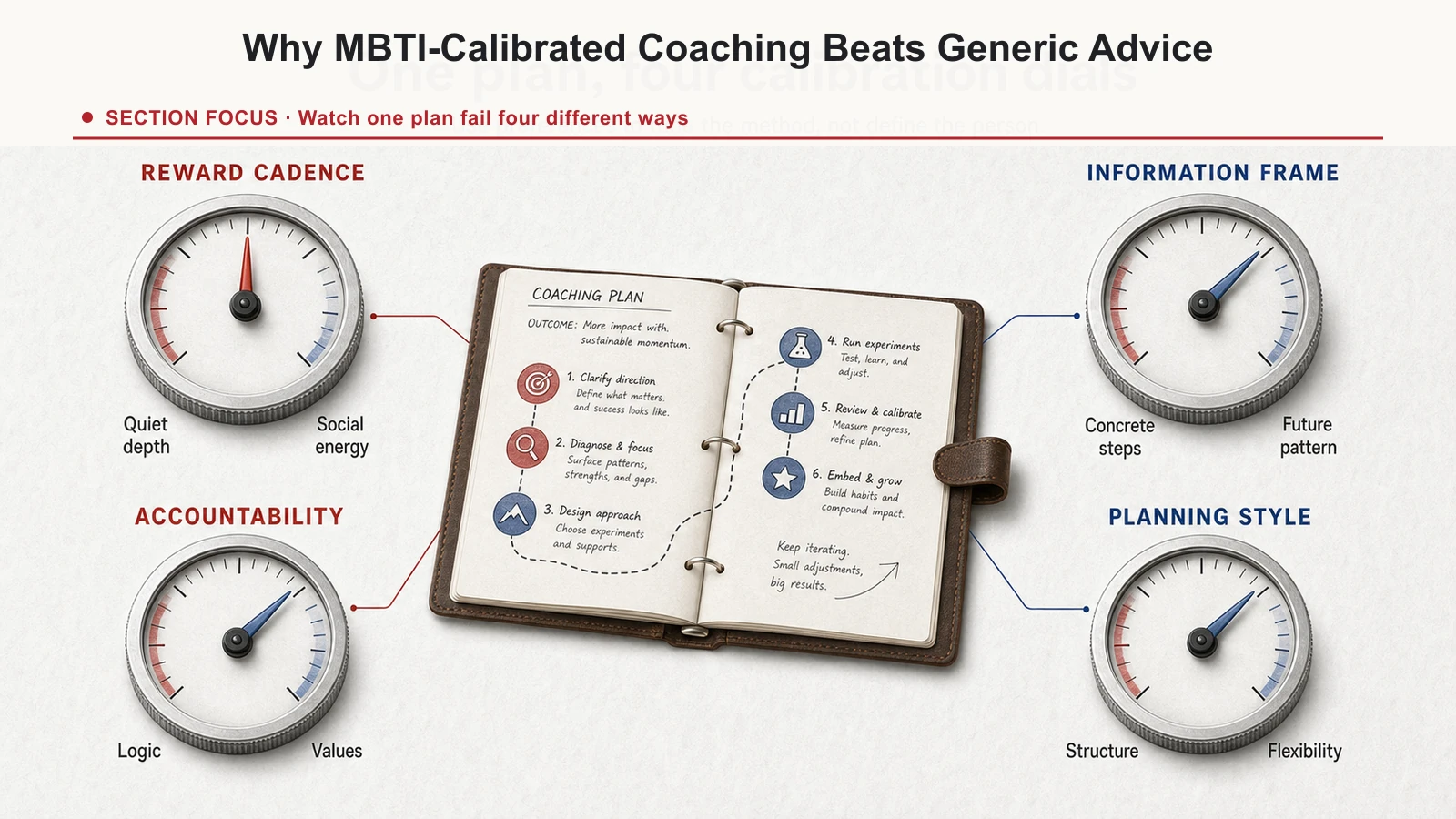
Take a standard prescription: set a measurable 90-day goal, break it into daily tasks, track every completion, celebrate the small wins. Reasonable advice, on paper. Now hand it to four different people.
Someone with an INTJ-style brain wants the system airtight before they'll even start, and rebuilds the tracking sheet three times before touching day one. The daily completion check feels babyish. The little celebrations for small wins read as manipulation rather than motivation. They finish the 90 days and quietly resent the whole process.
Someone with an ENFP-style brain loves the goal-setting energy on day one and has forgotten the tracking spreadsheet exists by day five. The daily check-in feels like a leash. The celebration is the one part that actually lands, because what they wanted was meaning and novelty, not a metric. The system gets abandoned around week two, and they blame their own discipline for it.
Someone with an ISTJ-style brain just quietly does the work: eighty-seven percent of daily tasks completed, no fuss, no drama. But the celebration script never quite fits their actual values, so the sense of being appreciated never really lands. They finish the 90 days and don't come back for round two.
Someone with an INFP-style brain sets a genuinely beautiful, values-aligned goal. Three weeks in, the daily tracking starts to feel hollow and disconnected from why they cared in the first place. They drop the system to go find one that "feels right," and often end up bouncing through five more communities chasing that feeling.
Same script. Four completely different ways of falling apart. None of those is a character flaw.
What calibration actually looks like
Here's the four-axis approach the TaskCoach.AI coaching engine runs on, built from a blend of MBTI, Big Five, and reinforcement sensitivity research.
Introversion and extraversion set your reward cadence
Extraverts tend to respond strongly to social reward and frequent feedback. Introverts tend to respond strongly to internal mastery cues and feedback that's rarer but carries more signal. Same underlying XP system, different delivery: an ENFP-style user might get a high-energy celebration animation every three tasks, while an INTJ-style user gets a quiet weekly mastery summary instead.
Sensing and intuition shape how a goal gets framed
Sensing types tend to anchor to concrete, near-term outcomes, something like "lose ten pounds before the Q3 weigh-in." Intuitive types tend to anchor to identity, something like "become someone who runs ultras." The underlying goal can be identical. Whether it feels meaningful depends almost entirely on the framing.
Thinking and feeling shape what counts as accountability
Thinking types respond well to information presented as plain data: the chart, the streak, the completion percentage, no commentary required. Feeling types respond to that same information framed relationally, something closer to "Sky noticed you completed your habit today. Proud of you." Same underlying fact, delivered in two very different languages.
Judging and perceiving shape how rigid the system should be
Judging types thrive on a fixed weekly rhythm and get thrown off by disruption to it. Perceiving types thrive on flexibility and chafe against a fixed schedule. The exact same daily-task system needs a flex-scheduling option for one group and firmer structure for the other.
Nine coaches, nine therapeutic approaches
The deeper point is that different cognitive styles don't just want a different tone of voice. They respond to different therapy modalities entirely. TaskCoach builds this in directly, with nine coaches, each grounded in a distinct evidence-based approach:
- Sky works from humanistic, person-centered therapy, the approach Carl Rogers pioneered. Built for people who lean high on feeling and intuition.
- Hank works from behavioral activation. Built for action-oriented, sensing-dominant people.
- Orion works from Acceptance and Commitment Therapy. Built for introspective, philosophically minded people.
- Stan works from standards-based behaviorism. Built for people who are high on thinking and anchored to results.
- Fiona works from motivational interviewing plus gamification. Built for extraverted, novelty-seeking people.
- Riley works from cognitive restructuring. Built for analytical, skeptical people.
- Zara works from mindfulness-based DBT. Built for people carrying more anxiety, who need help reconnecting with the present moment.
- Apex works from solution-focused brief therapy. Built for goal-oriented, data-driven people.
- Blake runs a sterile, CLI-style interface. Built for people who want zero psychological commentary, just the facts.
This isn't a marketing flourish. It's the only setup where an INTJ and an ENFP can use the same product without one of them abandoning it within a month.
The bottom line
You are not a bad self-manager. You've been handed a generic prescription that was written for a brain you don't have.
Find the coaching approach that matches how your reward system actually works, not whichever one happens to be loudest on social media this month. A system built to fit your brain wins. A system that requires you to rewire your brain to fit it loses, every time.
That's the actual mechanism at work here. Match the coaching to the brain, and what looked like a discipline problem disappears on its own.