A focus trick that sounds fake, but isn't
Sit in a coffee shop with your laptop and you get four hours of focused work done without much effort.
Sit at your own kitchen table with the exact same laptop and the exact same task, and you get twenty minutes done before you're forty-five minutes deep into Instagram.
If you have an ADHD brain, you've probably noticed this pattern your whole adult life without having a name for it. Now it has one: body doubling. It might be the most underrated productivity intervention available for ADHD brains right now.
The mechanism behind it is real, the science holds up, and the lift in focus duration is genuinely significant.
What body doubling actually is
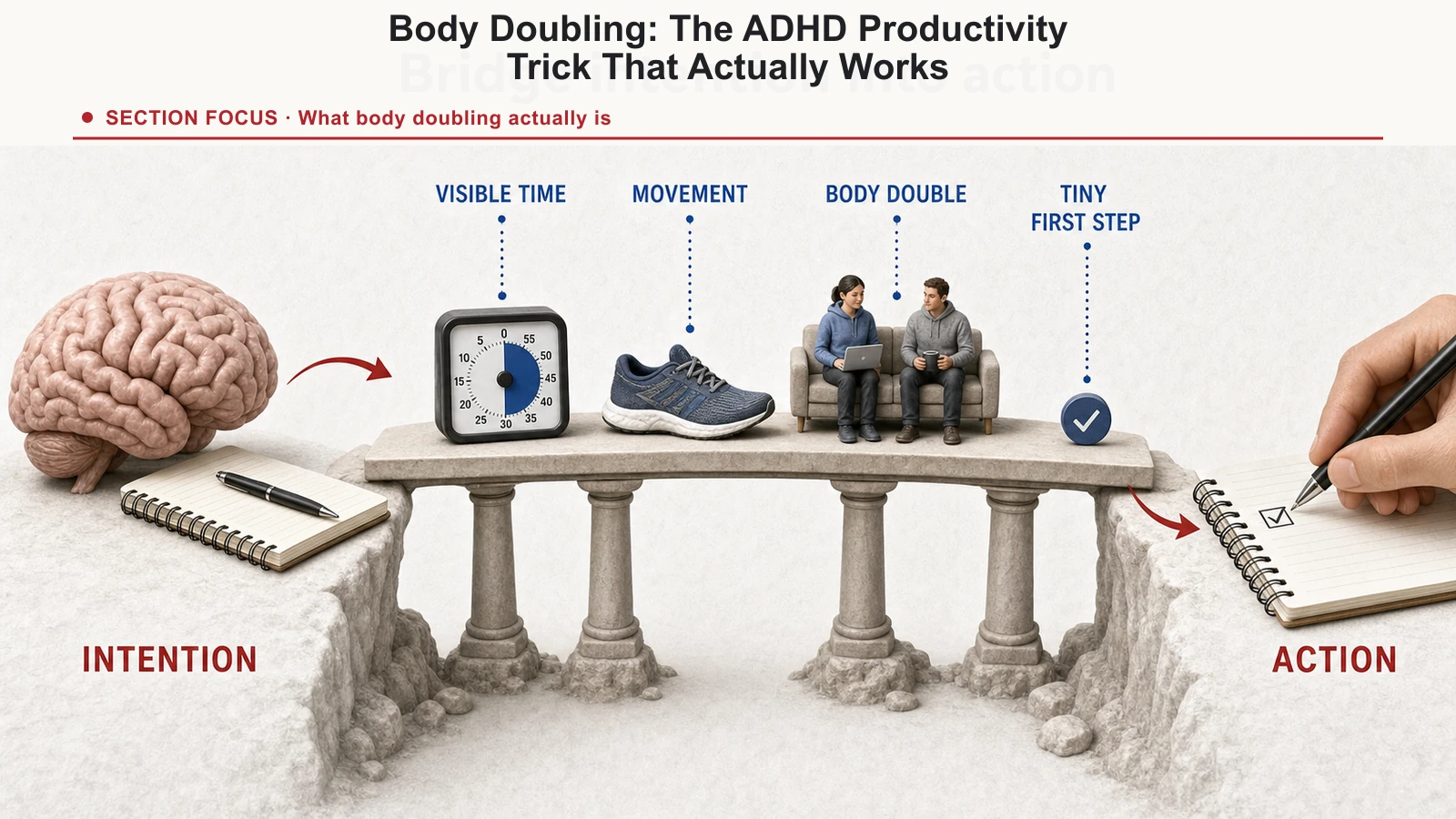
Body doubling, in its simplest form, means working in the presence of another person while you do your own task. They don't need to be doing the same thing you're doing. They don't need to interact with you at all. They don't even need to have ADHD themselves. They just need to be there.
The term comes from Linda Anderson, a coach for adults with ADHD who began formalizing the practice in the 1990s after noticing how differently her clients worked when someone else was in the room. It's since spread across TikTok, Discord communities, and dedicated apps like Focusmate and Caveday as a legitimate, well-documented productivity tool.
The skeptical read is that it's just accountability. The research says it's more than that.
The three mechanisms behind it
Here's what's actually happening under the hood.
1. Co-regulation of the nervous system. Stephen Porges' Polyvagal Theory, which also comes up in our piece on the fears behind procrastination, describes how mammalian nervous systems partly regulate themselves through proximity to other regulated nervous systems. A calm body near you measurably calms your own. For ADHD brains that tend to run in a state of chronic, mild sympathetic arousal, that co-regulation quiets the noise floor just enough to make focused work possible.
2. The mere presence effect. Psychologists have studied this since the 1960s under the name social facilitation: simply knowing another person is nearby changes how your brain handles a task, even when that person isn't watching you and never says a word. The classic explanation is that another person's presence raises your baseline arousal slightly, which makes it easier to keep doing something you already know how to do. For a brain that's constantly scanning for something more interesting to switch to, that small lift is often enough to tip the balance toward staying on task instead of reaching for the phone.
3. Externalized accountability. This one's simple. Knowing someone else is working too, and that you might compare notes once the session ends, raises the cost of breaking focus. It's a small cost, but a consistent one.
These three mechanisms stack on top of each other. Together they explain why a 25-minute body-doubled session often outproduces a solo 60-minute one for ADHD adults.
Why it works especially well for ADHD brains
Three reasons ADHD brains get an outsized benefit from body doubling:
ADHD baselines run noisier. The chronic, mild sympathetic arousal common in ADHD brains gets measurably reduced by social co-regulation. Neurotypical brains start from a quieter baseline, so they don't get nearly as much lift from the same co-regulation.
ADHD task initiation is harder to begin with. Body doubling supplies an external trigger for starting that an ADHD prefrontal cortex often can't reliably generate on its own. Related: our piece on ADHD paralysis covers the broader initiation problem in more depth.
ADHD social monitoring runs louder. The same social sensitivity behind RSD (covered in our piece on RSD) means the implicit awareness of another person carries more weight for ADHD brains than for neurotypical ones. The social-monitoring brake on impulsivity is turned up louder.
5 ways to install body doubling into your routine
1. The coffee shop protocol
The easiest entry point there is. A cafe, coffee shop, or library all work. Pick two laptop-friendly spots within 15 minutes of home and rotate between them. The barista and the other customers all function as body doubles without knowing it. The changing visual environment also activates a bit of novelty-seeking that a home office just can't offer.
Cost: about $5 a session. Return: usually 2 to 4 hours of genuinely focused work.
2. Virtual co-working (Focusmate, Caveday)
These apps pair you with another adult for a scheduled 25 or 50 minute session over webcam. You both work silently. The camera stays on. The accountability is real even though the interaction is close to nothing.
Reports from ADHD communities are fairly consistent here: a real extension in focus duration, especially for tasks you'd otherwise avoid entirely, usually landing around 60% as effective as a body double physically in the room with you.
3. Co-working Discord and Twitch channels
The free version of the above. Various Discord servers and Twitch streams run permanent, silent co-working rooms. Hearing someone else typing or working in the background substitutes for physical presence well enough for a lot of ADHD brains.
4. The trusted friend protocol
Schedule recurring 90-minute sessions with a friend, in person or over video. You both work on your own separate tasks. A quick check-in at the start, silence during, a brief debrief at the end. Plenty of ADHD adults find this is the single most effective ongoing arrangement they have, especially when the friend also has ADHD.
5. The AI coach as an asynchronous body double
Not a replacement for human presence, but a genuinely useful supplement. TaskCoach.AI runs 25-minute focus-session check-ins, daily morning task pre-loads, and end-of-day debriefs that approximate some of the benefits of body doubling when a real person isn't available. AI scaffolding combined with periodic real body doubling tends to be the sweet spot in practice.
Tactical notes
A few things that matter in practice:
- Same room beats different rooms. Video co-working works, but anecdotal reports from ADHD communities put it at somewhere around 60% as effective as being physically in the same space.
- Quiet beats noisy. Coffee shops work because of presence, not because of the noise. A library might actually outperform a busy cafe for some ADHD profiles.
- Recurring beats ad hoc. A scheduled Tuesday 10am session that you keep for 8 weeks straight beats a vague "we should work together sometime" arrangement every time.
- The other person doesn't need to be working at all. A friend reading a book, a partner cooking dinner, even a pet in the room works for some people. Presence is the active ingredient, not parallel work.
The bottom line
If you've got an ADHD brain and you're not body doubling, you're leaving real focus duration on the table. The science holds up, the cost is low, and it's one of the few interventions that works consistently across most ADHD profiles.
Pick one of the five options above. Run it for 30 days. Measure the difference in what you actually ship.
The gap will be obvious. Now go find a coffee shop.