Two dopamine problems, one substrate
Here's the claim up front: ADHD brains run on lower baseline dopamine than neurotypical brains, and heavy, high-speed pornography use pushes D2 dopamine receptors down even further. Put both of those in the same body and they don't just add up. They compound.
If you're dealing with both ADHD and a pornography habit that's spiraled past where you're comfortable with it, you're sitting on one of the most under-discussed overlaps in the self-improvement world. Most advice treats these as two separate problems that need two separate fixes. That's the wrong model, and it's probably part of why so many attempts at either one stall out halfway through.
The overlap is also where most of the relief lives, once you know it's there.
Why ADHD brains get hit harder
Three things stack up to make ADHD brains more vulnerable to pornography overstimulation specifically.
A hungrier dopamine system goes looking for novelty. ADHD brains under-produce dopamine at rest, and chasing novelty is one of the main ways that gap gets closed. Russell Barkley's influential model of ADHD treats this as a built-in feature of the condition, not a character flaw or a bad habit someone picked up. For a brain wired to seek out novelty, high-speed internet pornography is about as efficient a novelty source as exists. The brain finding its way there is the path of least resistance to the thing it's short on, not a moral failing.
A weaker brake makes it harder to stop. The same prefrontal underactivity that makes starting your taxes feel impossible also weakens the brake on impulsive consumption. "I'll just check for a minute" turns into an hour, and it happens faster and more often in an ADHD brain than a neurotypical one.
Hyperfocus can point the wrong way. The same hyperfocus that produces a nine-hour coding binge can just as easily produce a six-hour pornography binge, if that's where it locks on. We've written before about hyperfocus as a double-edged tool, and this is the sharp edge of it.
Put those three together and you get a fairly consistent pattern: ADHD adults often report using pornography three to five times as much per session as neurotypical peers, with more compulsive use and a bigger hit to their baseline ADHD symptoms.
Why quitting pays off more if you have ADHD
The same logic runs in reverse. Cut the habit, and ADHD brains tend to get more out of it than neurotypical brains do.
Receptor recovery raises the exact thing you're short on. Since ADHD brains already run on a thinner dopamine supply, removing the chronic overstimulation that suppresses D2 receptors even further brings that supply closer to a typical baseline. Some of what looks like "ADHD symptoms improving" during a NoFap streak is really the underlying ADHD getting more dopamine to work with.
The hours come back. Time that used to disappear into pornography becomes available for everything else. If you're already running close to the edge, which a lot of ADHD adults are, those recovered hours can be the difference between a life that holds together and one that doesn't.
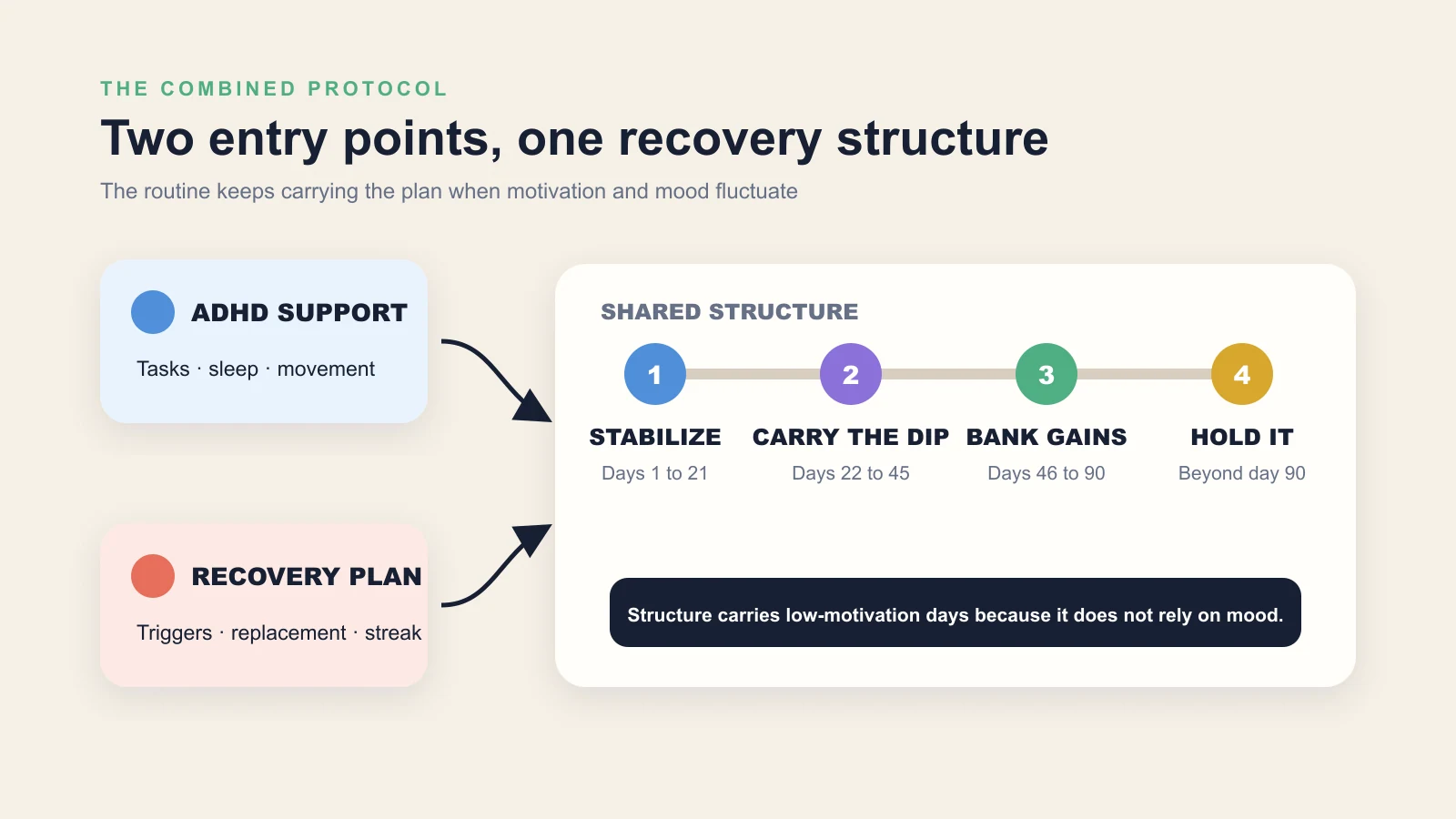
The two protocols were never actually separate. Cold exposure, aerobic exercise, an externalized environment, and a broader dopamine detox are standard first-line moves for both pornography recovery and ADHD management. You're running a single program that helps with both, not two programs that happen to overlap.
That last point is worth sitting with: you need one recovery plan here, not two.
A combined protocol
This is the version that blends the standard NoFap streak structure with ADHD-specific moves. It's what we'd walk someone through if they came to us with both.
Days 1-21: stabilize the substrate
Start with the approach from our dopamine detox protocol. It's nearly identical to the first three weeks of a NoFap streak, plus the broader dopamine cleanup that helps ADHD brains regardless of the pornography question.
That means:
- No short-form video, no pornography, full stop
- Daily cold exposure
- Daily aerobic movement (more in our piece on ADHD and movement)
- A protein-anchored breakfast (see ADHD morning routines)
- A real sleep protocol (see ADHD sleep)
- An externalized environment (see object permanence)
These three weeks are the hardest stretch. ADHD symptoms and withdrawal feed each other, and your head might genuinely feel foggier before it clears. That's expected. It doesn't mean you're doing it wrong.
Days 22-45: get through the flatline
The NoFap flatline hits ADHD adults particularly hard, because dopamine baseline hasn't caught up to receptor recovery yet. You're past the acute withdrawal, but you don't feel the payoff yet either.
Three extra moves for this stretch:
- If you take ADHD medication, talk to your prescriber about whether a dose adjustment makes sense during this window
- Use body doubling to keep yourself engaged with tasks
- Lean harder into social contact than usual, since isolation makes the flatline feel worse than it is
Days 46-90: bank the gains
By day 46, the NoFap rebound and the ADHD-substrate improvements start compounding together. Focus sharpens, motivation comes back, and socializing feels less like a chore.
The job here is building the structure that protects what you've gained. Run the identity-based habits approach: "I'm someone who doesn't use pornography," paired with "I'm someone who keeps an ADHD-friendly environment." That identity layer is what carries the gains past day 91, once the streak counter itself stops being the thing holding you together.
What the evidence actually shows
The data here is self-reported accounts from NoFap and adult-ADHD communities, plus a handful of small clinical case reports, not research-grade. Within those limits, a consistent pattern shows up. ADHD adults who complete a 90-day streak tend to report:
- Bigger mood improvements than neurotypical streak-completers
- Bigger gains in focus and task initiation than the streak alone would predict
- Less reliance on behavioral workarounds, since the underlying substrate isn't being chronically degraded anymore
- Occasionally, reduced need for stimulant medication (a conversation to have with your prescriber, not a decision to make alone)
None of this would hold up as a clinical trial. But the pattern shows up often enough, across enough unconnected sources, that it's worth taking seriously.
Where TaskCoach fits
TaskCoach.AI runs the streak protocol alongside daily task pre-loading (see ADHD morning routines), pillar dashboards, and check-ins that function like a body double. It's built around ADHD from the ground up, and that architecture happens to line up almost exactly with what pornography recovery needs too.
You end up running one system, not two, because the underlying problem was one problem the whole time.
The bottom line
ADHD and pornography overstimulation are two dopamine problems sharing the same hardware. The recovery work overlaps almost completely, and the combined payoff is bigger than either recovery would produce on its own.
Stabilize the substrate. Get through the flatline. Bank the gains. Build the identity that holds it all in place.
You're running one recovery, not two, and the structure is what carries you through it.