ADHD · Career

Hyperfocus Is The Superpower. Distraction Is The Tax.

Your ADHD brain runs two extremes, laser focus and total distraction, and both come from the same system. Here's the neuroscience behind why, plus a 4-part protocol for getting more of one and less of the other.

https://taskcoach.ai/blog/hyperfocus-superpower-distraction-tax/

Two modes, one brain

If you've got an ADHD brain, you already know this contradiction from the inside. Tuesday, you can't hold focus on a single email for two minutes. Wednesday, you disappear into code for nine straight hours and forget to eat, drink, or check the time.

Same brain, both days. What changes is the neurochemical state, and that state is far more steerable than you've probably been told.

This is the part that gets lost under the diagnostic label. ADHD isn't an attention deficit. It's an attention regulation problem. What's actually impaired is your ability to direct focus on command. Your ability to focus deeply once the conditions line up? If anything, that's stronger than average.

Dr. Edward Hallowell, an ADHD researcher who has ADHD himself, has been making this point for three decades. The goal was never to suppress the ADHD brain. It's to build a life where hyperfocus lands on your highest-value work, and distraction costs you as little as possible when it inevitably shows up.

The same brain. Two opposite states. The mechanism is the dopamine substrate.


What hyperfocus actually is

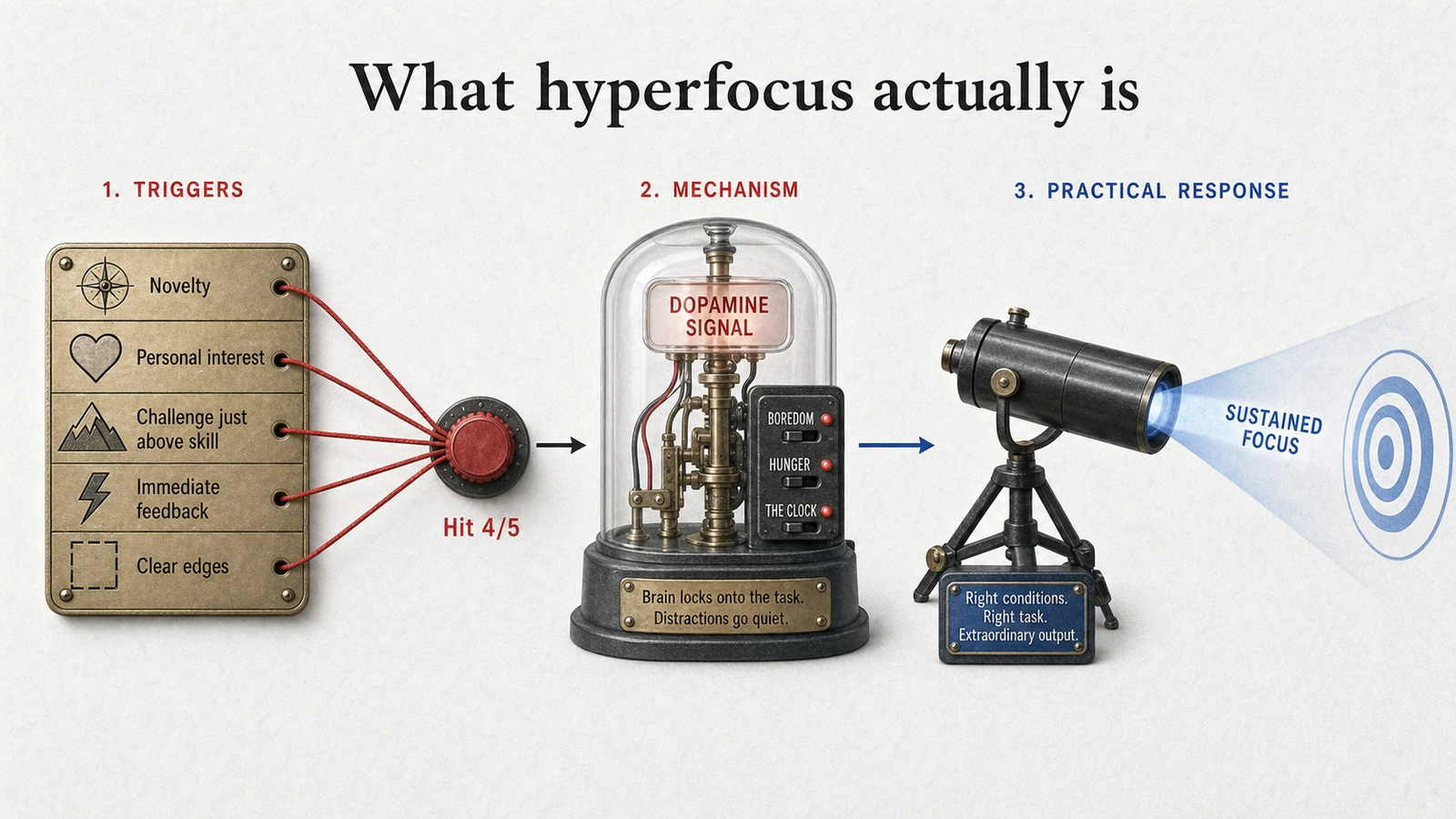
Hyperfocus isn't just "concentrating hard." It's a specific neurochemical state where your brain locks onto a task that's producing a strong dopamine signal, and the mechanisms that would normally pull you off task (boredom, hunger, the clock) simply stop firing.

The conditions that trigger it are more predictable than you'd expect.

Novelty. A new project, a new puzzle, unfamiliar territory. Dopamine responds to new things almost automatically.

Personal interest. Topics that genuinely grab you. Your brain does the selecting here, not your willpower.

Challenge that sits just above your skill level. This is Csikszentmihalyi's flow territory. Too easy, and you're bored. Too hard, and you shut down.

Immediate feedback. Every action produces a visible result right away: coding, writing, certain games, sports, playing an instrument.

Clear edges. A task with defined boundaries. ADHD brains tend to struggle with open-ended work but do well with something clearly bounded.

Hit four of those five, and an ADHD brain can reach a level of focus that genuinely beats the neurotypical baseline. That output, during those windows, is a big part of why ADHD shows up so disproportionately among creative, scientific, and entrepreneurial high achievers.

The catch: left to its own devices, hyperfocus tends to fire on the wrong things. Video games. Internet rabbit holes. Whatever hobby has your attention this month. It stubbornly refuses to fire on the right things: taxes, your inbox, the hard conversation you've been putting off.


What distraction actually is

Distraction is what happens when dopamine fails to attach to whatever you're supposed to be doing. Your brain just leaves, chasing the next available reward, no matter how small.

It's the same dopamine system, just running in reverse: low signal on the current task, and a room full of more interesting alternatives.

That's why ADHD distraction is more about your environment than your willpower. A quiet room with one task in front of you works fine. A room with three browser tabs open, two notifications waiting, and a phone lying face-up is hostile to ADHD focus by design.


The 4-part protocol to tip the balance

This comes out of Hallowell's clinical work, Russell Barkley's research on executive function, and the productivity literature built on top of both.

Step 1: engineer the hyperfocus conditions

Figure out which of the five conditions (novelty, interest, challenge, feedback, structure) you can install on your most important work. You can't manufacture genuine interest out of nothing. You can manufacture immediate feedback, clear structure, and the right level of challenge.

Here's what that looks like in practice: instead of "work on the Q3 strategy doc," try "spend 25 minutes producing one specific section, with a visible word count, on a timer, with a familiar playlist running." That turns a task your brain resists into one it might actually grab onto.

Step 2: build an environment that's hostile to distraction

Phone in another room. Tabs closed except the one you need. ADHD focus is environmental, and the fix is cheaper than the motivational one.

Phone in another room. Every browser tab closed except the one you need. Slack and email shut. Nothing distracting in your visual field. ADHD focus responds more to your environment than to your motivation, and fixing the environment is cheaper and far more reliable than trying to fix your motivation.

Cal Newport's deep work principles apply here. Adapted for an ADHD brain, they apply even harder.

Step 3: protect the session once it starts

The first 25 minutes produce only a fraction of what minutes 60-90 produce. Extract the value, don't break the spell for email.

Once you're in a hyperfocus state on something worthwhile, don't let anyone pull you out of it. Research on deliberate practice, plus what we know about flow states, both point the same direction: the first 25 minutes of a session produce a fraction of what minutes 60 through 90 produce. To actually extract the value, sessions need to run 90 minutes or longer.

Most ADHD adults cut their own sessions short around minute 35 to go check email. That "quick check" is what breaks the spell.

Step 4: put hard limits on the wrong hyperfocus

The same neurochemistry that pulls you into a nine-hour coding session can just as easily pull you into a nine-hour gaming session, a four-hour Wikipedia spiral, or an entire weekend lost to home renovation videos. The fix is hard time limits on the targets you don't want. Phone alarms. A partner who checks in. App blockers.

Without hard exits, your brain treats every hyperfocus target as equally worthwhile. They're not, and you know they're not, right up until the moment before you open the app.


The identity reframe that actually helps

The framing that consistently works best in adult ADHD coaching: you're not broken. You have a hyperfocus engine that needs better targeting.

Distraction isn't the absence of focus. It's the same engine firing at cheap, low-value targets because nothing pointed it anywhere better. The fix was never a more disciplined brain. It's better target selection. The brain was fine all along.


Where an AI coach actually helps

The hardest part of this whole protocol is target selection. ADHD brains tend to be bad at pre-deciding which task deserves the hyperfocus window before it opens. Having an AI coach in your pocket means the day's highest-value task can already be sitting in the queue, so when the window does open, the right thing is what's waiting for you.

TaskCoach.AI structures every morning around your top 3 highest-leverage targets, surfaced first, with friction stripped out so you can start fast, plus a streak and dashboard that reinforce actually following through. The whole architecture is built around ADHD-specific failure points: picking the right target in advance, removing the moment of negotiation, and keeping feedback visible.

We're not trying to be the focus. We're trying to be the target.

The bottom line

You don't need to fix your ADHD brain. You need to build your environment, your day, and your task list so the engine fires on what actually compounds, instead of on whatever's cheapest and closest.

Engineer the conditions. Build an environment that's hostile to distraction. Protect the sessions once they start. Put hard exits on the wrong targets.

The hyperfocus is the gift. Building the structure around it is the work. And the output, when it lands right, doesn't look like anything a neurotypical brain produces on its best day.

Aim it well. Let's get to it. , references: [ { name: 'Driven to Distraction: Recognizing and Coping with Attention Deficit Disorder from Childhood Through Adulthood', author: 'Edward M. Hallowell, John J. Ratey', datePublished: '1994', publisher: 'Pantheon Books', }, { name: 'Behavioral Inhibition, Sustained Attention, and Executive Functions: Constructing a Unifying Theory of ADHD', author: 'Russell A. Barkley', datePublished: '1997', publisher: 'Psychological Bulletin', url: 'https://doi.org/10.1037/0033-2909.121.1.65', }, { name: 'Flow: The Psychology of Optimal Experience', author: 'Mihaly Csikszentmihalyi', datePublished: '1990', publisher: 'Harper & Row', }, { name: 'Deep Work: Rules for Focused Success in a Distracted World', author: 'Cal Newport', datePublished: '2016', publisher: 'Grand Central Publishing', }, { name: 'The Role of Deliberate Practice in the Acquisition of Expert Performance', author: 'K. Anders Ericsson, Ralf T. Krampe, Clemens Tesch-Römer', datePublished: '1993', publisher: 'Psychological Review', url: 'https://doi.org/10.1037/0033-295X.100.3.363', }, ], }, { slug: 'adhd-in-women-late-diagnosis', pillar: 'Mind', category: 'ADHD', author: authors.orion, title: 'ADHD In Women: Why You Were Diagnosed Late', description: "The structural reasons women have gone undiagnosed with ADHD for decades, why the symptoms show up differently, and a real roadmap for what comes after a late diagnosis.", seoDescription: "Why women go undiagnosed with ADHD for decades, why symptoms show up differently, and a real roadmap for adult women after a late diagnosis.", imageUrl: '/blog-images/ai/audit-2026-07-round2/adhd-in-women-late-diagnosis-hero.webp', featured: true, publishedDate: '2026-05-06T09:00:00Z', updatedDate: '2026-05-13T17:26:00Z', tldr: "ADHD diagnostic criteria were built around school-age boys until 1994, and women are still paying for it: diagnosed 7 to 10 years later than men with identical symptoms, and half to three-quarters never diagnosed at all. The blind spot is structural: inattentive symptoms, heavier masking, and hormonal cycling the original criteria never accounted for.", keyTakeaways: [ 'Pre-1994 diagnostic criteria came from studying school-age boys in classrooms, which is where the hyperactive, bouncing-off-the-walls stereotype came from.', 'Women present more often with inattentive-type ADHD (daydreaming, organizational chaos), which schools and parents historically missed.', 'Masking runs higher in girls and women, and the cost of that compensation is invisible to outside observers but metabolically real.', 'Hormonal cycling matters too: estrogen modulates dopamine availability, which produces premenstrual symptom flares that male-derived criteria never predicted.', 'Late-diagnosis adults often grieve the decades of unexplained struggle. That grief is a normal part of the post-diagnosis process, not a detour from it.', ], faq: [ { q: 'Why is ADHD underdiagnosed in women?', a: "The original DSM criteria, before 1994, were built from studying school-age boys, which missed the inattentive-type and internalizing presentations that are more common in girls. Heavier masking, gender-role expectations around being organized and accommodating, and hormonal effects on symptoms across the menstrual cycle all add to it. The pattern is structural. It isn't about any individual woman missing something obvious." }, { q: 'How is ADHD different in women?', a: 'Women more often present with inattentive-type symptoms, like daydreaming, organizational chaos, and sensory overwhelm, rather than hyperactivity. Masking tends to run higher. Hormonal cycling produces premenstrual symptom flares as estrogen-linked dopamine availability shifts. Rejection sensitive dysphoria is also reported disproportionately by women.' }, { q: 'What should I do after a late ADHD diagnosis?', a: 'Three priorities: stabilize the substrate first (sleep, exercise, an externalized environment, possibly a medication trial), audit the compensation costs (the systems you have been holding together through sheer force of will), and let yourself grieve the decades of unexplained struggle before redirecting that energy into rebuilding sustainably.' }, ], mentions: ["Russell Barkley", "Patricia Quinn", "Sari Solden", "DSM-5", "Inattentive-Type ADHD", "Rejection Sensitive Dysphoria"], relatedSlugs: ['adhd-tax-cognitive-costs', 'rejection-sensitive-dysphoria-rsd', 'adhd-masking-hidden-cost', 'adhd-burnout-recovery-protocol'], references: [ { name: 'Genetics of Attention Deficit Hyperactivity Disorder', author: 'Stephen V. Faraone and Henrik Larsson', datePublished: '2019', publisher: 'Molecular Psychiatry', url: 'https://www.nature.com/articles/s41380-018-0070-0', }, { name: 'Diagnostic and Statistical Manual of Mental Disorders, Fourth Edition (DSM-IV)', author: 'American Psychiatric Association', datePublished: '1994', publisher: 'American Psychiatric Association', }, { name: 'Understanding Women with AD/HD', author: 'Kathleen G. Nadeau and Patricia O. Quinn', datePublished: '2002', publisher: 'Advantage Books', }, { name: 'Women with Attention Deficit Disorder', author: 'Sari Solden', datePublished: '1995', }, { name: 'ADHD for Smart Ass Women: How to Fall in Love with Your Neurodivergent Brain', author: 'Tracy Otsuka', datePublished: '2024', publisher: 'HarperCollins', url: 'https://www.harperacademic.com/book/9780063307056/adhd-for-smart-ass-women/', }, ], content:

The statistics were not calibrated for you

Until 1994, the official diagnostic criteria for ADHD were built almost entirely from observations of school-age boys in classrooms. The image that stuck in the cultural imagination through the eighties and nineties was an eight-year-old boy bouncing off the walls, and if you didn't look like that kid, the odds of anyone connecting your struggles to ADHD dropped fast.

The cost of that narrow starting point is still being paid. The current best estimate is that adult women get diagnosed with ADHD years later than men with equally severe symptoms, and a large share of women with clinical ADHD are never diagnosed at all.

If you got your diagnosis in your late twenties, your thirties, your forties, or later, you're not an outlier. You're the pattern the system actually produces.

The reasons behind that are reasonably well understood at this point. The path forward after diagnosis is increasingly well mapped too.

The criteria were built for a different brain. Yours was real all along.

Why women get missed

Three mechanisms, drawn from decades of work by researchers like Patricia Quinn, Stephen Faraone, and Ellen Littman, explain most of the late-diagnosis pattern.

The presentation looks different. The classic male-coded picture of ADHD is hyperactive and impulsive: physically restless, blurting things out, visibly unable to sit still. The pattern that shows up more often in women runs quieter: mind-wandering, daydreaming, chronic disorganization with none of the visible hyperactivity. That internal version was historically invisible to the teachers and parents who only ever flagged the loud one.

Masking starts earlier and runs deeper. Girls pick up heavier social pressure to be quiet, tidy, and accommodating from a much younger age than boys do. The masking behavior that results compounds the invisibility problem. By the time that girl is an adult, she's been running the suppression so long that the ADHD underneath it is buried under decades of coping.

Symptoms get pinned on something else. Plenty of women get an earlier diagnosis of anxiety, depression, or generic "stress" long before anyone raises ADHD. Those comorbidities are often real, but the underlying ADHD driving part of them goes untreated. The actual ADHD diagnosis frequently only shows up after years of partial treatment for whatever got misdiagnosed first.

Put it together and you get a woman with textbook inattentive ADHD who reaches adulthood having been told she's anxious, or a perfectionist, or lazy around the house, or simply "a bit absent-minded." The ADHD itself stays invisible until something finally breaks.

What usually triggers the late diagnosis

Postpartum. New job. Divorce. Eldercare. A child's diagnosis. Perimenopause. Catalysts that exceed the compensation.

The pattern across thousands of clinical cases is remarkably consistent. Women who get diagnosed late usually arrive at that conversation through one of four doors.

A life transition outstrips the compensation system. Childbirth, especially the postpartum period. A demanding new job. A divorce. Eldercare. Whatever coping system carried someone through their twenties simply gives out under the new load.

A child gets diagnosed first. ADHD runs heavily in families (heritability estimates land around 74%, per Stephen Faraone's research), so a mother researching her child's new diagnosis often recognizes herself in the same criteria.

Hormonal shifts turn the volume up. Perimenopausal drops in estrogen frequently reveal ADHD that hormone-driven changes in dopamine had been quietly masking for years. It's a well-documented pattern that still doesn't get talked about much.

Recognition arrives from outside the medical system. A video, a podcast episode, a friend's own diagnosis. The spark comes from somewhere other than a doctor's office, and the woman brings the question to her doctor herself instead of the other way around.

"I'm just now learning I have ADHD at 38" isn't a strange story. It's close to the median one.

The roadmap after diagnosis

A late diagnosis creates its own emotional and practical workload. The roadmap below draws on adult-ADHD coaching practice and on the reframing work of Tracy Otsuka and Sari Solden, two of the most prominent voices on adult-female ADHD.

Phase 1: grieve the time

Real grief for the years spent believing you were broken or lazy. Four to eight weeks of permission. Skipping it converts to anger later.

This sounds dramatic. It's also accurate. Most women diagnosed late go through a real grief cycle for the years they spent believing they were broken or lazy, when what they actually had was a treatable neurological condition. That grief is legitimate, and skipping it tends to just convert it into anger or numbness down the line.

Give yourself four to eight weeks of permission to actually feel this. Journal about it. Talk to a therapist who understands adult ADHD. Read what other women have written about it. The grief eventually turns into recognition, and recognition turns into direction.

Phase 2: audit the compensations

Write down every workaround you've built over the past couple of decades. The over-prepared meeting notes. The elaborate calendar discipline. The masking behaviors. The systems you've hidden from coworkers. The strategies you use just to make it through a normal day.

Most women are shocked by how long this list turns out to be. The audit isn't just venting, it's data. It shows you exactly where your energy has actually been going.

Phase 3: decide on the medical path

Stimulant medication helps somewhere around 70 to 80% of clinically diagnosed ADHD adults. Whether to medicate is a conversation to have with a psychiatrist who actually specializes in adult ADHD, not a primary care doctor working from a fifteen-minute appointment slot.

Some women find stimulant medication genuinely life-changing. Others find the side effects aren't worth it and go a different route: non-stimulant medication, or no medication paired with heavier architectural support. Both are legitimate paths, and neither is the "correct" one for everybody.

Phase 4: rebuild the architecture for the brain you actually have

The compensations from Phase 2 were built for a brain you thought you needed to fix. The new architecture gets built for the brain you actually have, and that includes:

  • Externalized memory, covered in our piece on the ADHD tax
  • Less masking in the spaces where it's safe to drop it, covered in our piece on ADHD masking
  • Real sleep restoration, covered in our piece on ADHD sleep
  • Body doubling, covered in our piece on body doubling
  • Coaching calibrated to how you think, since female-presenting ADHD often pairs with a strongly feeling-oriented cognitive style, covered in our piece on MBTI calibration

The architecture is the actual work. The diagnosis is just what opens the door to it.

Where algorithmic coaching plays a part

For a lot of women diagnosed late, that moment brings both relief and a wave of overwhelm. The relief is real. The overwhelm comes from suddenly seeing every system that needs to be rebuilt at once.

TaskCoach.AI was designed to be a starting scaffold that doesn't require you to design the system yourself. Sky, the more humanistic of the coach personas, is calibrated for feeling-oriented cognitive styles. Morning task pre-loading removes a chunk of the decision load before your day even starts. The pillar dashboard makes any imbalance visible instead of leaving it to guesswork.

The product wasn't built specifically for women. It just happens that the architecture maps closely onto what the research on female-presenting ADHD actually recommends.

The bottom line

You weren't late to your own diagnosis. The diagnostic system was late to you. The years before your diagnosis weren't wasted. They were the years you got through while working from the wrong instructions.

The new instructions are more accurate. The path forward is real, and the architecture for it is buildable.

You were always running real software on a system that wasn't calibrated for you. The calibration is just the next chapter.

Frequently asked questions

Is hyperfocus an ADHD symptom?

Yes, and it's one of the most underrated ones. ADHD is more accurately an attention-regulation condition than an attention deficit. The same brain that can't hold focus on a boring task for two minutes can hyperfocus on a stimulating one for nine hours. When the conditions line up, hyperfocus depth can actually exceed neurotypical baselines.

How do I trigger hyperfocus on demand?

Stack the dopamine triggers on purpose: novelty, a visible immediate reward, genuine interest, urgency, and one clearly defined task. Externalize the trigger with visible work and a pre-loaded environment, protect the window from interruptions, and bound the session with a timer. The engine does the firing. The protocol just points it.

Is hyperfocus dangerous?

Unbound hyperfocus can be. Skipping meals, water, sleep, and bathroom breaks produces a real, measurable crash the next day. That's exactly why the 4-part protocol treats bounding the session as non-negotiable. Hyperfocus is a genuine advantage when it's bounded. Left unbounded, it's a metabolic debt you'll pay off later.