Why you can't find your keys, again
You put the keys down twenty minutes ago. You know you put them down, you might have even said it out loud: "keys go here." Now you can't find them anywhere.
You buy a new phone charger because the old one is "gone." By the end of the week you've found six of them, spread across three different drawers.
You skip the leftovers because you can't see them in the fridge. Three days later, you're throwing them out.
None of that is carelessness. There's an actual name for what's happening, and it explains a lot more than "you're bad at this" does: functionally reduced object permanence. It's one of the most under-discussed features of the ADHD brain, and once you understand why it happens, the fix stops being about trying harder.
What's actually happening
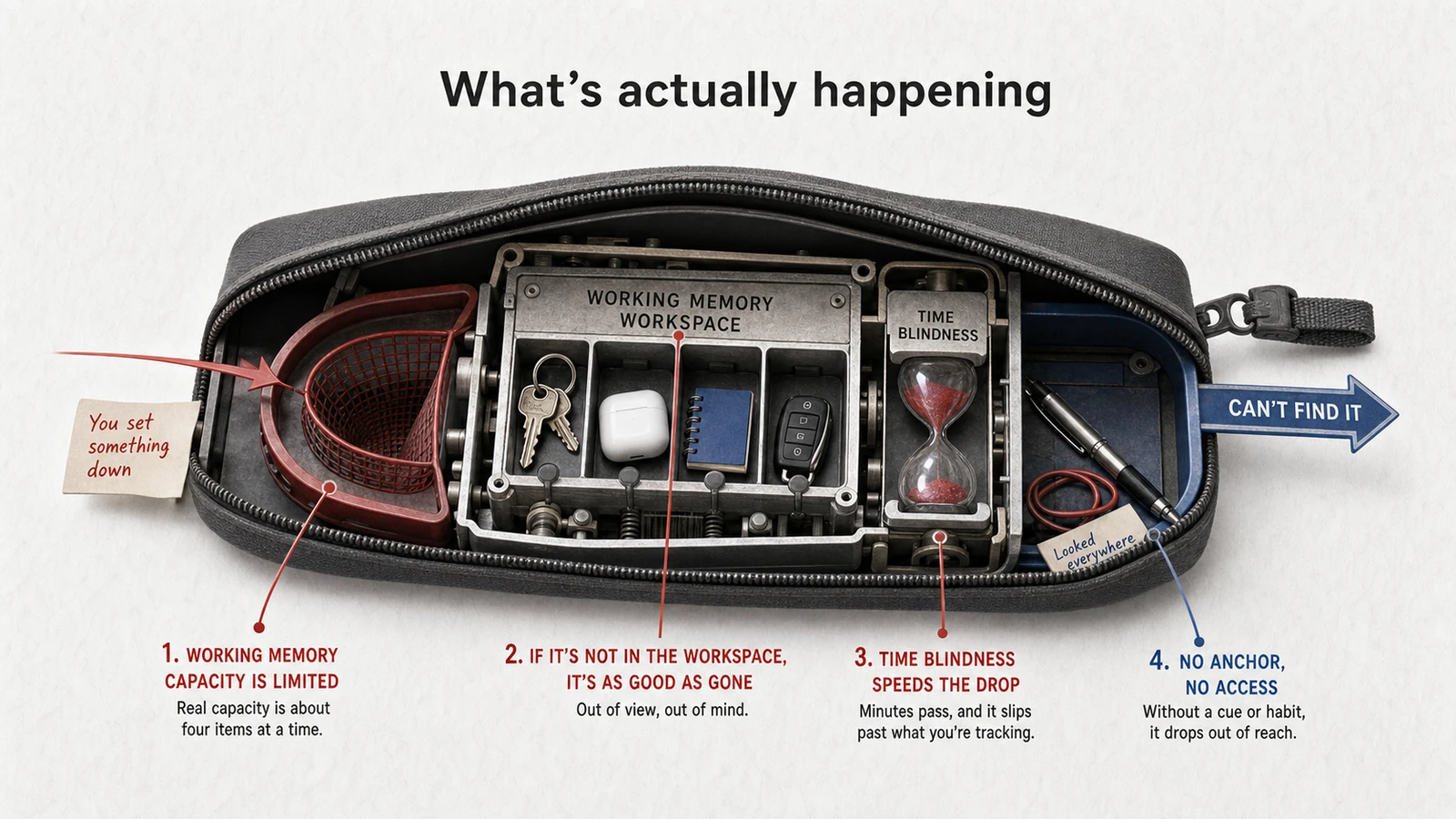
In developmental psychology, object permanence just means understanding that something keeps existing even after it's out of view. Piaget's research on infants found that most babies develop this by around eight months old. After that, conventional wisdom says you have it for good.
ADHD complicates that picture, though not in the way people assume. Russell Barkley's model of ADHD names working memory as one of four central deficits: the mental workspace that holds information ready for use even when you're not looking straight at it. When that workspace is running under capacity, the result looks a lot like reduced object permanence. The keys you can't see might as well not exist, because your brain isn't holding onto their location well enough to send you back for them.
That workspace is smaller than most people think, and that's true of any brain, not only an ADHD one. Working-memory research from Nelson Cowan puts real capacity at around four items at a time, well below the "magic number seven" most of us grew up hearing. Stack time blindness on top of that, and something you set down twenty minutes ago has often already slipped past what your brain is actively tracking.
It's also why ADHD memory tends to be so specific. You remember where the keys are if you said the location out loud. You remember where the laptop is because it always lives on the kitchen counter. Take the anchor away, and the object drops out of reach.
Same logic explains why open shelves beat closed cabinets, clear bins beat opaque ones, and a to-do list taped to the wall beats one buried three folders deep. If your brain can only track what it can currently perceive, the fix is making more things perceivable.
Why the object tax adds up
We've written before about the ADHD tax, the pile of small costs that come with running on reduced executive function. Object loss is one of its steadiest entries. Replacing things you already own costs real money, and because it never shows up as one big line item, it's easy to underestimate what it adds up to across a year. Layer the search time on top: every "where did I put it" hunt eats another fifteen to thirty minutes of focus that was supposed to go toward the actual day.
The bigger cost is psychological. Losing the same three things over and over builds a story that you're bad at basic life skills, which feeds straight into the inner critic we cover in rewriting self-talk. Twenty minutes spent hunting for your keys is never really just twenty minutes. It comes with a small deposit of shame attached.
The 5-part externalization protocol
This builds on Barkley's idea of externalizing whatever working memory can't hold, applied to an actual household. The rule underneath it: if you can't count on your internal memory, make the environment do that job instead.
Step 1: one location for anything expensive to lose
Keys, wallet, phone, glasses, medication. Each one gets exactly one home, used every single time, no exceptions. Bowl by the door. Hook on the wall. Same drawer in the kitchen, always.
Not "wherever feels natural in the moment." One spot. Your brain learns to check a single address instead of guessing.
Step 2: open, see-through storage
Closed cabinets are where objects in ADHD households go to disappear. Swap closed pantry doors for open shelves wherever you can. Clear containers in the fridge. Glass jars for spices. Mesh bins in the bathroom. If you can't see it, your brain quietly stops believing it's there.
Step 3: keep active projects out in the open
Anything you're actually working on this week stays on the counter or the desk, not filed away in a drawer. "Keep your desk clear" is fine advice for most people and bad advice for you. Visible beats tidy.
The same goes for projects. The book you're reading stays on the coffee table. Materials for a project stay on the kitchen island. A half-finished hobby stays out where you'll actually see it and pick it back up.
Step 4: your lists need the same treatment
Same principle, aimed at information instead of objects. Keep the grocery list somewhere visible in the kitchen. Put this week's priorities on a whiteboard you walk past daily. Load your tasks into a tool you already open, not one you have to remember to check. Anything that only lives in your head is something you're going to drop eventually.
This is the whole premise behind how TaskCoach.AI works: the system holds the open loops so your brain doesn't have to. We go deeper on that idea in why architecture beats willpower.
Step 5: the 30-second scan before you leave
Before you walk out the door: keys, wallet, phone, ID. Check each spot, thirty seconds total. It catches 90 percent of "I left it at home" moments before they happen.
The same idea scales for travel. A physical checklist taped to the door, checked every time, beats trying to hold it all in memory while you're rushing to leave.
A signal problem, not carelessness
Most ADHD adults experience object loss as a personal failing. Barkley's reframe is more useful: things go missing because your working memory never held a strong enough trace of where you put them down in the first place, not because you weren't paying attention.
That distinction matters because "pay more attention" is exactly the operation that's already running on empty. It's an environment you have to build so it remembers for you, not a discipline problem you can push through with willpower.
Once that clicks, the shame usually drops first. Then the system gets built. Then the losses slow down.
Where TaskCoach fits in
Object permanence is really the physical version of a bigger pattern: externalize whatever your working memory can't reliably hold. TaskCoach.AI applies the same idea to tasks and goals: daily tasks pre-loaded, weekly priorities pinned, your pillars visible at a glance. Same rule as the bowl by the door. It just runs in software instead of a hallway.
The bottom line
Objects vanish from your attention the second they leave your hands, because working memory was never built to reliably hold onto object locations on its own, and that's true of plenty of brains, ADHD ones most of all. The fix is environmental, not motivational.
One location per object. Open storage. Visible active projects. Externalized lists. A thirty-second scan before you leave.
Run that for thirty days and object loss typically drops somewhere between 60 and 80 percent in households that stick with it. The shame tends to drop right along with it.
Now go put the keys in the bowl.