Knowing the map is what separates quitting in week 4 from finishing in week 13
Most NoFap streaks don't fail because of weak willpower. They fail because someone hits a phase they didn't expect and reads it as proof the whole thing isn't working. The flatline in week 4 feels like the protocol broke. The withdrawal on day 5 feels like it's never going to end. The boredom in week 7 feels like the promised payoff was a lie.
With the map in hand, you know exactly what phase you're in. That turns a crisis into a checkpoint.
Below is the week-by-week timeline, built from community-reported data plus what the neurochemistry research shows. Use it.
Week 1: withdrawal peak
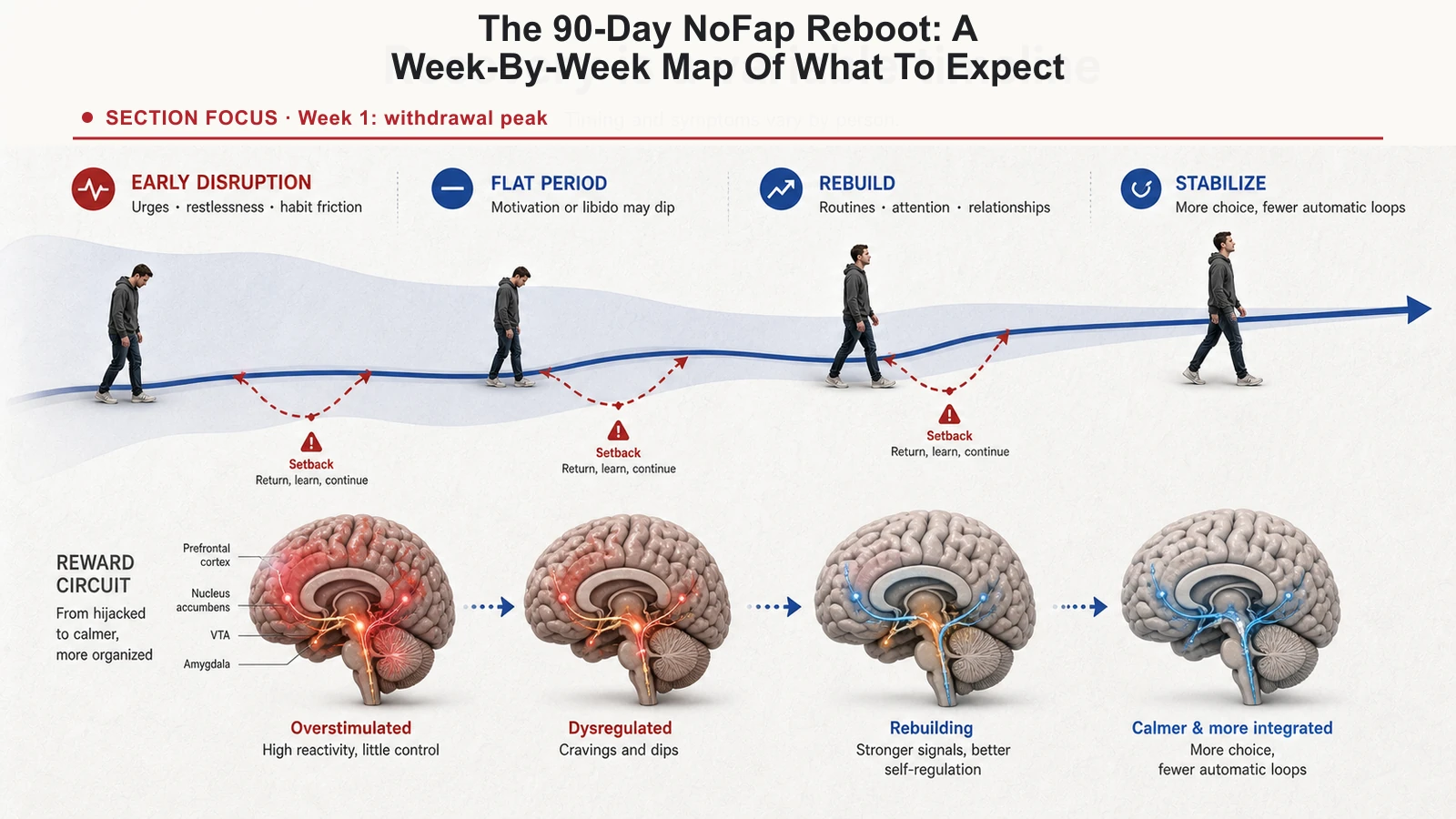
What's happening: Your brain is suddenly missing a stimulus pattern it had been running daily. Dopamine D2 receptors have downregulated, so your baseline dopamine is low, and your reward system is loudly demanding the thing it lost.
What you'll feel: Irritability. Intrusive cravings, especially at night. Disrupted sleep. Brain fog. A persistent "this is harder than I thought" feeling.
What to do: Go aggressive on the basics. Cold showers, daily cardio, no triggers left in your environment, no late-night phone, social contact every day. This is the same protocol covered in our piece on the dopamine detox.
Trap to avoid: Don't read anything that makes this sound harder or longer than it actually is. Withdrawal peaks around day 3 to 5 and starts easing after day 7. The hard part has a known end point.
Week 2: cravings ease, clarity comes in patches
What's happening: The acute withdrawal phase is ending. Dopamine receptors are starting to upregulate, and your baseline mood is lifting off its week 1 low.
What you'll feel: Cravings drop noticeably. Mental clarity shows up in patches, good days mixed with foggy ones. Sleep starts to settle. A faint sense that this might actually work.
What to do: Lock in your morning routine (see our piece on the ADHD morning routine). Keep running the same basics from week 1. Resist the urge to test yourself against borderline content.
Trap to avoid: Overconfidence. A lot of people relapse around day 12 to 14 in week 2 because they let the basics slip. The cravings haven't been replaced with real structure yet, they've just gone quiet.
Week 3: the flatline starts
What's happening: Counterintuitively, this is often when people feel worst. Baseline dopamine has started climbing, but your reward sensitivity is still low. Your brain is mid-repair.
What you'll feel: An energy dip. Motivation disappears. Libido flatlines. That earlier sense of progress fades, and you start doubting whether any of this is working.
What to do: Recognize the flatline for what it is: recovery in progress, not failure. Run the protocol from our piece on the NoFap flatline. Keep the cardio aggressive, keep the cold exposure and social contact going, and put the freed-up energy into work that actually matters to you.
Trap to avoid: Quitting now throws away the previous 21 days. This is the single most common point where people give up on the whole thing.
Week 4: the flatline deepens
What's happening: The flatline continues. Receptor upregulation is happening under the surface, but it hasn't caught up to how you actually feel yet.
What you'll feel: Emotional flatness. Some days are a bit better, most are just grey. Productivity and wanting to be around people can both dip.
What to do: Trust the process even without visible proof yet. Lean on a community or an accountability partner. Keep running the same protocol without changing anything. If working alone is hard, add body doubling (see our piece on body doubling).
Trap to avoid: Hunting for some magic fix to snap you out of the flatline. There isn't one. Time and consistency are the intervention. Adding more noise doesn't speed it up.
Week 5: the first signs of a rebound
What's happening: D2 receptors have meaningfully recovered by this point. Ordinary rewards (food, music, conversation) start landing harder than they did before you started.
What you'll feel: Your first real "I feel better than I did before this started" moments. Energy comes back in bursts. Mood lifts off baseline. Talking to people feels a little easier.
What to do: Notice the changes specifically and write them down. This early rebound is fragile, and naming the improvements out loud helps lock in the new baseline.
Trap to avoid: Deciding you're "cured." The rebound has barely started. Keep running the basics.
Weeks 6 and 7: the rebound solidifies
What's happening: Receptor density keeps recovering. Baseline mood keeps rising. Reward sensitivity keeps normalizing.
What you'll feel: Sustained energy. Clearer thinking. Easier social interaction. Better sleep. Ordinary activities start feeling genuinely rewarding in a way they haven't in years.
What to do: Layer in the Transmutation Protocol (see our piece on the Transmutation Protocol). All that freed-up energy needs somewhere to go: career projects, training, creative work, relationships.
Trap to avoid: Coasting. The streak starts feeling safe right around here, which is exactly when complacency-driven relapses happen. Keep your environmental protections in place.
Weeks 8 to 10: identity consolidation
What's happening: You've gone long enough without the behavior that your brain starts encoding "I don't do this" as identity, rather than as ongoing restraint.
What you'll feel: Less effortful resistance. Cravings fade substantially. Your social presence noticeably shifts too: calmer baseline, steadier eye contact, less vocal tension. That's cortisol normalizing, not testosterone spiking. (See our piece on what the testosterone research actually shows.)
What to do: Run the identity-based habits protocol (see our piece on identity-based habits). Shift the frame from "I'm quitting porn" to "I'm someone who doesn't consume it." That language shift actually matters.
Trap to avoid: The week 9 confidence trap. Confident streaks sometimes relapse precisely because people ease off their environmental protections.
Weeks 11 and 12: full rebound
What's happening: Receptors are near normal density. Your dopamine economy is essentially restored. The rebound isn't "starting" anymore, it's just your baseline now.
What you'll feel: Sustained energy. A calm baseline. Clear thinking. Social and romantic interactions feel less complicated. The protocol has delivered what it promised.
What to do: Start planning what comes after day 90. The streak doesn't end at day 91. The structure you've built has to outlast the original goal, so keep running the environmental and identity protocols for the long haul.
Week 13, day 90: completion
What's happening: You've finished the protocol. Receptor recovery is largely complete, and your new identity is partway locked in.
What to do: Recognize what you've done. Don't "celebrate" by relapsing. Day 90 isn't a finish line, it's a checkpoint in a much longer stretch of building a life your architecture actually supports.
Where TaskCoach fits in
This 90-day map is exactly the kind of structural protocol TaskCoach.AI was built to support. The streak counter persists on its own. Your morning task pre-loading channels the freed-up energy into real work. The pillar dashboards show your progress across Body, Mind, and Career at the same time. The structure survives the flatline because it doesn't depend on how you happen to feel that particular week.
We're not selling you 90 days. We're selling the structure that makes those 90 days survivable, and the next 365 sustainable.
The bottom line
The 90-day reboot follows a predictable shape. Withdrawal peaks in week 1. Clarity returns in week 2. The flatline runs weeks 3 through 5. The rebound starts around week 5 or 6. Identity consolidates in weeks 8 through 10. Full rebound lands by week 12.
Know the map. Get through the flatline. Trust the curve.
The receptors recover. The structure compounds. The next chapter starts.