A subway map is not the city
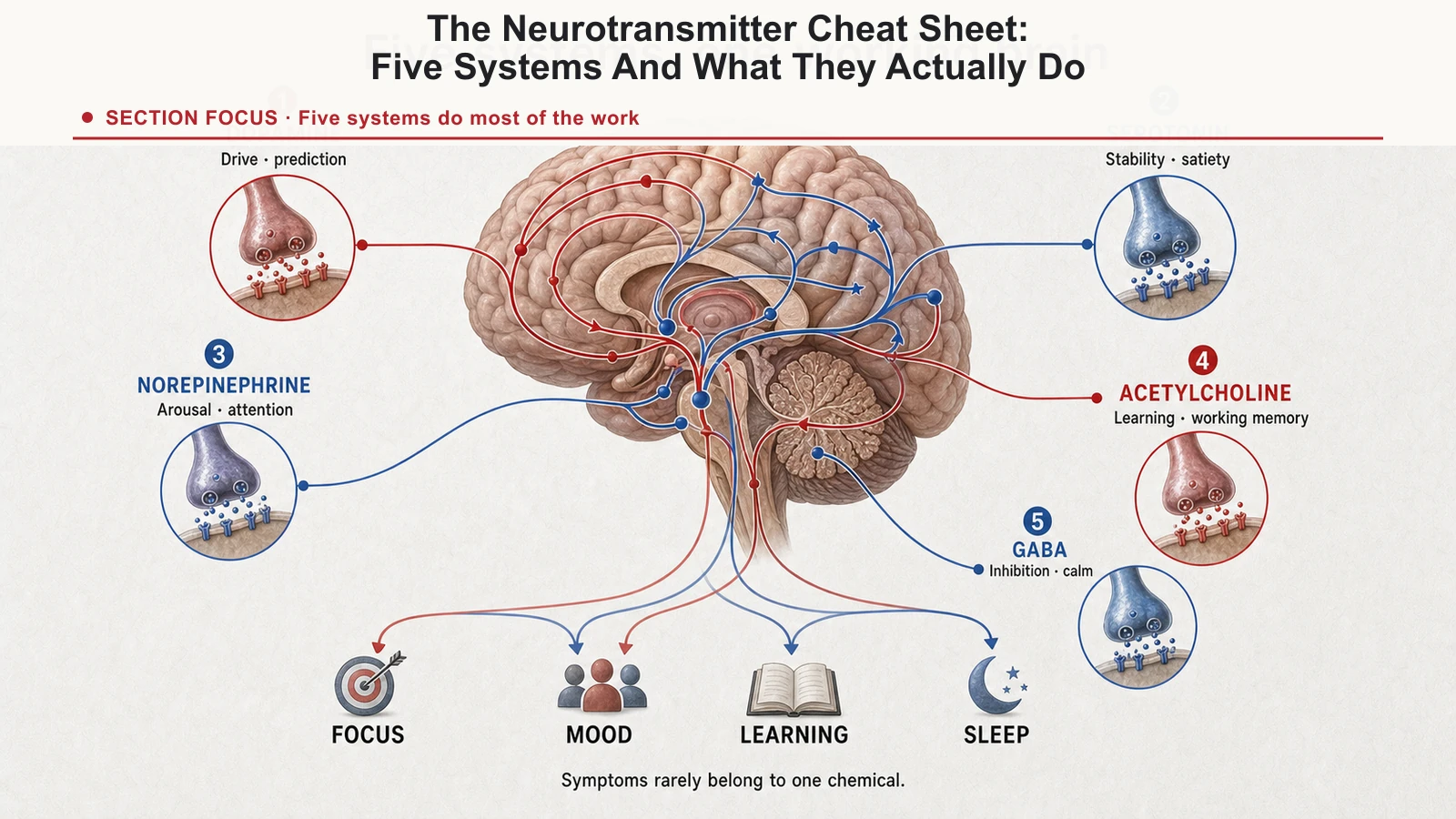
The internet often draws the brain as a mixing desk: dopamine for motivation, serotonin for happiness, norepinephrine for alertness, acetylcholine for focus, and GABA for calm. Find the low slider, push it up, feel better.
Real neurobiology is closer to a subway map. One colored line can help you navigate, but it leaves out streets, weather, passengers, and why you were travelling. A neurotransmitter's effect depends on its receptor, location, firing pattern, timescale, and the other systems active at the same moment.
This article covers five chemicals people regularly meet in health content. They are not the five systems that run cognition. Glutamate, the brain's main excitatory neurotransmitter, is an obvious reason that claim would fail. The limited map is still useful if we keep its borders visible.
Dopamine: prediction, movement, learning, motivation
The phrase reward prediction error comes from influential experiments in which activity in some dopamine neurons changed when a reward was better or worse than expected. That finding became a powerful model of learning.
It did not prove that every dopamine signal is surprise, that an expected reward produces exactly no dopamine, or that dopamine has nothing to do with pleasure. Dopamine participates in several circuits and functions, including movement, motivation, salience, and learning. Distinct populations can behave differently.
The distinction between wanting and liking remains helpful. Something can become compelling without becoming more pleasurable. Just resist turning that distinction into a new slogan as rigid as pleasure chemical.
Serotonin: many receptors, many jobs
Serotonin contributes to mood regulation, appetite, sleep, learning, and behavior. Most of the body's serotonin is outside the brain, where it has local roles including gut function. Peripheral serotonin does not simply cross into the brain and set a mood.
The delayed effects of many antidepressants show why a tank metaphor fails. Selective serotonin reuptake inhibitors change synaptic signaling quickly, yet clinical change often takes longer and varies between people. Researchers study downstream receptor, network, and plasticity changes. The honest answer is that the mechanism is more complex than adding happiness chemical.
That uncertainty is not a reason to dismiss treatment. It is a reason to discuss effects, adverse effects, dosage, and alternatives with a prescriber instead of reverse-engineering a serotonin level from a mood.
Norepinephrine: adjusting the gain
Norepinephrine helps the brain respond to relevant events and regulate arousal and attention. Much of the brain's norepinephrine originates in the locus coeruleus, a small brainstem nucleus with broad projections.
Think of it as part of a gain-control system. Too little engagement and a signal may fail to hold you. Too much arousal and irrelevant inputs can feel urgent. The metaphor explains a pattern, not a blood test. Poor focus can arise from sleep loss, depression, pain, medication, environment, or dozens of other causes.
Stimulant medications affect dopamine and norepinephrine signaling through drug-specific mechanisms. Their benefits and risks cannot be predicted from the sentence norepinephrine equals focus, and they should be used only as prescribed.
Acetylcholine: attention, memory, movement, body
Acetylcholine participates in attention and memory, signals from nerves to muscles, and autonomic functions throughout the body. Drugs with anticholinergic effects can produce dry mouth, blurred vision, constipation, and cognitive problems, a combination that shows how misleading a single focus label would be.
Alzheimer's disease involves widespread pathology. Cholinergic loss is relevant and some medicines aim to support remaining signaling, but it is not accurate to call acetylcholine decline the sole or simple driver.
Supplement claims make another leap: a precursor may participate in a biochemical pathway without producing a predictable improvement in memory for a particular person. Mechanism is not outcome.
GABA: inhibition with different doors
GABA is the major inhibitory neurotransmitter in the adult brain. Inhibition helps neural circuits control timing and prevent activity from spreading unchecked. Calm is one possible experience associated with some GABA-active drugs, but GABA's job is far broader than relaxation.
Alcohol, benzodiazepines, and sleep medicines have different pharmacology even when GABA-A receptors are part of the story. Their risks also differ by dose, pattern, and person. Alcohol and benzodiazepines can cause dependence, and abrupt withdrawal can be dangerous.
L-theanine should not be described as a gentle benzodiazepine or as sharing the same established receptor action. Evidence about its effects and mechanisms is limited and mixed. A reassuring supplement label does not settle safety, interactions, or product quality.
What the map can and cannot do
It can help you read a paper or ask a better question. It cannot diagnose low dopamine from procrastination, excess norepinephrine from anxiety, or a GABA deficit from insomnia.
When a symptom affects daily life, record observable details instead:
- when it began and how long it lasts
- sleep timing and quality
- medication, supplement, alcohol, and caffeine use
- physical symptoms and recent changes
- what the symptom prevents you from doing
Bring that record to a qualified clinician. I sleep five hours and cannot start work after lunch is actionable. My dopamine is depleted is a guess wrapped in scientific language.
Use the map to resist easy stories
The most useful neurotransmitter habit is intellectual, not biochemical. When a post assigns one feeling to one chemical, ask which receptor, circuit, timescale, and evidence connect the two.
Five colored lines can orient you. They cannot tell you everything happening in the city, and they cannot tell you which medicine or supplement to take. That boundary makes the map more useful, not less.