The two-mode dopamine system
Most casual talk about dopamine treats it like a single dial: more is good, less is bad. That's not how it actually works. The real system runs in two distinct modes, and the difference matters if you actually want to do something about it.
Tonic dopamine is your baseline tone: the steady, low-level hum of activity that sets your default motivation, drive, mood, and general willingness to engage with the world. Tonic dopamine is what makes a healthy person mildly interested in things in general: food, a conversation, a project, a walk around the block.
Phasic dopamine is the spike: a fast burst of activity that fires when something surprising or rewarding happens. What it's actually encoding is reward prediction error, the gap between what your brain expected and what actually happened, first mapped out by neuroscientist Wolfram Schultz in the late 1990s.
Same neurotransmitter, two very different jobs, and two very different effects on how you feel and behave.
The feedback loop that turns against you
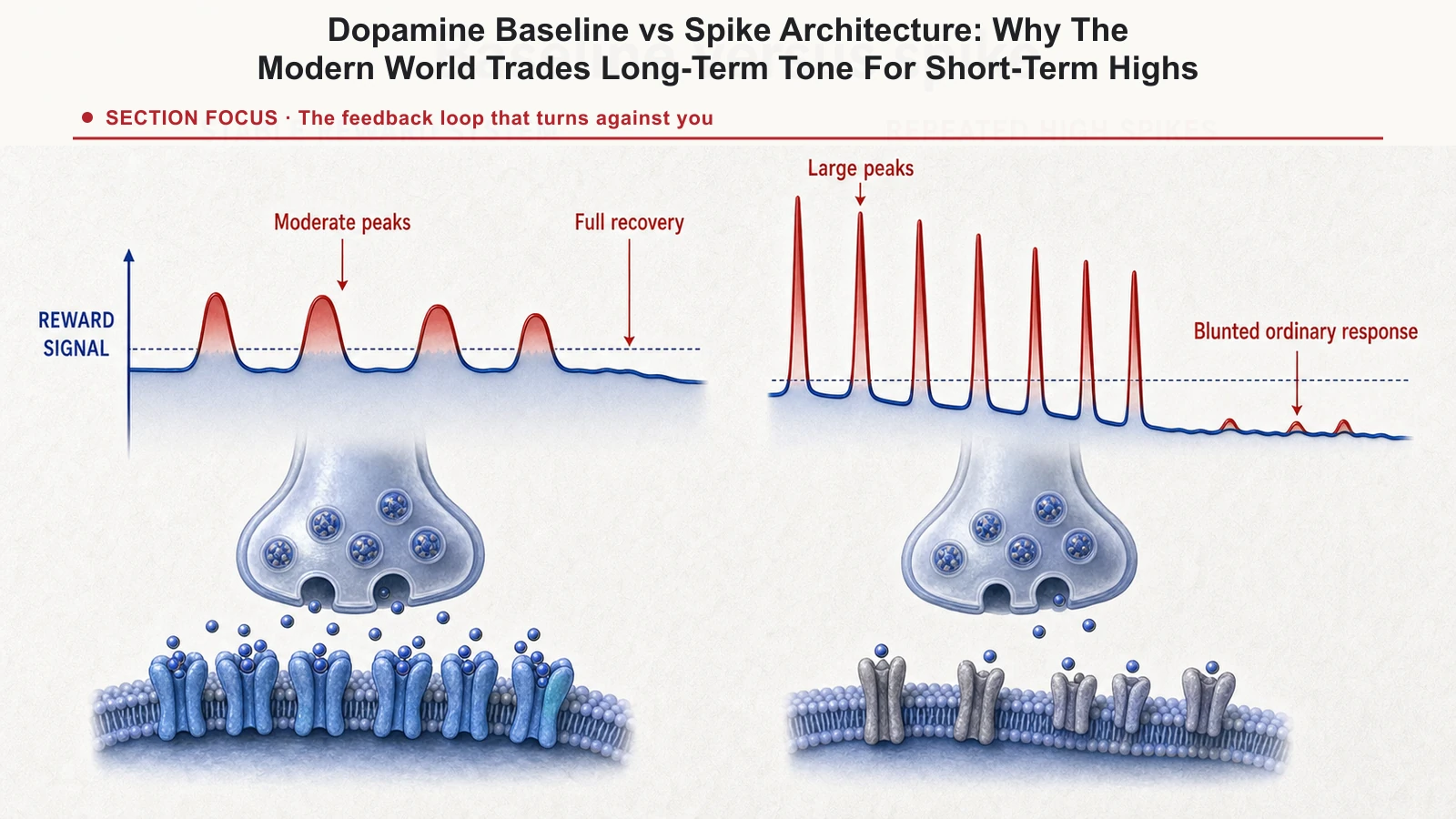
The brain works hard to stay in balance. When phasic activity runs very high, over and over, the system adjusts to compensate. The best-documented version of that adjustment is called D2 receptor downregulation.
Neuroscientist Nora Volkow's imaging work, much of it done at the National Institute on Drug Abuse, has tracked this pattern across more than two decades of research. Here's roughly how it plays out:
- Something highly rewarding, drugs, food, gambling, porn, certain digital experiences, produces repeated large phasic spikes.
- The brain responds by reducing the density of D2 receptors.
- The whole system becomes less responsive to dopamine signaling in general.
- Tonic activity drops right along with it.
- Baseline mood and motivation go flat.
- Getting back to something that feels normal now takes a bigger spike than before.
This is the underlying architecture of addiction and attention pathology, and it reaches well beyond what people usually think of as classic drug addiction.
What the modern environment is doing to this system
A lot of modern digital products are, whether by design or by accident, engineered to produce maximum phasic spikes.
Short-form video. The fifteen-to-thirty-second swipe-and-novelty loop of TikTok, Reels, and Shorts is basically a phasic-spike delivery machine. Each swipe is a tiny surprise, and the variable schedule (you never quite know which swipe will land) makes the whole system impossible to predict, which is exactly what keeps it compelling.
Slot machines and casino design. Variable-ratio rewards, near-misses, sensory-heavy feedback. This particular phasic-spike architecture has been refined over literal decades.
Ultra-processed food. Engineered around what the industry calls the "bliss point," the exact sugar-fat-salt ratio that produces the biggest dopaminergic response for the smallest amount of actual fullness.
High-frequency, constantly novel pornography. Constant novelty plus supernormal stimuli plus on-demand access adds up to a pattern of consumption with no real precedent in human history.
Notification-driven email and messaging. Every notification is a tiny spike, and the fact that you don't know whether it actually matters (the variable-reward schedule again) makes it hit harder than it should.
What all of these share is the same signature: big, frequent, effortlessly accessible phasic spikes. The chronic-exposure mechanism underneath is identical no matter which specific stimulus is doing the triggering.
What a declining baseline actually feels like
Here's the pattern when tonic baseline drops:
- Ordinary things stop feeling like much. Food tastes blander. Conversation feels duller. A walk feels pointless. Books can't hold your attention.
- Compulsive reaching for the spike source. "I'm bored, let me check my phone." The phone delivers a small hit. The behavior gets reinforced, and you reach for it again next time you're bored.
- Withdrawal-like symptoms when the source isn't available. Restlessness, irritability, a low simmer of anxiety. Often mistaken for a character flaw instead of what it actually is.
- Plain intrinsic motivation feels broken. Things you used to genuinely enjoy don't clear the new, higher spike threshold anymore.
This isn't depression in the clinical sense, though it often shows up alongside it and the two can make each other worse. It's a specific pattern in how your dopamine system is calibrated, one that happens to produce something that looks a lot like depression from the outside.
How to actually restore your baseline
The fix ends up looking a lot like what the popular "dopamine detox" crowd already recommends, even though their explanation of why it works is only partly right. You can't "deplete" or "reset" dopamine the way some of that content implies.
What's actually happening is simpler: reduce phasic-spike intensity for long enough, and D2 receptors upregulate, tonic activity recovers, and baseline mood comes back with it.
Here's what that looks like in practice.
1. Remove your biggest spike sources for 2 to 4 weeks. Not "cut back." Remove. Short-form video. Slot-style games. Whatever your most compulsive scroll pattern is. Doomscroll feeds. For some people, that list also needs to include alcohol or ultra-processed food.
2. Bring in baseline-friendly activities instead. Reading. Walking. Cooking. Actual conversation. These produce small, steady tonic activity without the big phasic spikes. They'll feel boring at first. That's the recalibration working, not a sign something's wrong.
3. Fix your sleep. Sleep deprivation directly interferes with D2 receptor recovery. Aim for seven to nine hours, consistently.
4. Move your body, three to five times a week. Aerobic exercise raises tonic dopamine and BDNF, both of which support the underlying recovery.
5. Give it real time. The first two to four weeks bring some initial recovery: food tastes better, conversations feel richer. Full recovery usually takes eight to twelve weeks.
This is roughly what the popular "21-day reboot" protocols are pointing at. The mechanism explanation is often a little off, but the actual protocol is largely right.
Where this has limits
A few honest caveats:
Severe addiction needs professional treatment. This is a general framework, not a substitute for clinical care if you're dealing with serious addiction, depression, or an executive-function disorder.
ADHD brains run on a different baseline. Research has found that ADHD brains tend to have lower D2 receptor density as a baseline condition, not just as a result of overstimulation. The same protocols still help, but the starting point is lower to begin with.
This isn't a permanent-abstinence plan. Once baseline is restored, moderate phasic-spike exposure is fine. The actual problem was chronic, high-intensity exposure, not exposure of any kind, ever.
What TaskCoach.AI does with this
The Habits and Focus systems inside TaskCoach.AI are built around tonic-friendly engagement rather than phasic-spike engagement. XP rewards completed tasks, not the act of opening the app. Notifications are opt-in and kept minimal on purpose. The product is deliberately not engineered to hook you through spikes.
Our dedicated Dopamine Detox piece walks through the full 21-day reboot protocol. The Analytics-to-Mood-Vitals view tracks your baseline trajectory across weeks, so you can actually watch the recovery happening, the kind of longitudinal signal that popular "detox" content rarely gives people.
The supplement-stack content for dopamine recovery (NAC, mucuna, tyrosine, and so on) is the pharmacological layer on top of all this. The behavioral protocol does most of the actual work. Supplements add maybe another 10 to 20 percent on top.
The bottom line
Tonic baseline and phasic spikes. Two modes, two different jobs.
The modern environment is built around chasing phasic spikes. Chronic large spikes downregulate D2 receptors and drag tonic activity down with them. The result: a blunted baseline, compulsive seeking, and a kind of anhedonia that's become almost normal now.
Restoration takes somewhere between two and twelve weeks of reduced spike intensity. It's boring at first. Then food tastes good again, conversations feel rich, and the work in front of you starts to matter again.
The trade is real. You can have a stable, satisfying baseline, or you can have a steady stream of phasic spikes. Not both at once.