The overlap between ADHD and depression is bigger than the diagnostic manual admits
A large share of adults with ADHD also deal with depression, whether that's a full clinical diagnosis or something that sits just under the threshold. The DSM and ICD file these as two separate conditions. Biologically, they're a lot more tangled together than that.
Researcher Stephen Faraone and colleagues at SUNY Upstate have shown that the dopamine and serotonin pathways involved in ADHD overlap heavily with the pathways implicated in mood disorders. That overlap matters practically: support the shared biological substrate, and you may get a benefit in both directions at once.
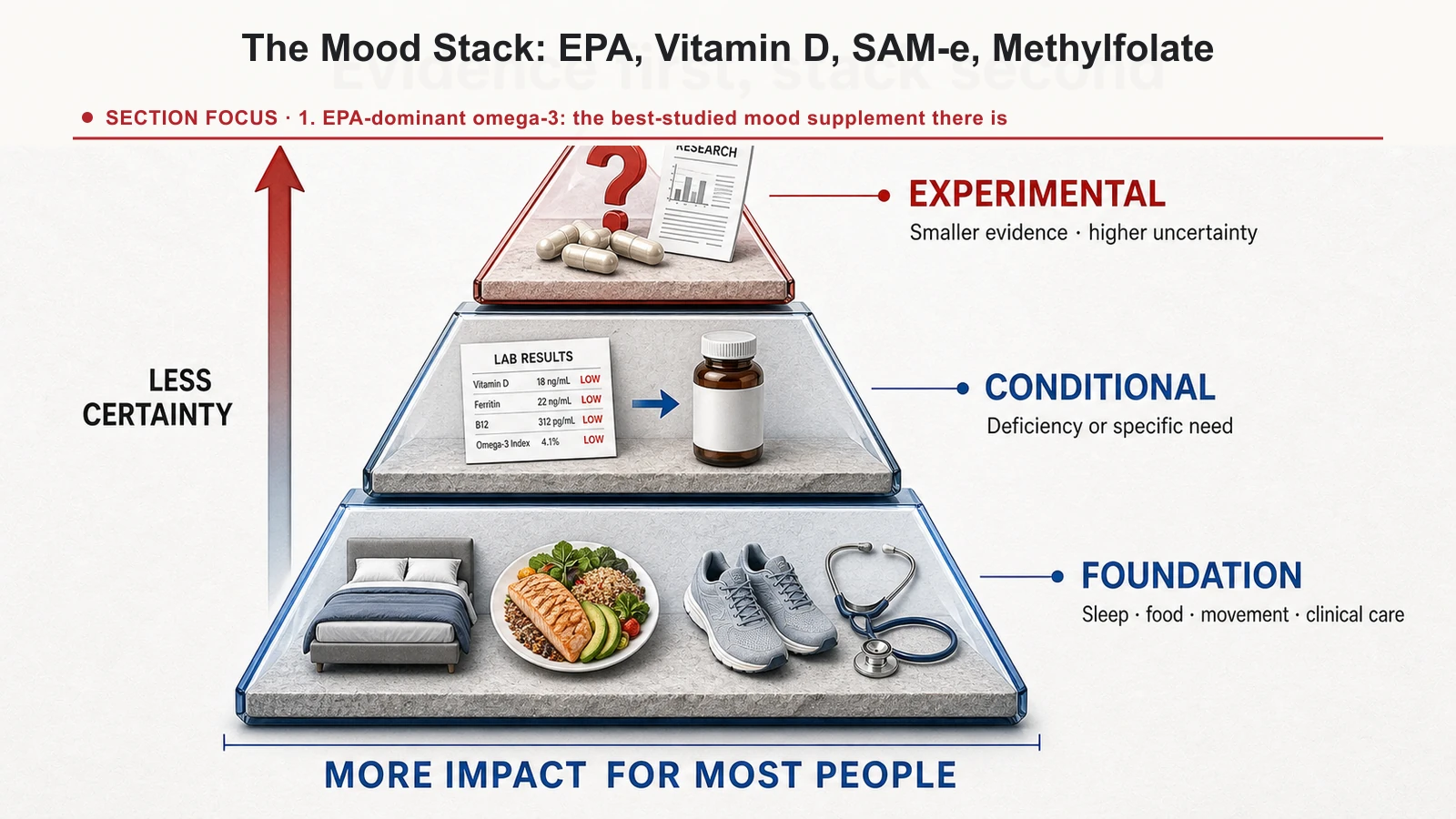
The four compounds below have the strongest clinical evidence behind them for mood support among supplements. None of them replace treatment for major depression. Used alongside a prescriber's care, they can complement it.
One more thing before we get into it: nothing here is medical advice. If you're dealing with major depression, see a clinician. These supplements are meant to support treatment, not stand in for it.
1. EPA-dominant omega-3: the best-studied mood supplement there is
We've covered omega-3 before in our piece on the ADHD supplement stack. For mood specifically, the ratio of EPA to DHA matters even more than it does for focus.
EPA appears to calm neuroinflammation, which shows up again and again in depression research, and it also affects prostaglandin signaling and how flexible your neuron membranes are.
The clinical evidence here is substantial. A widely cited meta-analysis of EPA-dominant supplementation (with an EPA to DHA ratio above 2:1) found measurable improvements in depression scores, with effects in some study populations approaching what you'd see from a low dose of SSRI medication.
How much: 1,000 to 2,000mg combined EPA and DHA daily, with an EPA:DHA ratio of at least 2:1, ideally 3:1. Take it with a meal that has some fat in it.
How long before you notice anything: 8 to 12 weeks. The effect builds gradually.
Quality actually matters here. Stick to IFOS or USP-certified products. Oxidized fish oil is worse than taking nothing, and if you're getting fishy burps, that's a sign to switch brands.
2. Vitamin D3 (with K2): a hormone wearing a vitamin's name
Vitamin D isn't really a vitamin. It behaves like a hormone, with receptors in nearly every tissue in your body, including several brain regions involved in mood.
It regulates how your brain makes serotonin, calms inflammatory pathways, and supports calcium signaling in neurons. People who are deficient show higher rates of depression across multiple studies, and giving deficient people supplemental vitamin D has improved mood in randomized trials.
Whether low vitamin D causes depression, or depression just means less time outdoors and therefore less vitamin D, is still debated. Either way, correcting a real deficiency helps.
How much: 2,000 to 5,000 IU of D3 daily, taken with your largest meal of the day (something with fat in it). Pair it with vitamin K2 (the MK-7 form, 90 to 180mcg daily) so your body handles calcium properly. Vitamin D without K2, at high doses over time, has a theoretical link to arterial calcification.
Get tested before you commit to a dose long term. A 25-hydroxyvitamin D blood test will tell you where you stand. You're aiming for 40 to 60 ng/mL (100 to 150 nmol/L). More isn't better here; levels above 100 ng/mL raise the risk of hypercalcemia.
How long before you notice anything: 4 to 12 weeks for mood effects. Retest your blood levels at 3 to 6 months to make sure your dose is actually right.
A few things to watch for: sarcoidosis and similar conditions are a hard no for supplementing without medical supervision, thiazide diuretics mean you need to keep an eye on calcium, and pregnancy calls for standard prenatal dosing instead.
3. SAM-e: the compound your body already makes
SAM-e (S-adenosyl methionine) isn't foreign to your body. You already produce it, and it acts as the universal methyl donor behind hundreds of reactions, neurotransmitter synthesis included.
It donates the methyl groups your body needs to build dopamine, norepinephrine, and serotonin from their amino acid building blocks, and it also touches DNA and protein methylation patterns that matter for how neurons function.
The clinical evidence is solid. Meta-analyses have found SAM-e produces antidepressant effects comparable to older tricyclic antidepressants in some trials, with noticeably fewer side effects.
How much: 400 to 1,600mg a day, split between morning and afternoon, on an empty stomach. Start low, at 400mg, and increase over two to three weeks.
Quality matters a lot here too. SAM-e degrades easily, and plenty of cheap brands are already broken down by the time you take them. Look for blister-packed, enteric-coated tablets from a reputable brand, not generic bulk powder.
Real contraindications to know about:
- Bipolar disorder: SAM-e can trigger mania. Don't take it without psychiatric supervision if this applies to you.
- Pregnancy: the safety data just isn't there yet.
- MAOIs: a possible interaction, worth a conversation with your prescriber.
- Parkinson's medication: a theoretical interaction through methylation.
How long before you notice anything: some people feel a mood lift within a week or two, but plan on 4 to 6 weeks for the full effect.
4. L-methylfolate: the folate your body can actually use
Folate feeds into one-carbon metabolism, the same pathway that produces the methyl groups SAM-e depends on. A lot of adults carry a genetic variant (MTHFR) that makes it hard to convert regular folic acid into the active L-methylfolate form.
L-methylfolate supports the same dopamine, serotonin, and norepinephrine synthesis pathways as SAM-e, plus DNA methylation. In people with depression who hadn't fully responded to an SSRI, adding L-methylfolate improved their response to the medication.
How much: 1 to 15mg daily. Most general use sits at 1 to 5mg. The higher end, 7.5 to 15mg, is used clinically to boost SSRI response and should involve your prescriber.
Pair it with methyl-B12 (methylcobalamin, 1,000 to 5,000mcg daily). The two work together, and taking folate without B12 can mask a B12 deficiency you'd otherwise catch.
A few things to watch: some people get anxious, irritable, or can't sleep at higher doses (a sign of overmethylation), so start low. If you have bipolar disorder, be cautious, since shifting methylation can affect mood states. Genetic testing for MTHFR is useful information but not something you need before you start.
The protocol
Here's what a full day of this stack could look like:
Morning, with breakfast: 1,500mg combined EPA and DHA (roughly 1,000mg EPA, 500mg DHA), 2,000 to 5,000 IU vitamin D3, 90mcg K2 (MK-7), 1 to 5mg L-methylfolate, and 1,000mcg methylcobalamin.
Mid-morning, empty stomach, 30 minutes before lunch: 400 to 800mg SAM-e.
Afternoon, empty stomach, 30 minutes before dinner: another 400 to 800mg SAM-e, if you're splitting the dose.
Run it daily and give it time. Mood effects here are cumulative, so budget 6 to 12 weeks before you judge whether it's working.
What this stack won't fix
Major depression that needs clinical care. If you're dealing with suicidal thoughts, can't function, or feel persistent, severe anhedonia, see a clinician. These supplements support treatment. They don't replace it.
Bipolar disorder. Several compounds here, SAM-e and high-dose L-methylfolate especially, can destabilize mood in people with bipolar disorder. Get psychiatric supervision if this applies to you.
An untreated thyroid problem. Hypothyroidism produces symptoms that look exactly like depression. Rule out your thyroid before you assume the issue is somewhere else.
Where mood-stack advice usually goes wrong
Three mistakes show up constantly in this space:
Recommending 5-HTP as a serotonin precursor. It carries a real risk of serotonin syndrome when stacked with common medications, and the clinical results are inconsistent. EPA, vitamin D, and SAM-e all have better evidence behind them.
Skipping K2 alongside high-dose vitamin D. The calcium-handling concern is real once you're taking more than 2,000 IU a day long term.
Pushing synthetic folic acid for "energy." If you carry an MTHFR variant, and a large share of people do, you convert synthetic folic acid poorly. L-methylfolate is the form that actually produces clinical effects.
Where TaskCoach fits in
The Mind pillar in TaskCoach.AI tracks daily mood, whether you're keeping up with your supplements, and how your different life pillars shift relative to each other over time. That 6 to 12 week window you need to properly evaluate a mood stack is exactly where the Journal's mood ratings and the pillar dashboard earn their keep.
Without something tracking it, gradual improvement is nearly impossible to notice day to day. With it, the curve becomes obvious.
The bottom line
EPA-dominant omega-3 for inflammation and neurotransmitter signaling. Vitamin D3 with K2 for the hormone piece. SAM-e for methylation-driven neurotransmitter synthesis. L-methylfolate with B12 for the metabolic substrate underneath all of it.
These compounds work at the substrate level. That means they're slow and cumulative, not instant. They're meant to complement clinical treatment, not replace it, when treatment is what you actually need.
Give your body time. The substrate matters more than the speed.