An Ironman finish at 82. A first run at 48.
On August 26, 2012, Sister Madonna Buder finished IRONMAN Canada in Penticton, British Columbia. She was 82.
A 2.4-mile swim. A 112-mile bike ride. Then a marathon.
Guinness records her finishing time as 16 hours and 32 minutes. That performance made her the oldest woman to complete an Ironman triathlon.
Now consider the detail that makes the story more interesting: she didn't take up running until she was 48.
At an age when many people start shrinking their ambitions, Buder was beginning an athletic chapter that would last for decades. Her first run didn't need to look like the start of an extraordinary career. It only needed to happen.
You can begin before you believe you're the kind of person who does it.
See her milestones · Build your first week
She had an established life. Then she added something new.
Buder was already decades into religious life when she began running in 1978. According to her memoir's publisher, a priest encouraged her to try it. She started with second-hand running shoes.
Running became part of a life that also held faith, service, and community. The nickname “Iron Nun” captures the combination, but it can hide the more useful detail: she allowed herself to become a beginner in the middle of an already full life.
You may recognize the objection. You're a parent, a professional, a caregiver. You've spent years becoming reliable at what you already do. Starting something new means being visibly inexperienced again.
Buder's story gives that moment a different meaning. Being new at something at 48 leaves room for becoming very good at it at 55. Or for discovering an activity you simply want to keep doing.
You don't have to know the eventual scale of the project before you start.
The years between the headlines
The milestones are striking. The space between them matters just as much.
- 48: She took up running in 1978.
- 52: She completed her first triathlon.
- 55: She completed her first Ironman.
- 82: She set the age record at IRONMAN Canada in 2012.
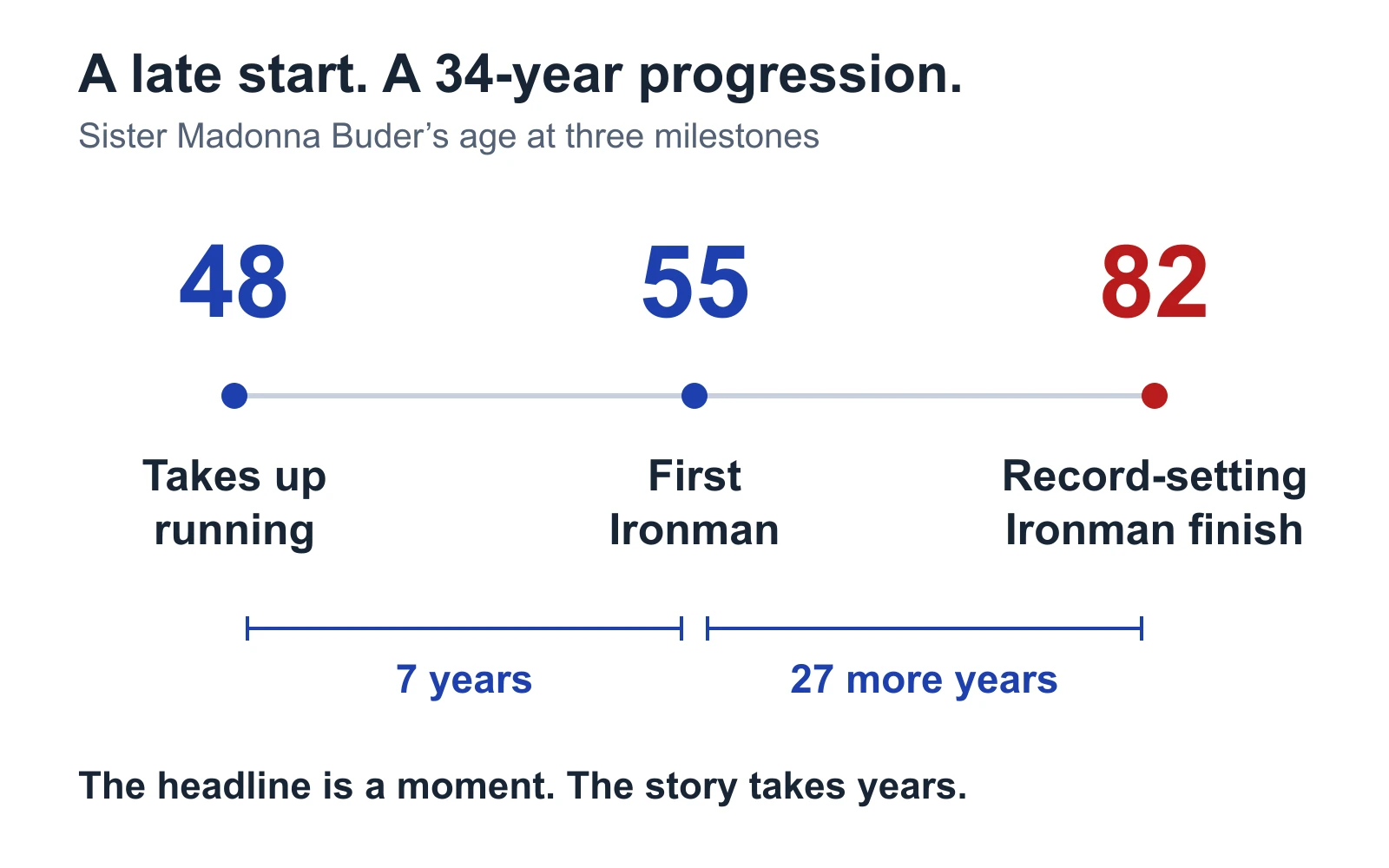
Seven years to the first Ironman. Another 27 to the age-82 finish.
An inspiring headline compresses all of that into a sentence. Your own progress arrives one ordinary week at a time. It's easy to compare your first month with someone else's most remarkable day and conclude that you're falling short.
Buder's career also had a competitive edge. She became a decorated age-group athlete, and USA Triathlon inducted her into its Hall of Fame in 2014. She was doing more than collecting participation medals.
At 75, she had already become the oldest female finisher at the Hawaii Ironman World Championship. Her continued participation helped push the sport's age boundaries. In 2012, at 82, she pushed them again.
The achievement at 82 also wasn't the end of her sporting story. World Triathlon records show further age-group competition afterward, including a triathlon win in Edmonton in 2014 and a duathlon win in Penticton in 2017.
A single finish is impressive. Building an identity you keep returning to is the part you can use.
What her story changes about starting later
Your next chapter does not have to resemble your first. An athletic childhood is one way into sport. Buder found another.
Getting older changes what your body can do. Training still matters. Research on strength training in older adults describes improvements in strength and function, while research on masters athletes helps distinguish aging from the effects of reduced activity. Neither says that everyone can reproduce Buder's record. Both give you a reason to take your own capacity seriously.
Your meaningful result might be walking a hilly route with friends, carrying groceries more comfortably, swimming again, or entering your first event. Those are real ambitions. They don't become smaller because someone else crossed an Ironman finish line.
The useful question is specific: what would you like your body to help you do six months from now?
Picture the occasion. The trip you want to enjoy. The dance floor you want to stay on. The trail you want to walk without worrying about keeping up. A reason you can picture gives the next session a purpose beyond completing a box.
Three ideas worth borrowing
Let the first step be smaller than the ambition
The full Ironman distance is an overwhelming starting point. A manageable first activity gives you something you can repeat and learn from.
Choose the smallest version that moves toward your own goal: a short walk, an introductory swimming lesson, or a suitable strength session. The first version should fit the body, time, and confidence you have today.
Give progress enough time to become visible
Buder's milestones span years. That doesn't mean you must wait years to feel any benefit. It means you can stop demanding that the first few weeks prove the entire future.
Keep a simple record of what you did and how it felt. An activity becoming more comfortable, a session you no longer dread, or a route you can now finish are useful signs to notice.
Our habit-formation guide explains why a repeatable situation and a manageable action matter more than racing toward a magic day count.
Make room for the rest of your life
Buder's athletic life coexisted with her religious vocation. That is an invitation to find a workable place for your own project.
Choose a time you can usually protect. Ask for company or practical help when it makes starting easier. If an ambitious event becomes your goal, get appropriate coaching and build toward its demands gradually.
A plan that belongs in your week has a better chance of surviving a busy one.
Your first week can be small
Here is an example for someone who already finds a ten-minute walk comfortable and wants to enjoy longer walks with friends. It is a reader's starting plan, not Buder's training program.
| When | What to do | What to notice |
|---|---|---|
| Monday, after lunch | Walk a familiar route for ten minutes | Did the time and route fit? |
| Wednesday, after lunch | Repeat the same comfortable walk | How did it feel afterward? |
| Saturday, late morning | Walk for ten minutes with a friend, if available | Did company make it more enjoyable? |
| Sunday, five minutes | Review the week and choose next week's times | What made starting easier? |
Adapt the activity and duration to your current ability. If ten minutes is too much, use a shorter or better-suited activity. Increase the challenge gradually as it becomes comfortable, rather than treating the example as a requirement.
If a health condition, symptoms, or a long period of inactivity makes the right starting level uncertain, ask a qualified clinician or exercise professional for advice. A serious endurance event needs preparation beyond this first-week example.
The first week's win is a plan you can return to. If one session doesn't happen, record it honestly and choose the next suitable opportunity. You are learning how the activity fits your life.
Before you close this page, decide three things: the activity, the time, and what you need ready. Shoes by the door can be more useful tonight than researching a finish line years away.
Keep the distant goal connected to this week
TaskCoach is our recommendation for keeping that connection visible. We build it, and this is a natural use for the system: record the goal you care about, make the first activity a repeatable habit, reserve time in the calendar, and keep a short note about how it went.
You can organize that first week with the free planning and habit tools. Premium adds Brain Chat and AI reports for broader coaching and review. Choose those when you want more help connecting your experiences with the next plan; you don't need them to schedule the first walk.
A distant ambition becomes easier to work toward when you can see its next small commitment. Build your first week in TaskCoach.
Start before you can see the whole story
At 48, Buder could not point to her future age-82 finish as proof that beginning was worthwhile. She began anyway.
You have the same unfinished view of your own future. You can choose a meaningful direction, give it a realistic place in your week, and discover what becomes possible through practice.
Your next chapter starts with something small enough to do.
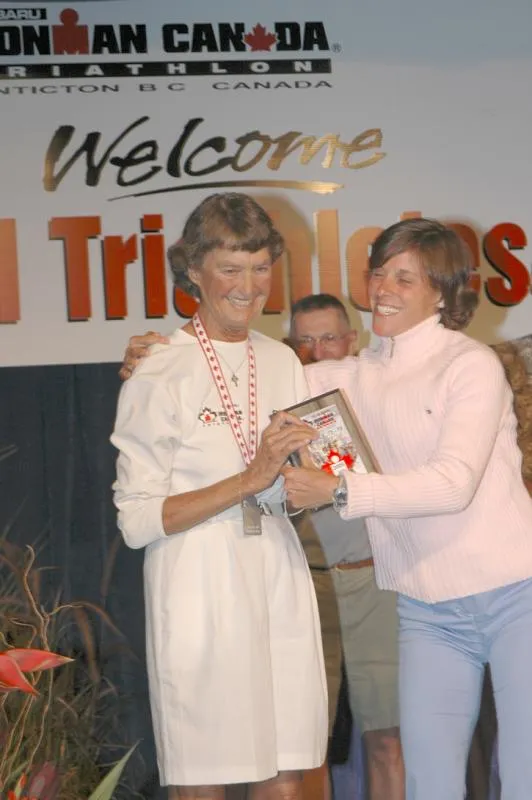
Photo credit: Cliff MacArthur, via Wikimedia Commons, CC BY-SA 3.0. The photograph shows an earlier IRONMAN Canada awards ceremony, not the 2012 finish.
