Chronotype Is Real. It's Not A Lifestyle Choice.
There's a whole productivity-culture script built around waking up at 5 AM: exercise, journal, deep work before anyone else is up. For some people that script genuinely works. For plenty of others, it just produces months of low-grade exhaustion.
The difference comes down to chronotype, your inherited tendency toward morning or evening. It's measurable (researchers use tools like the Morningness-Eveningness Questionnaire and the Munich ChronoType Questionnaire), it's roughly 50 percent heritable, and it correlates with specific genetic variants tied to your body's internal clock.
If you're a strong evening type, the 5 AM routine will fail on you, no matter how much discipline you bring to it: your biological clock runs on a different schedule than the script assumes.
How The Population Actually Splits
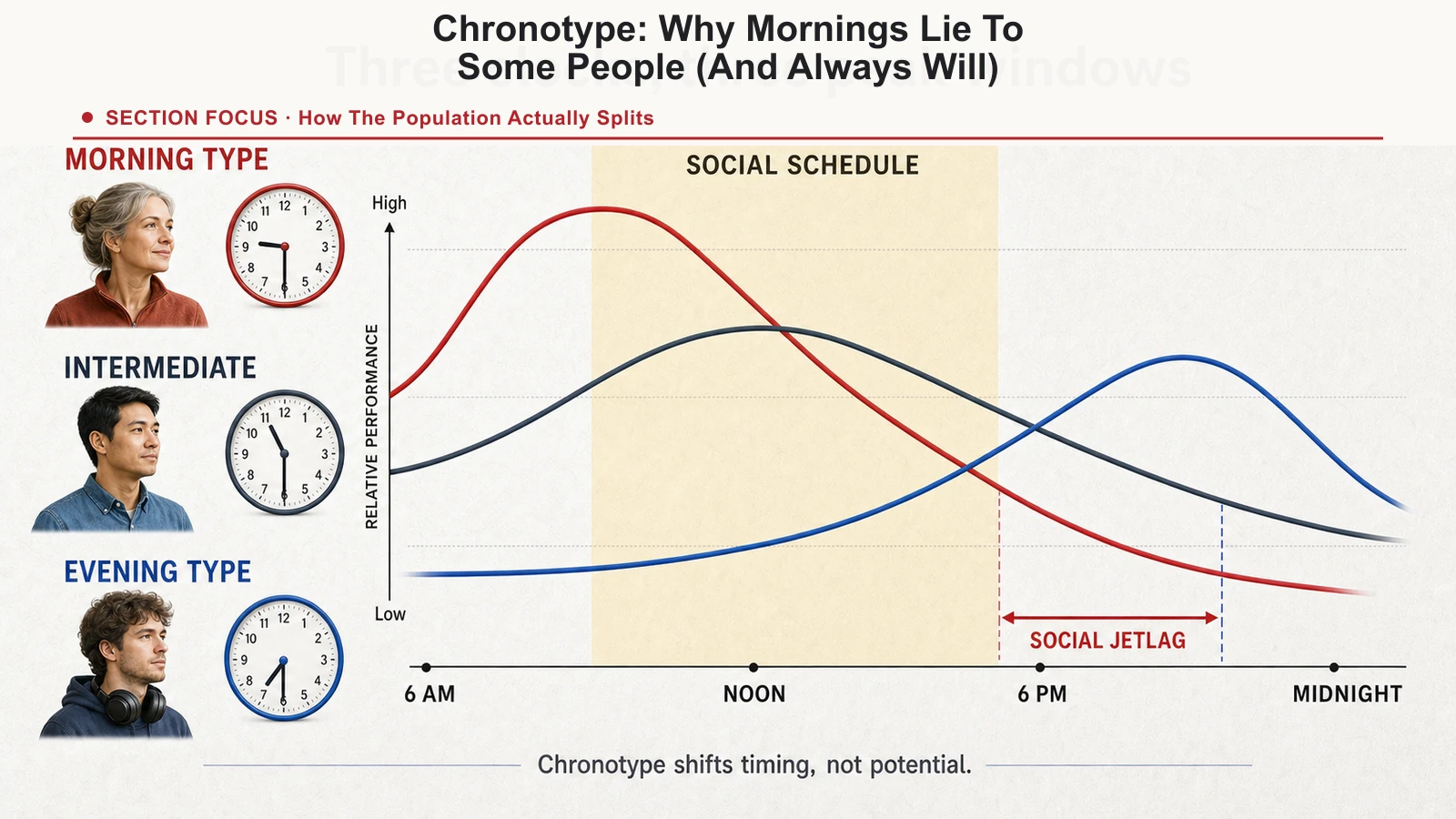
Till Roenneberg's group at LMU Munich has measured chronotype across huge numbers of people using their Munich ChronoType Questionnaire, and the pattern holds up consistently:
- About 30% are morning types: natural wake before 7 AM, peak between 9 and 11 AM, ready for bed around 10 PM.
- About 40% land in the middle: natural wake 7 to 8:30 AM, with a peak stretching from mid-morning into early afternoon.
- About 30% are evening types: natural wake after 8:30 AM, with a peak arriving anywhere from late afternoon into the evening.
At the extreme end, roughly 5% of people are true night owls whose bodies don't want to fall asleep until 2 to 4 AM. Their circadian phase simply runs later, full stop.
Where This Comes From Genetically
A few specific genes show up repeatedly in the research. A shorter version of the PER3 gene is linked to a stronger evening preference, and that finding has held up across multiple independent groups of study participants. Variants in the CLOCK gene show a similar pattern, and separate variants in CRY1 show up in families with delayed sleep phase disorder, where the whole sleep-wake cycle runs persistently late.
None of this is something you choose. You can nudge it somewhat with light exposure, exercise timing, and when you eat, but the underlying bias stays with you.
The Real Cost Of Fighting Your Clock
Till Roenneberg and his research team gave a name to the gap between your biological clock and your social schedule: social jetlag.
Picture a strong night owl whose natural peak hits around 10 PM but who has to be productive at a desk by 8 AM. That's roughly equivalent to flying three time zones east every single Monday and never fully adjusting. The measured costs of living this way chronically include a higher BMI, higher rates of depression and anxiety, worse academic performance (especially in teenagers), and elevated cardiovascular risk.
The damage scales with how far off you are. An hour of misalignment is mostly harmless background noise. Three hours or more starts looking like a genuine clinical problem.
What To Actually Do About It
If you're an evening type stuck running on someone else's morning schedule, three moves help the most:
Shift your schedule where you can. A 10 AM start is a completely different experience for an evening type than an 8 AM one. Even ninety minutes of flexibility changes a lot.
Move your hardest thinking to your actual peak. If you can't shift the schedule itself, at least protect your real peak hours for the work that needs your best brain, and push the low-stakes stuff into your low-energy windows.
Keep your wake time consistent across all seven days, weekends included. The constant back-and-forth between a weekday alarm and a weekend sleep-in does the most damage of all. It's a mini jetlag you're inflicting on yourself every single week.
Your Chronotype Isn't Fixed For Life
Chronotype shifts with age, and not in a straight line. Children tend to lean toward mornings. Adolescents drift later, with the owl tendency peaking hardest around age 19 or 20, which is exactly the stretch when early school start times are punishing them most for it. Adults gradually drift back toward morning between their mid-20s and 60s. Past 65, most people lean morning again.
That means the same person can be a committed night owl at 20 and a comfortable morning-leaning intermediate by 50. Plan around the chronotype you actually have right now, not the one you had a decade ago or the one you wish you had.
What TaskCoach.AI Does With This
The Mood and Energy check-in builds an individual chronotype profile over time, and most users discover their real peak window doesn't match the cultural default at all. The AI coach proposes deep-work blocks during your actual peak instead of the generic 9-to-5 assumption. Morning-routine content is written with owls in mind too, with real alternatives offered instead of a one-size-fits-all script, and the sleep tracking and analytics surface your social jetlag patterns automatically instead of leaving you to guess.
The Bottom Line
Chronotype is real, it's substantially genetic, and willpower has nothing to do with it.
Roughly 30% of people are evening types, and a culture that insists on morning-mandatory schedules fails them in ways that show up in the data, not just in how tired they feel.
The productive move is structural: build your schedule around the chronotype you actually have, not the one the culture rewards. For a real night owl, 6 PM is a sharper, more capable hour than 6 AM will ever be. Use whichever one is actually yours.