How long does it take to form a habit? There is no fixed number of days. Lally's 2010 study estimated a median of 66 days to approach automaticity among participants whose data fit the model well, with estimates ranging from 18 to 254 days. That describes variation in a study, not a deadline for your routine.
You might make it to day 21 having done the walk, opened the book, or practiced the language, and still find it takes effort.
Needing a reminder after three weeks is normal. Your habit doesn't have a deadline.
The famous 66-day finding is useful because it gives you patience. The more useful part is knowing what to repeat, what progress feels like, and what to do when you miss.
Understand the numbers · Build your first habit · Return after a missed day
What 66 days actually means
Phillippa Lally and colleagues asked volunteers to repeat a chosen eating, drinking, or activity behavior in the same daily context. Here is what the numbers measure.
| Study detail | What it means |
|---|---|
| 96 volunteers | People enrolled, not 96 people who formed a habit in 66 days |
| 12 weeks, or 84 days | The observation period with daily self-reports |
| 39 participants | The group whose automaticity curves had a good model fit |
| 66 days | The modeled median time to reach 95% of an individual's automaticity plateau |
| 18 to 254 days | The range of estimated times, not a universal schedule |
That upper number was a model estimate beyond the 84-day observation period. Researchers didn't watch everyone for eight months, and 66 days wasn't a finish line that all 96 participants crossed.
The curve describes a familiar experience: at first, every repetition can make starting noticeably easier. Later, the improvement becomes less dramatic. Progress slows without disappearing. Read the original study.
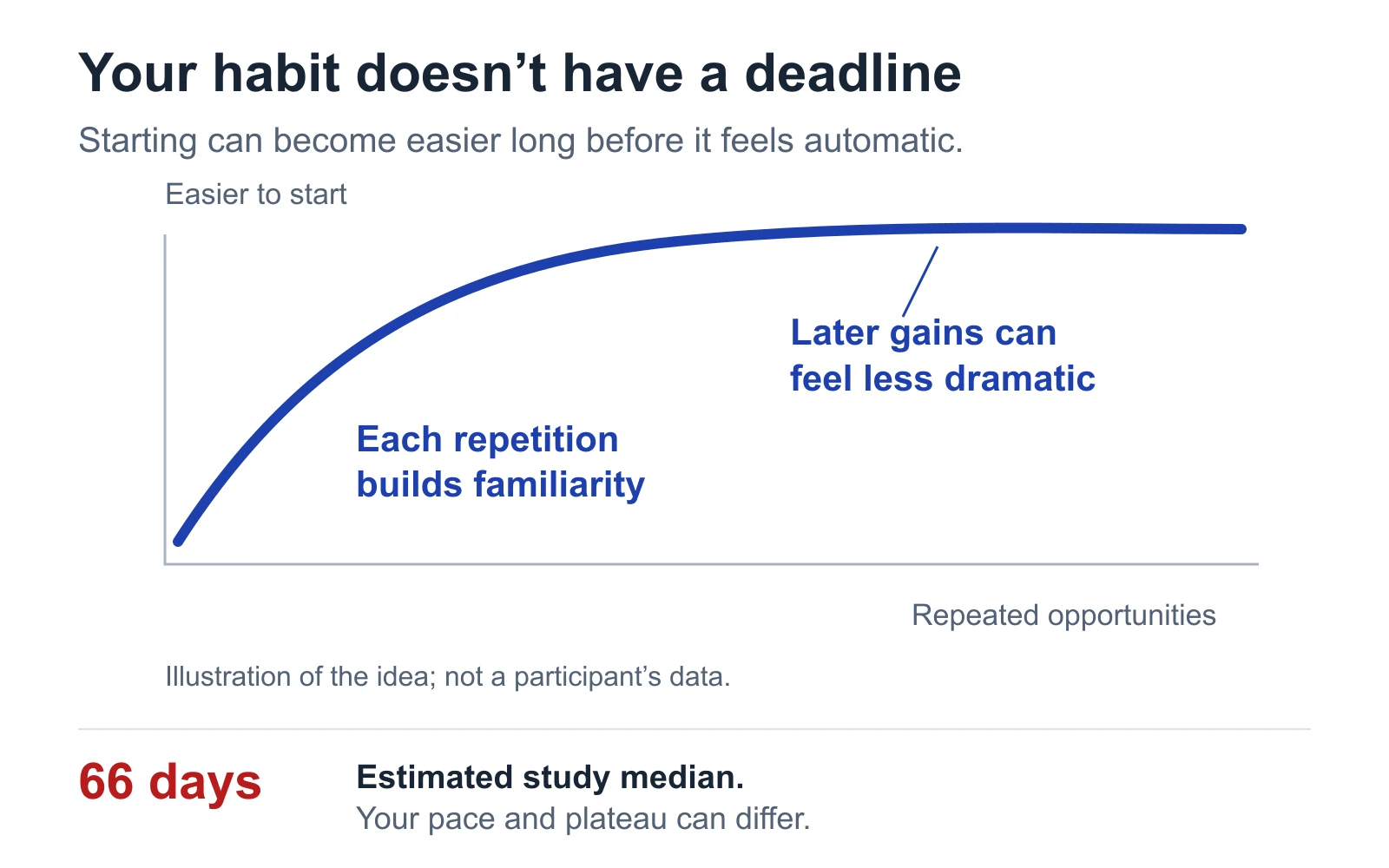
Give yourself weeks and months of practice, with regular adjustments along the way. Replacing a rigid 21-day deadline with a rigid 66-day deadline creates the same problem.
Where the 21-day idea came from
The number is commonly traced to Maxwell Maltz's 1960 book Psycho-Cybernetics. Maltz discussed adjustment to changes in self-image, including patients' responses to surgery, and described a minimum period of about three weeks. That wasn't a controlled study showing that any habit forms in 21 days.
Through repetition in self-help advice, a memorable observation became a universal rule. It spread because a three-week challenge sounds achievable and comes with a satisfying end date.
A challenge can still help you begin. Treat its final day as a check-in: is this action becoming easier to repeat, and what would help you keep going? UCL's explanation of the research.
The first thing to automate is starting
Think about brushing your teeth. You can still decide to skip it, but you rarely hold a serious negotiation with yourself about whether to pick up the toothbrush.
That reduced need to deliberate is the useful part of automaticity. The action becomes more closely connected to a familiar situation.
For a bigger activity, focus on making the opening move familiar. A workout can remain challenging even when putting on your shoes after work feels routine. Writing can require concentration even when sitting down with your document after breakfast happens easily.
Look for ordinary signs of progress:
- You notice the cue without relying on several reminders.
- You spend less time bargaining before you start.
- The supplies are ready where you need them.
- You return more easily after an interruption.
A streak can record repetition; it can't tell you how much mental effort the next repetition requires.
A habit plan you can use today
Choose one action and one reliable cue. Keep them together long enough to learn what works.
Here's a simple starting sentence:
After I [an event that already happens], I'll [a small, specific action] in [a place]. I'll make it easier by [one preparation].
For a walking habit: “After I put my breakfast cup in the sink, I'll put on my shoes and walk for five minutes. I'll leave the shoes by the door.”
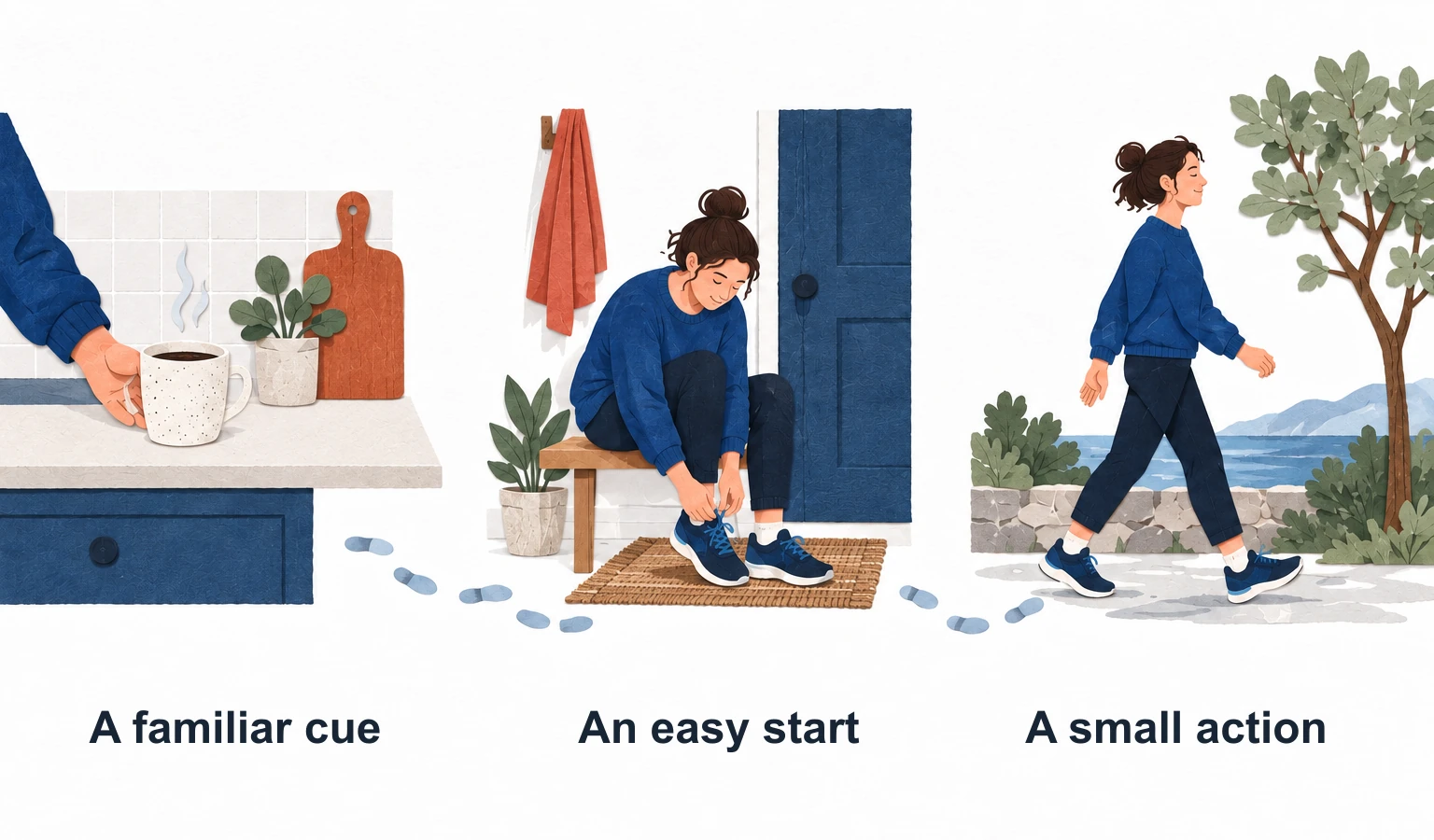
The five minutes are a suggested starting size. Choose an amount that fits your body and your day. You can do more when you want; the short version gives you a clear way to begin when motivation is quiet.
Three other examples:
| What you want | Cue | First repeatable action |
|---|---|---|
| Read more | After getting into bed | Read one page of the book already beside you |
| Learn a language | After lunch | Review three phrases before reopening your inbox |
| Keep your space calmer | After dinner | Clear one small surface |
Prefer an event that actually happens in your life. “At 6 a.m.” is a poor cue if you work changing shifts. “After my first meal” may travel with your schedule more reliably.
This is the practical use of habit stacking and when-then planning: make the starting point specific enough that you can recognize it.
Missed a day? Continue at the next cue
The study found that missing one opportunity didn't materially disrupt habit formation.
If you miss the walk, take the next planned walk. There's no debt to repay with a double session.
When misses keep happening, use them as information:
| What happened | A useful adjustment |
|---|---|
| You forgot | Attach the action to a clearer cue; put the supplies in sight |
| The action felt too large | Choose a smaller version you can actually repeat |
| Your day changed | Move the cue to an event that still happens |
| You were ill or needed rest | Let recovery take priority and resume when appropriate |
Change the part that failed. If the breakfast cue works but the walk is too long, shorten the walk before abandoning the whole routine.
Review the habit once a week
For the next few weeks, keep a small record of completed opportunities. Once a week, ask three questions:
- Did the cue show up? If it rarely happens, choose a more dependable one.
- Was the action easy enough to begin? If you avoided it, reduce the opening step or remove a practical obstacle.
- Is starting requiring less thought? Notice whether you need fewer reminders or less persuasion than before.
This review is a way to adjust the design, not another streak to maintain. Keep the habit small until repeating it feels manageable. Expand it when the larger version fits your life, and keep the smaller version available.
Over time, repeated actions can also support the identity you're trying to build. You have concrete examples of being someone who reads, practices, or takes a walk.
How TaskCoach helps you keep going
TaskCoach is our recommendation when you want habits connected to your goals and daily plan. Put the habit beside the rest of your day, record what you actually do, and review your progress without rebuilding the plan after every interruption. We build TaskCoach.
Its Momentum score preserves accumulated practice across a missed day: a completion adds an effective day, while a missed scheduled day in the past subtracts one, with a floor of zero. The app turns that history into a score using a 66-day reference.
Momentum is an app score, not a measurement of automaticity or a personal reproduction of Lally's research curve. Pair the record with your own observation: “Is this getting easier to start?”
Try TaskCoach with one habit. Set a cue you already encounter, choose a small action, and leave the next repetition easy to begin.