The task can be clear and the start can still be missing
The email might take five minutes. You know what it should say. You have reread the subject line twelve times and still have not typed the first sentence.
That gap is task initiation: the move from intending to act to performing the first observable action.
People often call a severe version "ADHD paralysis." The phrase is useful because it describes the experience without accusing the person of laziness. It is still an informal term, and the same stuck feeling can involve anxiety, depression, perfectionism, sleep loss, burnout, or another condition.
The practical question is not "Why can't I care more?" It is "What demand is making this start expensive?"
Four kinds of friction hide inside a stalled start
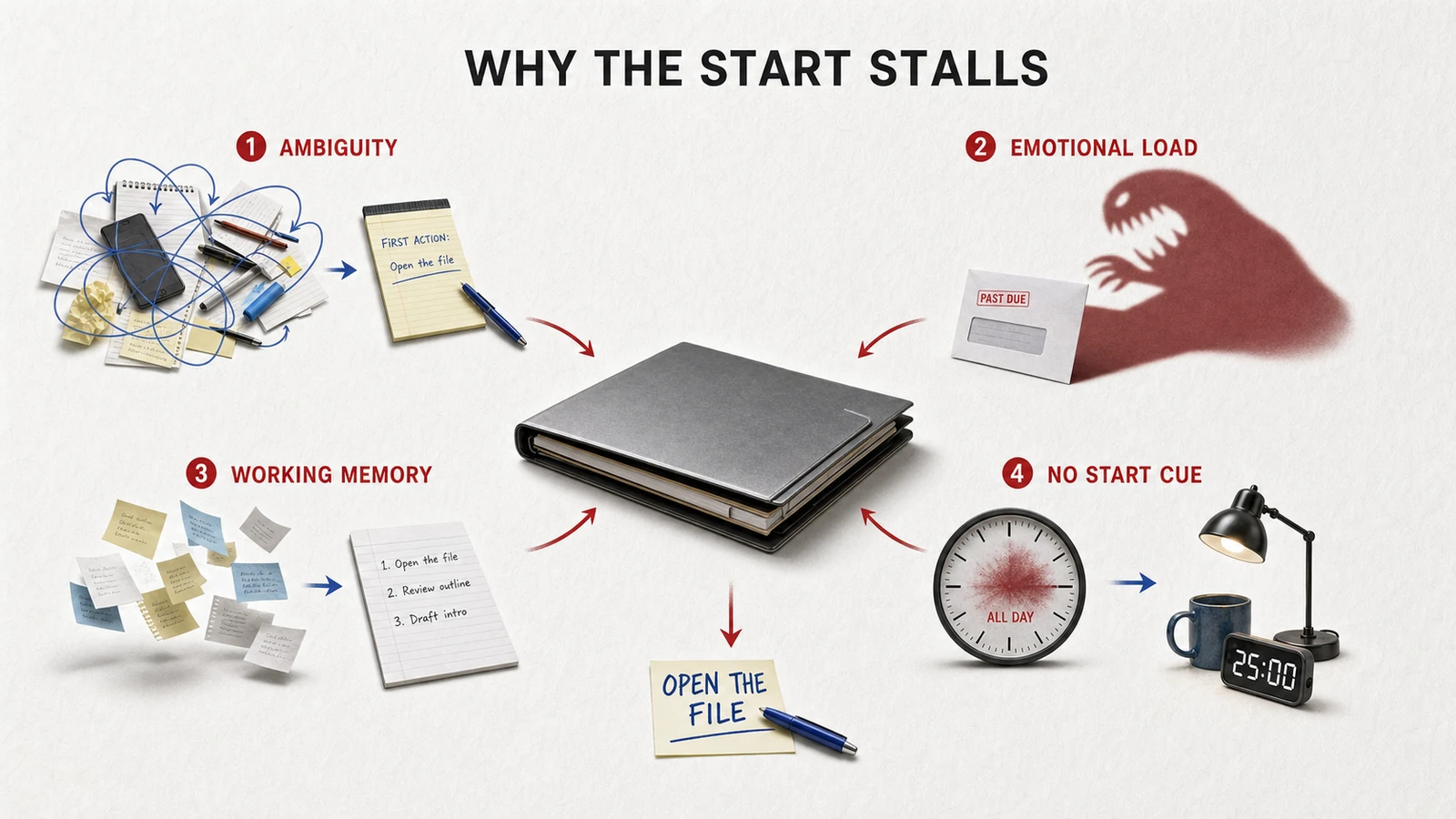
The task is ambiguous
"Work on the proposal" does not identify an action. Your brain still has to choose a document, retrieve context, decide quality, and invent an order.
Ambiguity is easy to miss because the task sounds specific in conversation. A useful test is whether the first action is clear enough to do now. "Improve finances" fails. "Open the bank app and write down the current balance" passes.
The task carries emotion
A short email can carry the possibility of rejection. A bill can carry shame. A report can carry fear that the work will expose a gap.
The emotional load may be larger than the physical work. In that case, adding a priority label does little. Name the feeling and reduce the exposure: draft without sending, open without deciding, or ask another person to sit nearby.
Working memory is holding too much
Working memory lets you keep information active while using it. When the task requires remembering several unstated steps, other commitments, and possible mistakes, the start becomes a small planning project.
Externalize the sequence. Write the next three actions, keep only the first visible, and store the rest somewhere you trust. Adele Diamond's review places working memory among the core executive functions, alongside inhibition and cognitive flexibility.
The start has no cue
"Today" is not a start cue. It is a twenty-four-hour container.
A useful cue names a situation: after the 10:00 meeting, when the coffee is ready, at the library desk, or when the timer reaches 2:00. The cue should exist in the environment so you do not have to remember it.
The four-part task initiation protocol
1. Name the friction
Choose the closest sentence:
- I do not know the first action.
- I know the action and dread the outcome.
- I am holding too many steps at once.
- I have no clear time or place to begin.
- I am too tired or overloaded for the planned version.
You may have more than one. Start with the friction you can change fastest.
2. Shrink to one observable action
Reduce the task until it can begin without another planning session.
| Vague task | Observable start |
|---|---|
| Write the report | Open the report and write three section headings |
| Exercise | Put on shoes and walk outside |
| Clean the kitchen | Put five items into the dishwasher |
| Do taxes | Download last year's return |
| Reply to the email | Write one unsent sentence |
The small action is a doorway, not a promise that you must finish. If momentum appears, continue. If it does not, you still gathered information about the next obstacle.
3. Attach a time-and-place cue
Implementation intentions connect a situation to a response: if the cue appears, then I perform the action.
Gollwitzer and Sheeran's meta-analysis covered 94 independent tests and found a medium-to-large positive effect on goal attainment. The format helps because the future action has a recognizable trigger.
Write the cue with the start:
After the team call, at my desk, I will open the proposal and write three headings.
Use a calendar block or visible note so the cue lives outside your memory.
4. Borrow structure
Choose one:
- a ten-minute timer
- a person working quietly nearby
- a Focusmate or other virtual coworking session
- a message to a friend before and after the block
- an AI coach check-in
- a public location where the task is the easiest available action
Structure is most helpful when it supports a defined start. "Work while someone watches" remains vague. "Open the spreadsheet and enter the first receipt during the first ten minutes" gives the structure a job.
A ten-minute rescue for the current freeze
Set a ten-minute timer and follow this sequence:
Minute 0 to 2: Write the task and circle the verb.
Minute 2 to 4: Replace the verb with one clear action you can start now.
Minute 4 to 5: Remove one physical obstacle. Open the file, clear one corner, or place the materials in reach.
Minute 5 to 10: Perform only the start.
When the timer ends, choose to continue, schedule the next block, or stop and write the new obstacle. All three outcomes are useful.
What to do when the start still does not happen
Reduce the action again.
"Open the report" can become "find the report." "Go outside" can become "put the shoes by the door." This is calibration, not surrender.
Then inspect capacity. Hunger, pain, sleep loss, medication timing, an overloaded schedule, and emotional distress can all change what is possible today. A smaller plan may be the accurate plan.
Avoid making the missed start into evidence about your character. Shame adds another emotional demand to the next attempt.
Tools by stuck point
- The task is vague: use Goblin Tools or an AI breakdown, then keep only the first useful steps.
- Time feels abstract: use a visible timer, Tiimo, Structured, or a 24-hour schedule.
- Starting alone is unreliable: try a body double or Focusmate session.
- The day keeps falling apart: use an AI planner for ADHD with fast replanning.
- Tasks drift away from larger goals: use a connected system such as TaskCoach.
Our guide to executive function apps for adults compares these mechanisms directly.
Where TaskCoach fits
TaskCoach can break goals into tasks, place work on a 24-hour schedule, run focus timers, and use Plan Day to draft Recover, Steady, and Push versions of the day. You can edit the draft before accepting it. Ordinary AI changes appear as proposals you can accept or reject.
The core goals, habits, tasks, calendar, notes, focus, and journal tools are free, with AI assistance available inside selected features. Premium adds the standalone Brain Chat and broader cross-context AI tools.
If connected planning is the missing structure, try TaskCoach free with one stalled task. Start with the smallest version.
The bottom line
Task initiation becomes easier when you identify the friction, shrink the first action, attach a visible cue, and borrow enough structure to begin.
You do not need to feel ready. You need a start small enough to enter.