The most underused fuel source in human performance
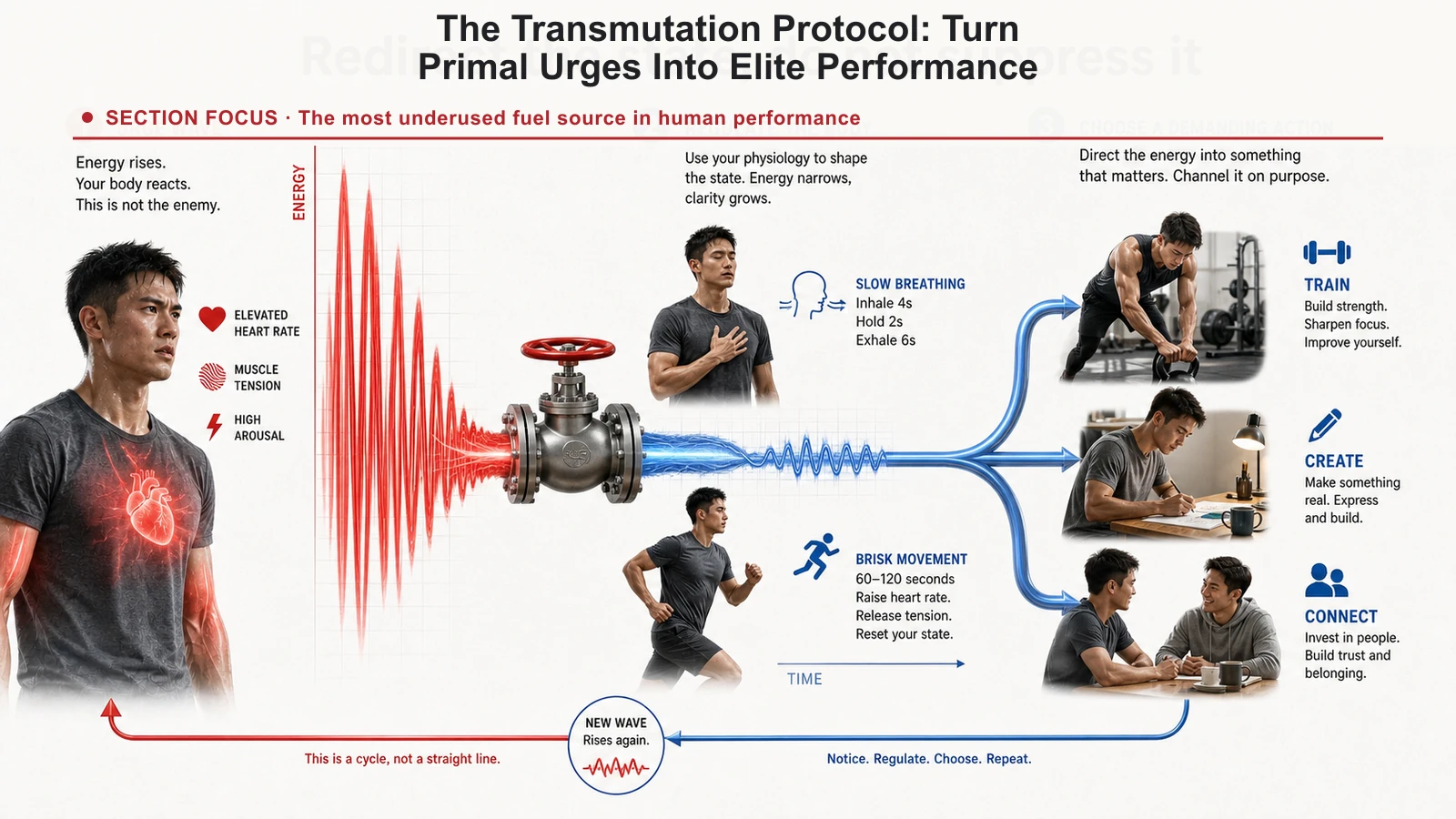
In 1937, Napoleon Hill published Think and Grow Rich, which went on to become one of the best-selling self-help books of the century. Buried in it was a strange, specific claim: that the outsized success of the men he studied, Edison, Ford, Carnegie, traced back to something he called "sexual transmutation," the deliberate redirection of intense biological drive into their life's work.
Sigmund Freud landed on a similar idea decades earlier and called it sublimation: converting raw biological impulse into something culturally productive. Carl Jung took the idea further still. For most of a century this sat in an awkward gray zone between psychology and mysticism, usually dressed up in language about chakras and rising "energy" that made it easy to dismiss.
Modern neuroscience has cleared away the mysticism and left the mechanism intact. Transmutation isn't metaphysics. It's endocrinology, and once you see how it actually works, you can start using it on purpose.
What "sexual energy" actually is, biologically
Strip away the vague language and you're left with a specific physiological state: high mobilization, high arousal, high metabolic availability. When your limbic system fires this up, three things happen at once:
- Dopamine floods the nucleus accumbens, sharpening focus and generating real craving.
- Adrenaline and norepinephrine spike, raising your heart rate, opening your airways, and sharpening your senses to prepare you for action.
- Glucose gets released from storage to supply the energy for whatever's coming next.
Feeling "wired," restless, or sexually charged is your body producing one of the most potent fuel mixtures it has. The engine's revving in neutral, and it wants to be put into gear.
Spend that charge on a screen and it just dissipates as waste heat. You end up drained, foggy, unmotivated, and the dopamine system you just overstimulated quietly turns down its own sensitivity in response (this is covered in detail in Anna Lembke's Dopamine Nation).
So what happens if you don't take the shortcut?
The three-step protocol
Transmutation, stripped down, is just redirecting dopamine-driven craving from one circuit into another. You take the elevated heart rate, sharp focus, and available glucose meant for one kind of release, and push that same fuel through your muscles or your mind to get something hard done instead.
Step one: notice the agitation. The urge shows up. You feel restless, distracted, keyed up. Your sympathetic nervous system is fully online and demanding relief. The instinctive read is "I'm distracted." The more accurate read is "fuel just entered my bloodstream." That reframe alone changes what happens next.
Step two: let your prefrontal cortex override it. This is the brain's executive control center, and it has to actually engage and say no to the shortcut. Research on delay of gratification, including a well-known Cornell study that re-tested people forty years after the original "marshmallow test," found that activity in this exact region predicts how well someone can override an impulse in the moment. This step is uncomfortable. You're sitting on a reservoir of real, mobilized energy, and you can't meditate it away because it's too active for that. It has to go somewhere.
Step three: burn it off. Redirect the arousal into something that actually demands it.
- Physically: heavy lifting, sprints, combat sport. Your muscles will happily consume circulating glucose and adrenaline directly.
- Mentally: deep, hard cognitive work, writing, coding, strategy, real learning. Your brain already eats up roughly a fifth of your total energy use, and focused effort burns through the same mobilized fuel via a different final pathway.
Push the task through to completion and your brain still delivers its reward, dopamine, endorphins, serotonin, just earned through output instead of handed over for free. You gave your brain the chemical hit it wanted. You just made it build something to get there.
What compounds over months
Keep this up consistently and three durable changes show up. None of them are mystical. All of them are measurable.
A stronger prefrontal cortex. Every override is a rep for your executive-control circuit, and repetition strengthens whatever fires most. Over months, overriding an impulse stops feeling like effort and starts feeling like default behavior. Stan goes deeper on this in his piece on why willpower is the wrong target.
Dopamine receptors recovering. Starve your reward system of cheap, oversized stimuli and dopamine receptor density tends to climb back toward baseline. Ordinary things, books, work, a real conversation, start feeling textured again instead of flat.
A steadier, more grounded presence. As cortisol normalizes and the spike-and-crash cycle fades, the low-grade neediness that quietly repels people tends to fade with it. Posture opens up. Your voice settles. Eye contact gets easier. You start reading as someone who doesn't need anything from the room, which people notice, even if they couldn't say why.
The connection to the bigger picture, dopamine sensitivity, meaningful struggle, real connection, is laid out in our piece on the Dream Life Formula.
The bottom line
Your primal drive is one of the most potent biological forces you have access to. It's built empires, cathedrals, relationships, and plenty of the bodies you'd actually want to have.
You can spend it carelessly on a screen and stay mildly drained and reactive. Or you can sit with the discomfort for a minute, use it on purpose, and put that relentless energy toward something that actually compounds.
The hard part is the override, not the theory. The path of least resistance is always the cheap version. TaskCoach.AI handles the metabolic-burn-off side of this structurally: the morning task pre-load surfaces the highest-value work that can actually absorb that mobilized energy, with almost no friction between deciding and starting. Related reading: our pieces on the dopamine detox protocol and movement and the ADHD brain cover the physical side of this same substrate.
Transmutation was never about suppressing your nature. It's about pointing it somewhere on purpose.