You can collect self-improvement methods faster than you can use them. One notebook holds a life audit. Another has a half-finished vision board. Your habit app remembers a routine that no longer serves the goal written in your planner.
Each tool may be useful. Progress usually disappears during the handoff to the next one.
A life transformation toolkit solves that handoff problem. Diagnosis produces a direction. Direction produces a behavior. Behavior produces evidence. A weekly review sends that evidence back through the system.
The eight tools at a glance
This toolkit mixes research-backed behavior techniques with practical coaching and planning tools. They do different jobs, so forcing them into one giant morning ritual would miss the point.
| Stage | Tools | The output you need |
|---|---|---|
| Diagnose | 1. Life audit, 2. Wheel of life | One bottleneck supported by recent evidence |
| Choose direction | 3. Challenging goal, 4. Mental contrasting | A target, the real obstacle, and a plan for it |
| Design behavior | 5. Implementation intention, 6. Tiny anchored habit, 7. Identity evidence | A cue, a small action, and a way to count showing up |
| Review | 8. Weekly review | One adjustment for the next seven days |
The life audit and wheel often act as alternatives. The vision-board piece is optional. Most people need four or five tools active, with the others available when a specific gap appears.
Stage 1: diagnose before you choose a goal
A life audit asks you to inspect the major areas of your life and support each score with evidence from the last 30 days. Sleep times, conversations, completed work, spending, movement, and time off tell a more useful story than whichever mood happened to arrive with the worksheet.
The output should be one bottleneck. Look for the area creating the most spillover. Poor sleep can weaken Career, Mind, and Social at once. Financial pressure can occupy attention far beyond the Wealth pillar. Fixing the upstream problem usually beats adding a goal to every category.
The wheel of life assessment displays the same diagnosis as a shape. Its strength is visual speed: one collapsed spoke becomes obvious. Its scores remain subjective, and the wheel is a coaching heuristic rather than a validated psychological test. Score importance beside satisfaction so a deliberately quiet area does not become fake urgency.
Stop diagnosing once you can complete this sentence:
The next area I will strengthen is [pillar], because the last 30 days show [evidence], and improving it would reduce pressure on [other area].
That sentence is the handoff to goal-setting.
Stage 2: turn the diagnosis into direction
Locke and Latham's goal-setting research consistently favors goals that are specific and challenging over vague instructions to do your best. Difficulty alone does not carry the effect. Commitment, feedback, ability, and access to the required resources all matter.
Turn the diagnosis into a target you can inspect. "Improve my health" gives you no finish line. "Average seven hours of sleep for five nights a week by the end of August" gives you a direction and a feedback signal.
Then name the obstacle before optimism edits it out. Gabriele Oettingen's mental contrasting pairs the desired outcome with the internal barrier most likely to block it. WOOP packages the sequence as Wish, Outcome, Obstacle, Plan.
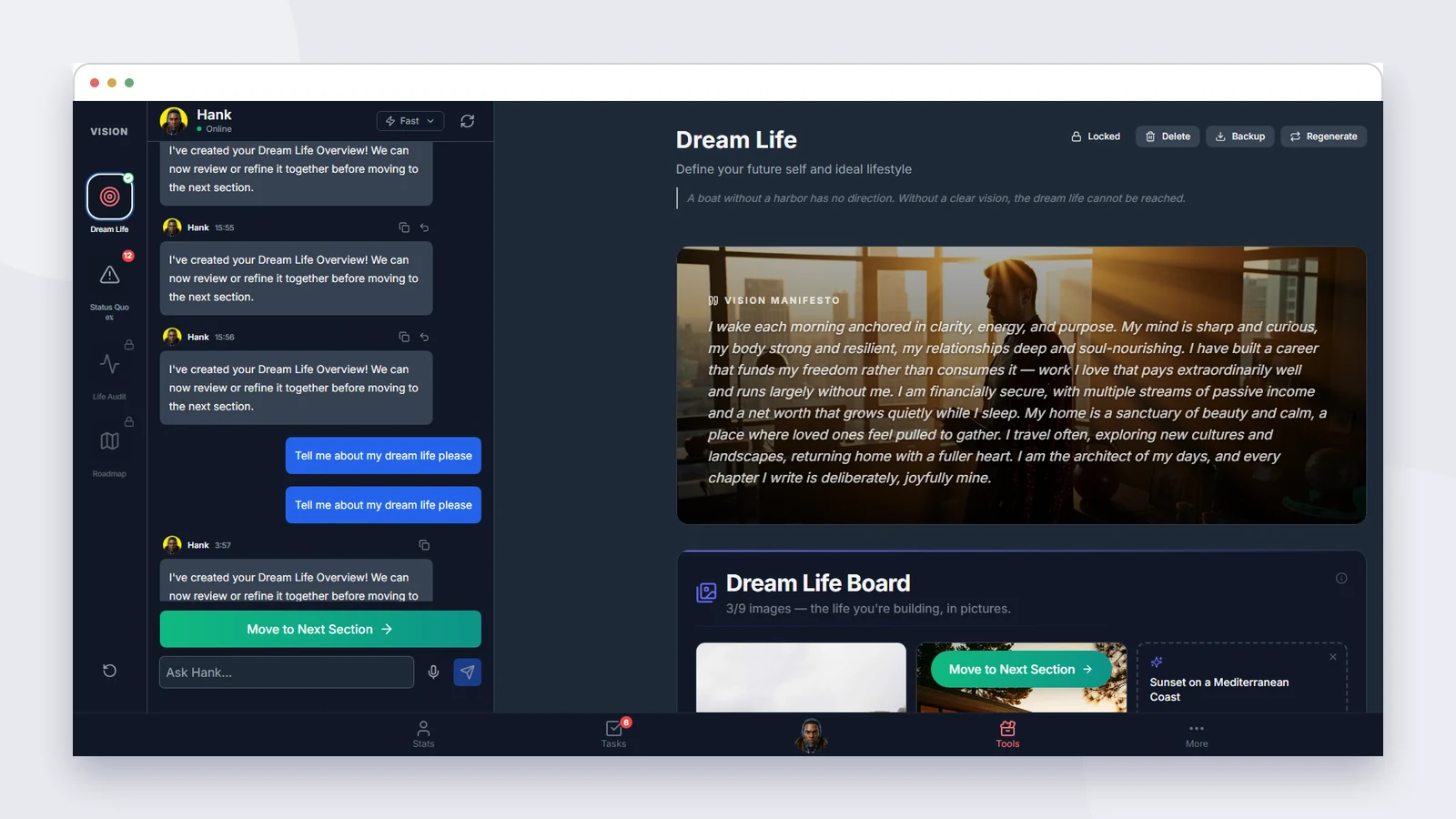
A useful digital vision board follows the same rule. Show the future, then show the process and obstacle beside it. Research comparing outcome and process simulation found better preparation when people rehearsed the work required rather than enjoying the imagined result alone.
Your direction stage should end with three lines:
- Target: the result and deadline.
- Obstacle: the recurring internal or environmental barrier.
- Response: what you will do when that barrier appears.
Stage 3: design behavior for an ordinary day
A goal still needs a moment when action begins. Implementation intentions provide a rigid handoff:
WHEN [specific situation], THEN I will [specific behavior].
Gollwitzer and Sheeran's meta-analysis pooled 94 studies and found a meaningful positive effect on goal attainment. The technique works by making the cue easier to notice and preselecting the response before the moment becomes negotiable.
"When I have time, I will exercise" contains no observable cue. "When I close my laptop on Monday, Wednesday, and Friday, I will walk for ten minutes" does.
Habit stacking strengthens the cue by attaching the action to something that already happens. BJ Fogg's behavior model says behavior depends on motivation, ability, and a prompt arriving together. Ability is the lever you can stabilize: shrink the action until a tired version of you can still begin.
- After I pour coffee, I will write one sentence.
- After I brush my teeth, I will lay out tomorrow's medication.
- After I close the dinner dishes, I will walk to the end of the street.
The tiny action is a floor, not a ceiling. Continue when energy is available. Count the floor as a successful start.
Identity-based habits add a useful tracking lens. The phrase was popularized in modern habit writing rather than established as a separate psychological theory. Its practical value lines up with self-efficacy research: repeated experiences of following through can change what you believe you are capable of doing.
Track the evidence precisely. "I am becoming a writer" is supported by opening the document and writing. It does not require pretending the book already exists.
Stage 4: close the loop every week
Plans decay quietly. A cue stops fitting the schedule. A goal survives in the app after your priorities have changed. A habit produces activity without moving the outcome.
A weekly review catches those mismatches while they are still cheap. David Allen made the ritual central to Getting Things Done because a planning system only earns trust while it reflects reality.
Keep the review short enough to survive a bad week. Fifteen minutes and three questions are enough for the core loop:
- What happened? Look at completed actions, missed cues, and relevant outcome data.
- Where did the handoff fail? Diagnose the goal, obstacle, cue, action size, or schedule.
- What changes next week? Choose one adjustment and put it where it will happen.
Masicampo and Baumeister found that creating a specific plan can reduce the mental interference caused by unfinished goals. The review earns its place by converting vague open loops into clear next actions.
Build the first version in 30 minutes
You can assemble a useful first loop today:
- Ten minutes: audit the major life areas and choose one bottleneck.
- Five minutes: write one specific, challenging target.
- Five minutes: name the most likely obstacle and your response.
- Five minutes: write one when-then plan and shrink the action to a bad-day minimum.
- Five minutes: schedule a recurring weekly review.
Run that version for two weeks before adding another goal or rebuilding the template. Real friction will tell you which tool is missing.
Where TaskCoach fits
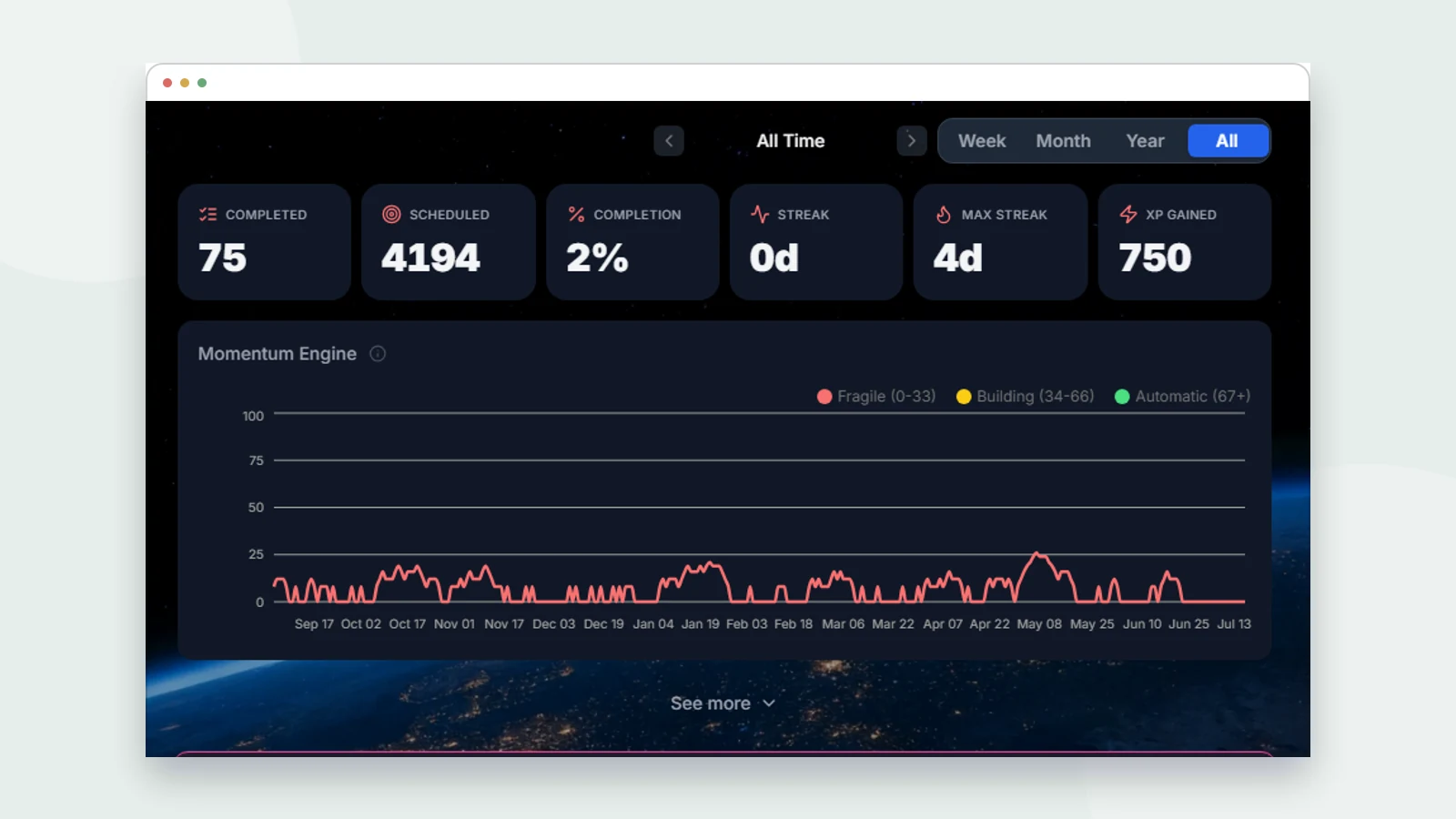
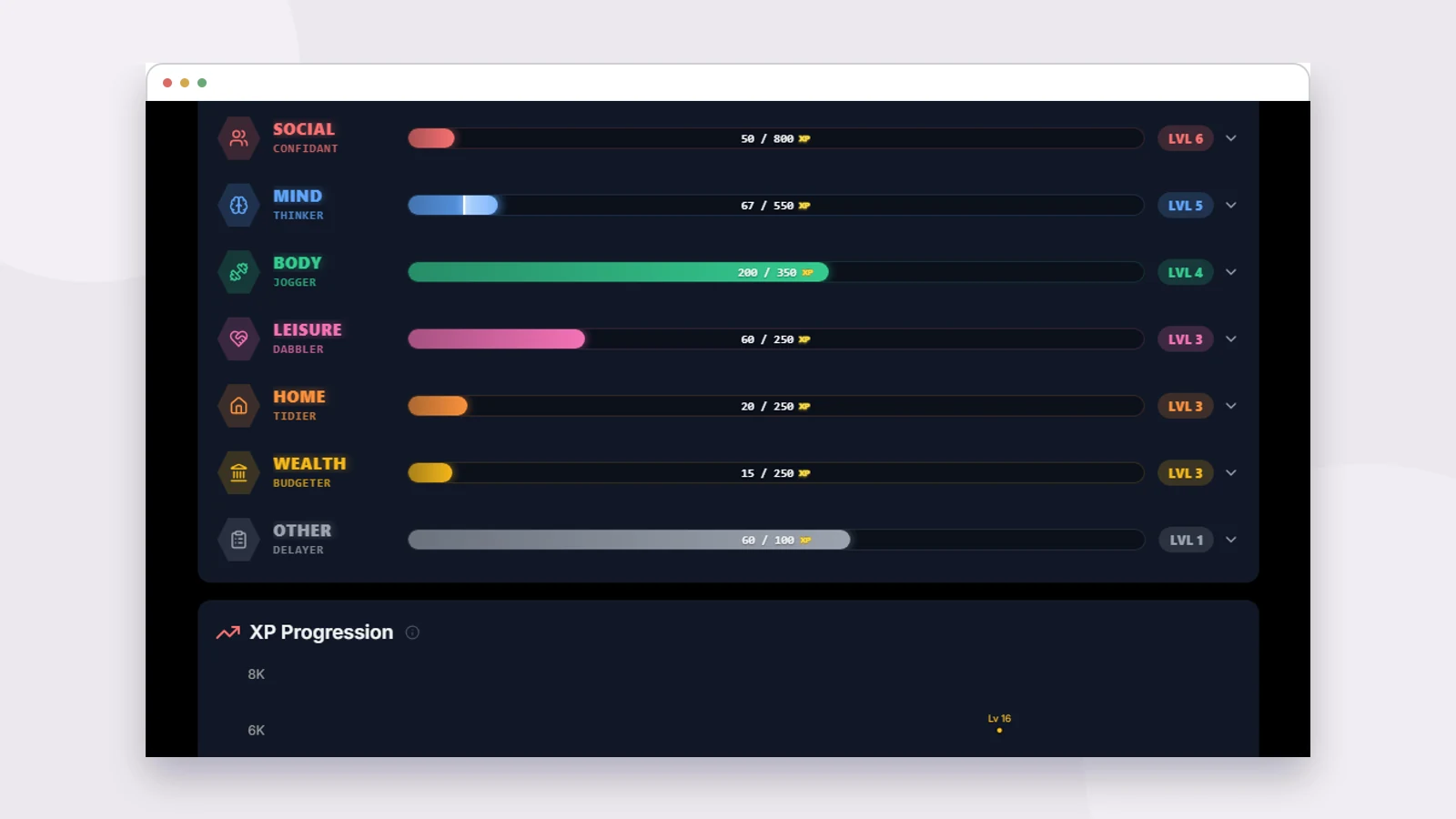
TaskCoach keeps the handoffs visible in one system. Vision moves through Dream Life, Status Quo, Life Audit, and Roadmap. Goals connect to the daily task and calendar surfaces. Habits retain their pillar and momentum history. Analytics and the weekly recap bring recent activity back into the review.
The daily dashboard shows Schedule, Calendar, Habits, and Goals together, which prevents each list from becoming its own private version of your priorities. AI-proposed changes use reviewable diffs for ordinary planning actions, so you can approve or reject them before data changes.
Paper can run the same loop. The tradeoff is maintenance: you must carry each output into the next tool and keep the review current yourself. Software is useful when that repeated wiring is the part that keeps breaking. TaskCoach is free to try.
Common ways the toolkit breaks
Starting with a habit because it feels concrete. Diagnosis and direction give the habit a reason to exist.
Keeping every tool active. The wheel does not need a weekly redraw. The vision board does not need daily editing. Use each tool when its stage needs work.
Treating identity as affirmation. Identity evidence comes from completed behavior, even when the behavior is tiny.
Using the review as a trial. The review investigates the system. Shame produces very little useful diagnostic data.
Adding a second goal before the first loop works. Multiplying a broken handoff creates more places to lose the plan.
The bottom line
The eight tools become useful as four connected stages: diagnose, choose direction, design behavior, and review. Each stage should leave behind something concrete that the next stage can use.
Start with one bottleneck. Build one goal, one obstacle response, one cue-action pair, and one weekly review. Two weeks of that small working loop will teach you more than another weekend spent collecting frameworks.