A kid will grind 400 hours to level a fictional elf
A teenager will sit at a screen for four hundred hours straight, killing the same monsters in the same forest, watching the same numbers climb on the same character sheet, and never get bored.
That same teenager can't make themselves put twenty hours into a real skill that would actually change their life.
The easy explanation is to blame the kid: lazy, no discipline, addicted. That's the wrong diagnosis. Four hundred hours of sustained, voluntary effort is not what a lack of discipline looks like. The brain doing the grinding is clearly capable of focused, sustained effort. What's missing is the engagement architecture the game has and the real skill doesn't.
That architecture has a name: gamification. The video game industry has been refining it since Dungeons & Dragons showed up in 1974, and modern role-playing games have turned it into one of the clearest engagement structures in software.
Once you can see the structure, you can transplant it onto anything. That's what this piece is about.
A note on the neuroscience: this article uses the language of loops and rewards because it is useful for analyzing game design. Dopamine is not a simple pleasure chemical, and a progress-bar movement cannot be assumed to produce a measurable dopamine release. The strongest evidence here concerns feedback, motivation, participation, and learning outcomes, not a universal chemical response.
The dopamine loop behind the grind
The most common misunderstanding about why games can be so compelling is that they simply feel good. Mostly, they don't. Grinding the same dungeon for the tenth time isn't "fun" in any rich sense of the word. It's compelling, which is a different thing entirely.
Dopamine is part of this story, but the pop-science version of dopamine as a simple "pleasure chemical" is wrong. Foundational research on dopamine neurons in primates linked their activity to reward prediction and prediction error. Translating that finding into a claim about a particular app interaction requires caution.

The practical point is simpler. A progress bar filling four percent doesn't deliver the final reward, but it does make improvement visible and confirms that the last action counted.
Many games build around this pattern. The XP number floats up after a kill. The bar visibly extends. You can see exactly how many more actions it takes to level up. Some games add uncertain loot drops on top. By the time the bar overflows into a level-up, the player has received a long sequence of clear feedback. Then a new, slightly longer bar appears, and the loop starts over.
That is one reason a player can grind for hours without getting bored: progress is always visible.
For more on how these loops drive, and sometimes wreck, human motivation, see the molecular mechanics of the high.
The anatomy of a compelling level-up
Strip an RPG down to its bones and you find four mechanisms working together.
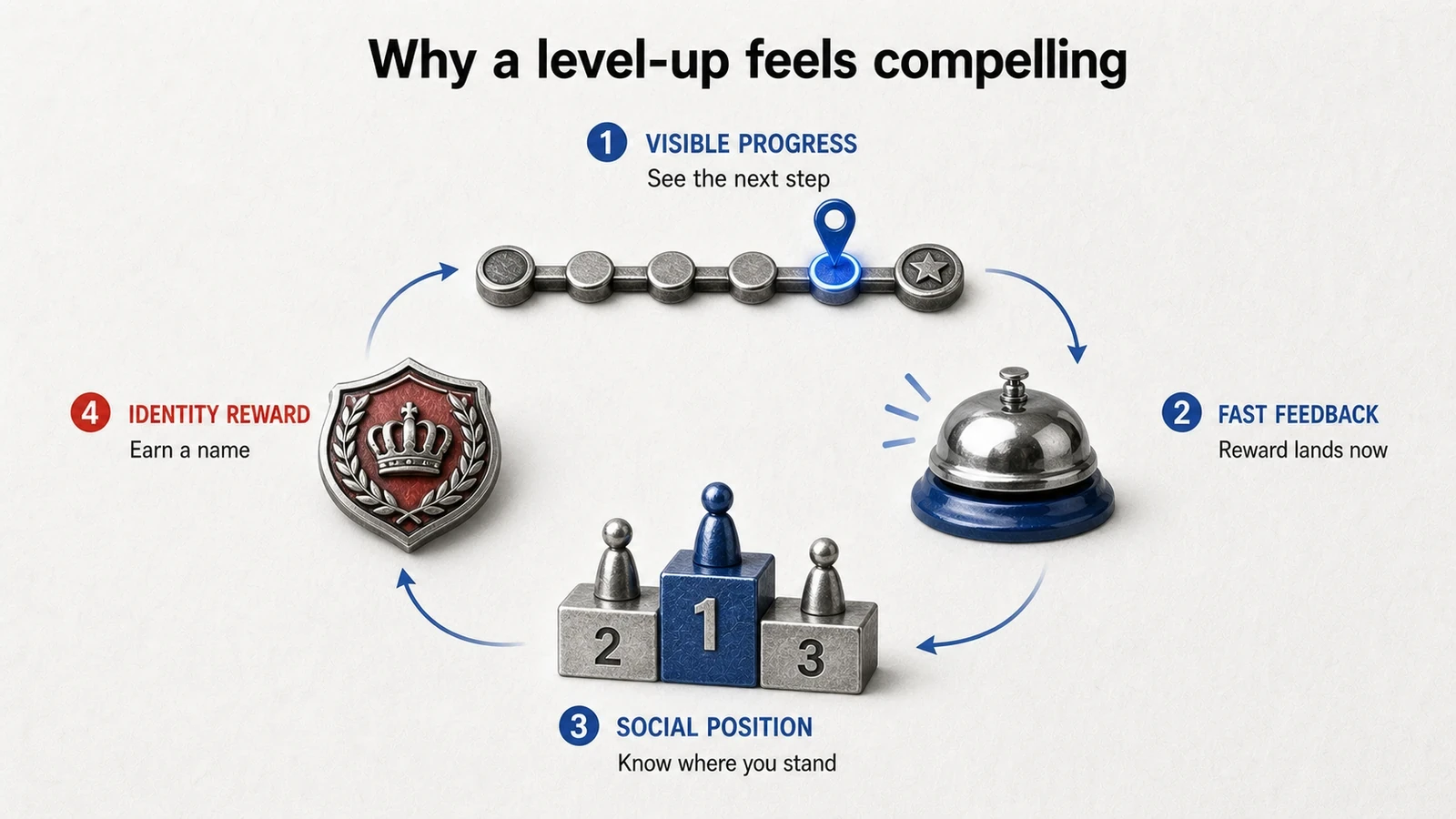
Each pillar alone does very little. The real effect comes from stacking all four.
Visible progression alone gets you a thermometer: informative, but limited.
Immediate feedback alone can become noisy and pointless. Players quit once the novelty fades.
Social ranking alone gets you a leaderboard nobody bothers climbing, because the climb has no texture underneath it.
Identity reward alone gets you a certificate: a one-time event that doesn't compound.
Hit all four at once and you get World of Warcraft. Path of Exile. Diablo. Elden Ring. Forty years of game design has been a slow optimization toward that exact combination.
Why grinding a fictional character feels meaningful
There's a deeper layer most explanations miss: every action in an RPG is a vote.
When you kill a goblin and gain 47 XP, the game is telling you something about who your character has become. Slightly more capable than a minute ago. Slightly closer to the next threshold. Slightly more distinct from the version that started in the tutorial.
That's the identity dimension of gamification, and it's what makes RPGs stickier than puzzle games or arcade games. Tetris is fun, but you don't have a character sheet. You don't become anything while playing it. Stop playing, and nothing is left behind.
In an RPG, when you stop playing, there's a level-47 elven ranger with a specific build, specific gear, a reputation in a specific guild, and 200 hours of accumulated XP sitting behind it. The character is now an asset, a fictional one, but a real cognitive structure all the same. It's the same idea James Clear gets at with identity-based habits: every behavior is a small vote for who you're becoming.
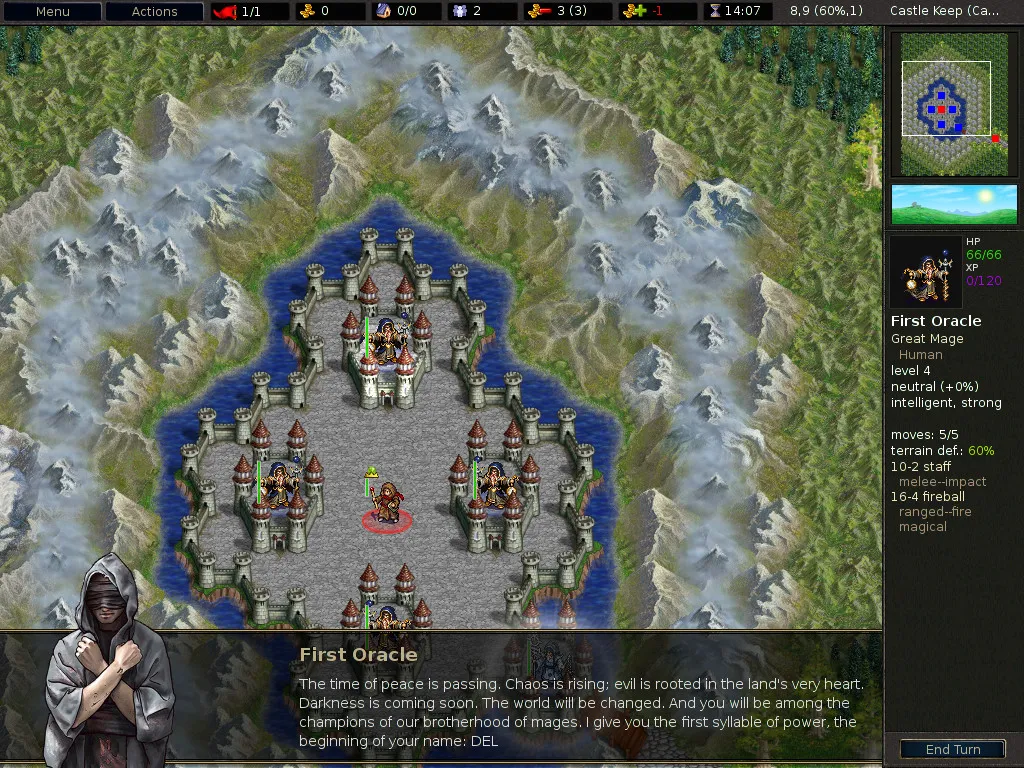
The cruelty of the comparison is this: video games hand you all that vote-counting infrastructure for free. Real life doesn't. Without some kind of external structure, you can run a daily protocol for six months and have no real sense of how much your "build" has changed. The progress is real. The receipts are missing.
That's precisely the gap gamification fills.
Leaderboards: the engine of social comparison
Back in 1954, social psychologist Leon Festinger published his theory of social comparison. The core finding has held up for seventy years: people judge their own performance mainly by comparing it to others. A number sitting alone rarely moves behavior the way the same number sitting next to other people's numbers does.
That's why leaderboards work. They take a private statistic (your streak, your reps, your XP) and turn it into a public position. The number alone is forgettable. The position is something you remember, and want to defend.

A solo XP counter tells you "you scored 4,732." A leaderboard tells you "you're #14, and #13 is 100 points away." That second sentence is the one that actually pulls behavior. The first one barely registers. That shift, from a private number to a public position, is one of the most reliable levers in modern product design.
Self-determination theory: the three needs games hit by accident
The psychological framework underneath all of this is Self-Determination Theory, developed by Edward Deci and Richard Ryan. Decades of research point to three needs that have to be met before people sustain motivation on their own:
- Autonomy: you chose this, nobody made you.
- Competence: you can see yourself getting better.
- Relatedness: you're not doing it alone.
RPGs hit all three, mostly by accident:
- Autonomy: you chose to roll the rogue. You chose the dual-wield build. You chose to grind that specific dungeon for that specific drop. The branching choices exist specifically to maximize your sense of self-direction.
- Competence: XP, levels, gear score, raid clear logs. There's no ambiguity about whether you're improving. The numbers are the proof.
- Relatedness: guild chat, raid groups, PvP teams. Even solo RPGs lean on asynchronous relatedness through leaderboards and shared challenges.
Hit all three and engagement compounds. Hit only one and the lift is small, sometimes negative. Our deeper dive on SDT goes further into the mechanics.
This is exactly where most "real-world gamification" falls apart. A points system bolted onto mandatory corporate training hits zero of the three needs: it's not autonomous (you were forced into it), it doesn't build competence (the points are flat-rate regardless of effort), and it's not related (you're doing it alone). The predictable result: still nobody does it.
The evidence base
Everything above is proposed mechanism. The outcome research is encouraging, but more conditional than the strongest gamification claims suggest.
Meta-analyses and systematic reviews spanning many studies report positive average effects on motivation, learning, and some health behaviors. They also report meaningful variation by context, mechanic, duration, and outcome. That makes design quality and measurement more important than the label "gamification."
The strongest single study is a six-month randomized controlled trial out of the University of Pennsylvania, published in JAMA Internal Medicine. Researchers put 200 people from 94 families through a step-tracking program. Half got a game layer on top: points, levels, and team challenges built around daily step goals. Half just got the plain step counter. The families with the game layer hit their daily step goal on 53% of days, compared with 32% for the group without it. The gap didn't disappear the moment the intervention ended, either. The gamified group kept walking measurably more through a 12-week follow-up after the game layer was switched off, even as the advantage gradually faded.
The signal across this research is conditional: some gamified systems improve participation and outcomes, while others produce small, temporary, or negative effects. The gap between bolt-on badges and thoughtful design explains why both the enthusiasm and the criticism persist.
What good gamification looks like
The research is unusually clear on five design rules.
1. Visible progression on goals the user actually picked. The progress should sit on top of something the user chose, or the system risks undermining autonomy. That's the difference between supportive feedback and a controlling mechanic.
2. Rewards calibrated to effort. Flat-rate rewards, where every action pays the same XP, destroy the competence signal. If a 30-second task and a 3-hour task pay identically, the score stops carrying useful information. RPGs get this right naturally: a level-3 monster gives less XP than a level-30 boss.
3. Identity-level milestones, not just numbers. "Level 47" is informative. "You are now a Master Smith" changes your identity. Every threshold should change what the user is called, not just the number next to their name. This is the part that compounds over years.
4. Social ranking through a winnable comparison. Festinger's social comparison only motivates when the comparison feels climbable. Tiered leagues (chess ELO, ranked divisions, Duolingo leagues) work because you can always see a realistic next tier. Global leaderboards don't work, because you only ever see an unreachable top.
5. Avoid rewarding what people already loved doing. Psychologists Mark Lepper, David Greene, and Richard Nisbett found that rewarding a behavior someone already enjoyed can reduce their motivation once the reward stops, the so-called overjustification effect. Save gamification for the behaviors people struggle to start, not the ones they'd do anyway.
How TaskCoach.AI implements the RPG architecture
Every design choice in TaskCoach.AI maps back to one of the four pillars, or one of the three SDT needs:
- XP attaches to habits and tasks you chose, never the system's chores. Autonomy first.
- Visible progression on every action. XP floats up, and pillar bars tick toward the next level. Every meaningful action receives immediate feedback.
- Rewards scale with effort. Harder habits earn more XP, so the reward actually carries information about what you overcame.
- Pillar levels across Body, Mind, Career, Wealth, Social, Home, and Leisure work like a character sheet, but for the parts of life you actually care about.
- Rank thresholds that mark identity: Initiate, Operative, Specialist, Elite, Apex. Crossing the line changes what you are, not just your score.
- Leaderboards turn a private number into a public position next to other players, keeping Festinger's social-comparison engine in its motivating range instead of its demoralizing one.
- An AI coach companion covers the relatedness need without forcing you into stranger-leaderboard dynamics.
It's the RPG engine, pointed at seven life pillars instead of a fictional kingdom.
The bottom line
A kid will grind 400 hours to level a fictional wizard from 47 to 48. The same brain refuses to put 20 hours into a real skill.
The brain works fine. The architecture is missing.
Forty years of competitive pressure in the game industry has produced one of the most engineered engagement loops in modern software: visible progression, immediate feedback, social structures, and identity-level milestones. Dopamine research helps explain reward learning, but it does not reduce the whole experience to one chemical switch.
Done well, gamification is the structural transplant of that engine onto behaviors that matter. Meta-analyses, systematic reviews, and randomized trials show that the category can work. They do not show that every mechanic works for every person or that engagement automatically becomes durable behavior change.
The skeptics are right that bolt-on points systems often fail. The evidence also gives designers good reason not to dismiss every form of gamification.
If you've ever wondered why you can sink a thousand hours into a video game while abandoning every real goal you set this year, the answer is architecture: one of them was built on forty years of psychological optimization, and the other wasn't. The fix is putting your actual life inside the engine.