Tennessee, 1944: the brace comes first
Wilma Rudolph was four when polio weakened her left leg. She had already survived double pneumonia and scarlet fever. Born prematurely at four and a half pounds, she had spent much of early childhood ill.
The diagnosis came with a bleak forecast. A doctor told her family she might never walk normally. Her mother, Blanche, heard that prediction and started looking for another path.
That search was harder than it sounds from a modern waiting room. The Rudolphs were a Black family living in segregated Tennessee. Clarksville did not have a hospital that would treat Wilma, so Blanche took her by bus to a clinic in Nashville. The trip became a weekly routine.
The clinic supplied expertise. Most of the work happened at home.
Rehabilitation became a family system
Rudolph grew up in a very large family. Her parents and siblings learned the massage and exercise routine prescribed for her leg, then took turns doing it several times a day. They removed the brace, worked the muscles, replaced it, and repeated the process.
There was no dramatic afternoon when one treatment fixed everything. Progress arrived in small physical changes. Rudolph learned to move with the brace, then to balance, then to walk with less support.
By 11, her mother found her playing basketball outside. By 12, she could walk without the metal brace or orthopedic shoe.
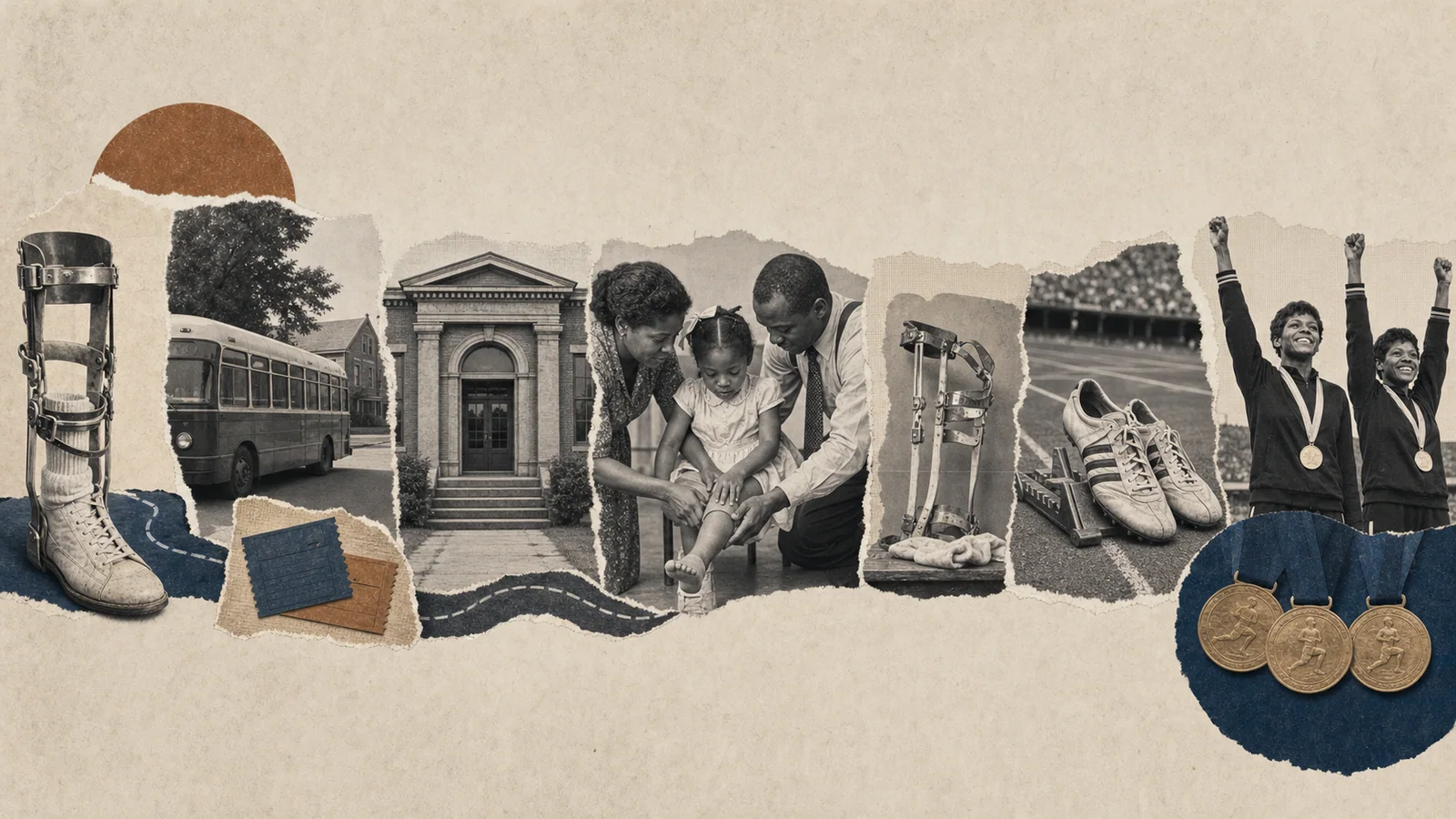
The clean version of this story says that Wilma beat polio. The useful version keeps the other people in the frame. A determined child did the work, and a family supplied transport, care, repetition, and belief for years before a track coach ever saw her run.
Walking led to basketball, then track
Once Rudolph could move freely, she wanted to play.
She became a standout basketball player at Burt High School in Clarksville. Her speed caught the attention of Tennessee State track coach Ed Temple, who ran the Tigerbelles, one of the strongest women's track programs in the country.
Temple invited her to train with college athletes while she was still in high school. The sessions were demanding and precise. Starts, stride mechanics, relay exchanges, recovery, then the same details again the next day.
At 16, Rudolph qualified for the 1956 U.S. Olympic team in Melbourne. She did not advance from the 200-meter heats, but the 4x100-meter relay team won bronze.
Pause on that timeline. A girl who had needed a leg brace was an Olympic medalist roughly four years after learning to walk without it.
Bronze did not end the project. It gave her a sharper target.
Motherhood and the second Olympic cycle
Rudolph became pregnant during her final year of high school and gave birth to her daughter, Yolanda, in 1958. The event interrupted her basketball path and complicated training, but she returned to the track.
She enrolled at Tennessee State, trained with the Tigerbelles, and rebuilt her race fitness. By 1960 she was one of the fastest sprinters in the world.
The Rome Olympics would be among the first Games carried to a large international television audience. Rudolph arrived at 20 years old, a Black woman from the segregated American South, racing under more public attention than she had ever experienced.
She won the 100 meters. Her 11.0-second final was faster than the listed world record, though the following wind made it ineligible for record status.
She won the 200 meters after setting an Olympic record in the preliminary round.
Then she anchored the United States to gold in the 4x100-meter relay.
Three events. Three gold medals. Rudolph became the first American woman to win three golds at a single Olympic Games and was widely called the fastest woman in the world.
The homecoming mattered too
Clarksville planned a parade and banquet when Rudolph returned from Rome. City events were still segregated.
Rudolph refused to attend unless both celebrations were open to Black and white residents together. The city changed the plan. Her parade and banquet became Clarksville's first integrated public celebrations.
That decision belongs in the transformation story. Speed gave her a platform, and she used it immediately. She did not accept a ceremony that praised a Black champion while excluding Black neighbors.
Rudolph retired from competition in 1962 while still holding world records. She finished her degree, taught school, coached track, worked with community programs, and later founded an organization supporting young athletes.
The medals were the most visible result. The longer result was a life spent widening the path behind her.
What actually changed across those 16 years
The distance from a polio diagnosis at four to Olympic gold at 20 looks impossible when compressed into one sentence. Broken into stages, the mechanism becomes clearer.
Medical care created the first opening. Blanche Rudolph found a clinic that would treat her daughter despite a segregated health system.
Family repetition turned instructions into progress. The treatment plan worked because people at home kept doing it between appointments.
Play became the bridge into training. Basketball gave Rudolph a reason to use her recovered movement before track gave that movement a competitive direction.
Expert coaching refined raw speed. Ed Temple and the Tigerbelles supplied technique, standards, and teammates strong enough to make an Olympic pace normal.
One Olympic cycle informed the next. Melbourne gave Rudolph a bronze medal and direct evidence about the gap between qualifying and winning. Rome came four years later.
Each stage depended on the one before it. None required pretending the brace, segregation, motherhood, or training load did not exist.
What this story does not prove
Rudolph's outcome was extraordinary. It should not be turned into a claim that determination can reverse every disability or illness.
Polio affects people differently. Access to treatment matters. Family support matters. Biology matters. Many people can do every part of rehabilitation correctly and still live with lasting impairment.
Rudolph's story supports a narrower and more practical claim: a prognosis describes the evidence available at one point in time. It does not perform tomorrow's work for you.
If you are recovering from an illness or injury, use a qualified clinician and a plan built for your body. A historical champion is evidence that patient rehabilitation can matter, not a safe medical protocol to copy.
Turning this into something you can use
If you are facing a long physical rebuild:
- Define the next physical ability. Start with walking to the corner, completing the prescribed exercise, or training twice this week. Olympic goals come later.
- Bring the plan home. A weekly appointment cannot carry a transformation by itself. Ask exactly what to repeat between visits and how often.
- Recruit practical support. Transport, reminders, childcare, and company count. Rudolph's family supplied the infrastructure that made consistency possible.
- Move from recovery into play. Find an activity you want to do, not only a test you need to pass. Enjoyment gives rehabilitation somewhere to go.
- Review after a full cycle. Melbourne did not settle Rudolph's ceiling. It showed her what the next four years needed.
What TaskCoach.AI does with this
A long rehabilitation goal needs more than a finish date. You can break it into clinician-approved exercises, recurring appointments, weekly training targets, and milestone abilities, then keep each next action visible in your plan.
The app cannot provide medical care, transport, or family support. It can hold the routine those people agree on, record what happened, and make the next review easier to prepare for.
The bottom line
Wilma Rudolph wore a metal leg brace as a child. At 16 she won Olympic bronze. At 20 she left Rome with three gold medals.
The years between those facts were filled with bus trips, family massage sessions, basketball games, track drills, motherhood, and two Olympic cycles. Her transformation had a remarkable athlete at its center and a large support system underneath it.
That is the part worth carrying forward. Big change often looks individual from the podium. Up close, it is usually a long chain of care, practice, coaching, and opportunities that someone kept choosing to use.