ADHD burnout is not what your HR department thinks it is
Ask an HR department what burnout looks like and you'll get the textbook picture: too many hours, not enough recognition, a slow slide into cynicism about the job. That picture comes from real research, and it's accurate for a lot of people. It's also not what's happening when an ADHD brain burns out, and treating the two as the same thing is a large part of why standard burnout advice quietly fails so often.
Regular burnout, as defined by Christina Maslach's research and now formally recognized by the World Health Organization, is a workplace syndrome with three signatures: exhaustion, cynicism, and a sense that you're no longer good at your job. It responds reasonably well to the standard interventions: time off, a lighter workload, a different role.
ADHD burnout is a different animal. It's the executive-function system itself collapsing under a compensatory load that's been running for months, sometimes years. Time off doesn't fix it the same way, because what's actually depleted isn't just energy. It's dopamine, norepinephrine, working memory, and emotional regulation, all running low at the same time.
Recovering from it takes a different plan.
How ADHD burnout actually builds
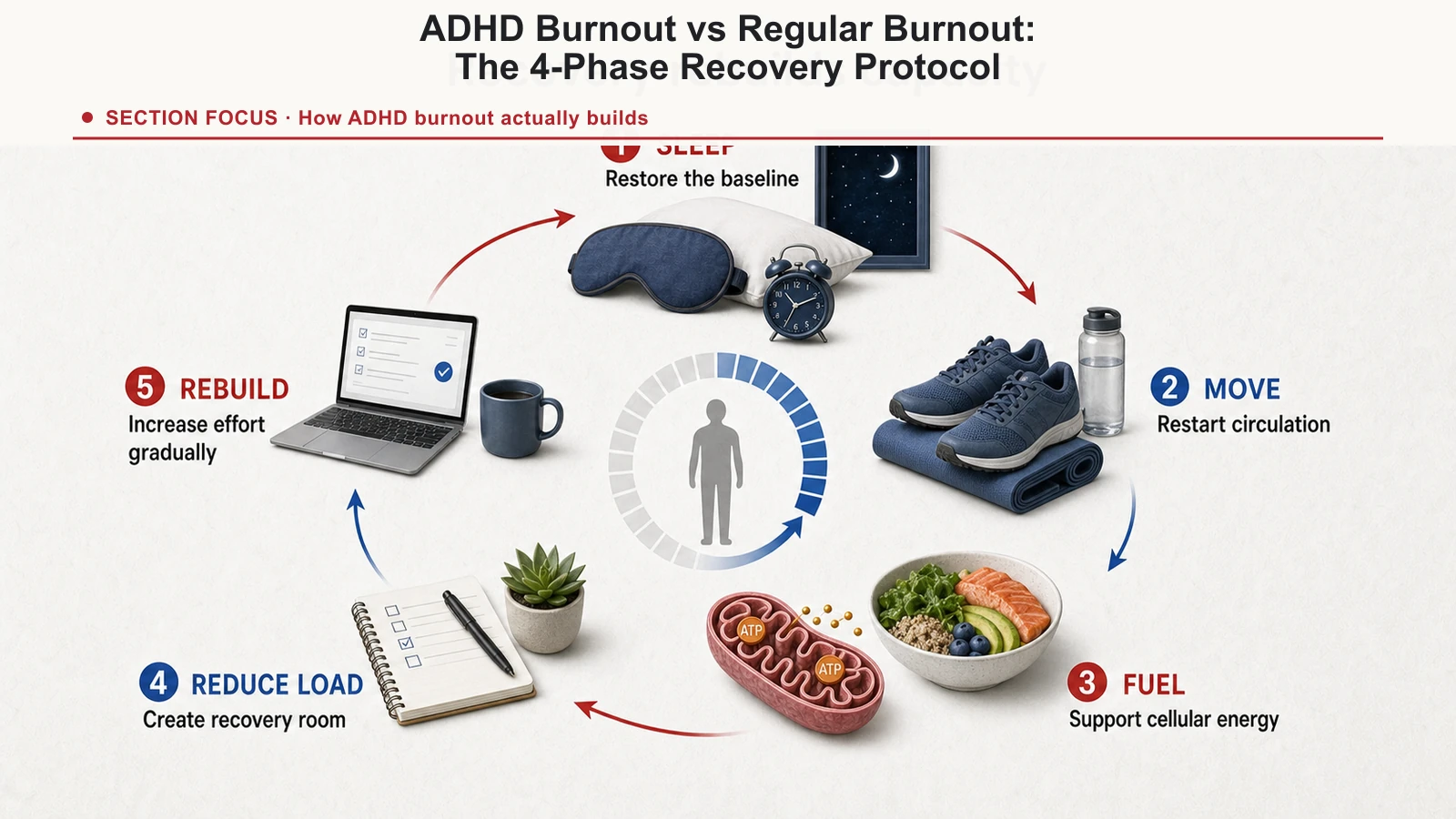
The pattern below draws on Russell Barkley's executive-function model of ADHD and on decades of adult-ADHD coaching literature, including Kate Kelly and Peggy Ramundo's You Mean I'm Not Lazy, Stupid, or Crazy?!.
Phase 0, the compensatory baseline. Adult ADHD survival usually runs on chronic overcompensation you've stopped noticing. You build elaborate external systems. You over-prepare for meetings that didn't need it. You quietly re-read every email three times before sending. You mask time blindness with a level of calendar discipline nobody else around you has to maintain. None of it looks like effort from the outside. It's expensive anyway.
Phase 1, load accumulation. Something stretches the compensation system past its usual range: a demanding project, a new baby, a partner's illness, a move. The compensating continues, but the margin for error keeps shrinking.
Phase 2, executive depletion. The brain's regulation capacity runs out faster than it can refill. Working memory drops. Starting tasks gets harder. Emotional regulation goes first, and everything built on top of it starts to wobble too.
Phase 3, collapse. Everything that was carefully masked becomes visible all at once. Objects get lost. Appointments get missed. Tasks freeze mid-thought. Sleep falls apart. This phase gets misdiagnosed constantly, usually as depression, generalized anxiety, or plain old "regular" burnout.
The collapse looks sudden, but the real cause was the previous eighteen months of compensatory load. Standard burnout literature doesn't really have language for this pattern, because it wasn't written with ADHD brains in mind.
Why the standard advice doesn't work here
"Take a vacation, cut your workload, talk to your manager" fails ADHD burnout for three specific reasons.
Rest alone doesn't restore dopamine function. Time off lets your body recover, but it doesn't rebuild the dopamine receptor sensitivity that chronic overstimulation, sleep debt, and the ultra-processed eating patterns that often ride along with ADHD burnout tend to wear down. The receptors need active intervention, not just a week at the beach. Our piece on the dopamine detox protocol covers the receptor-restoration side of this in more depth.
Reducing the external load exposes an internal one. Plenty of ADHD adults discover during burnout that what they assumed was workplace stress was actually the cost of running their own compensatory systems all day, every day. Take the job away and the executive-function shortfall is still sitting there underneath it, which is why ordinary burnout recovery so often stalls out halfway.
The compensation systems need rebuilding, not retiring. Most ADHD burnout involves a collapsed external system, whatever combination of Notion, calendar, and task list was being held together by pure willpower. What you need on the other side isn't no system. It's a more sustainable one.
The 4-phase recovery protocol
Built from clinical ADHD coaching practice and current executive-function research. Each phase runs roughly three to four weeks.
Phase 1: stabilize the floor (weeks 1-3)
The first job is restoring the substrate. Not productivity. Not the project. Just the substrate underneath both.
- Sleep. Eight-plus hours, a consistent bedtime, no screens for the sixty minutes before bed. This is the single most effective move available. Sleep researcher Matthew Walker's work makes the case well: consistent, sufficient sleep is the fastest lever there is for restoring a depleted brain, and even a couple of weeks of real consistency produces a measurable difference.
- Movement. Thirty minutes daily of low-intensity aerobic activity: walking, cycling, swimming. This isn't training. It's restoring a baseline.
- Food. Cut the ultra-processed stuff during this phase and anchor meals around protein. The dopamine system needs the raw material to work with.
- Social contact. One real conversation a day. Connection compounds across days more reliably than most people expect (our piece on the connection audit walks through why).
Productivity target for this phase: roughly 30% of your baseline. Anything more is too soon.
Phase 2: restore dopamine sensitivity (weeks 4-6)
The receptors need active intervention here, not just time passing. Run the protocol from our piece on the dopamine detox. The first week is the hardest one. The rebound that shows up around days 14 to 21 is real, and it's worth waiting for.
Productivity target: roughly 50% of baseline.
Phase 3: rebuild the external architecture (weeks 7-9)
This is where the collapsed compensation system gets replaced with something that can actually hold weight. Run the externalization approaches from our pieces on the ADHD tax and on fixing object permanence.
The goal is an architecture that runs without needing conscious effort behind it: pre-loaded daily tasks, externalized memory, low-friction micro-commitments, streaks that protect themselves.
Productivity target: roughly 75% of baseline.
Phase 4: re-engage at full capacity (weeks 10-12)
Only once the substrate is restored and the architecture is actually in place do you return to full output. The architecture is the safety net underneath all of it. Skip building it and the whole cycle repeats.
Productivity target: 100% of baseline, and sustainably this time.
Where TaskCoach picks up
Phase 3 is the hardest part of this whole recovery, because rebuilding an external architecture while you're still depleted is genuinely difficult. TaskCoach.AI was built around exactly this problem: the architecture pre-loads itself, the AI sequences the day's tasks, the dashboard tracks your balance across 7 life pillars, and the streak system protects against relapse.
This isn't a burnout cure, and we wouldn't claim it is. It's scaffolding that keeps the recovery from quietly collapsing again around week eight.
The bottom line
ADHD burnout isn't regular burnout with extra drama attached. It's a structural executive-function collapse that takes something like twelve weeks to recover from, not two. The compensation system that got you into this state won't be the thing that gets you out of it. Replace it with something more sustainable.
Stabilize the floor. Restore the receptors. Rebuild the architecture. Then re-engage at full capacity.
That's the whole protocol. Run it cleanly and the collapse becomes a one-time event instead of a pattern that keeps repeating.