The habit you never had to try for is still alive
Think about the one thing in your life you've never quit. A show you restart every night before bed. A word game you open before you're even fully awake. A walk around the same block, in the same direction, that you never actually decided to start. Some piece of your week just runs on its own. It doesn't ask permission and it doesn't care how tired you are.
Now think about the goal that's been sitting on your list for six years. The body you keep meaning to build. The move you keep meaning to make at work. The book, the savings account, the diet, whichever one keeps dying inside of two weeks.
Same person. Same week. The results aren't even close.
Here's the part that should bother you: the version of you who kept a pointless streak alive for 700 days and the version of you who dropped the goal that actually mattered are running on identical hardware. One of them just has an engine running underneath it, and the other one doesn't.
That engine is what the rest of this is about. Once you see it, "I just need more discipline" stops making sense as an explanation, and something a lot more useful takes its place.

The three phases everyone goes through before this clicks
Getting here usually takes the same predictable route.
Phase one is "I just need to try harder." You read Atomic Habits cover to cover. You build a color-coded dashboard. You set your alarm for 5am. It holds for about two weeks.
Phase two is "I just need a better system." You rebuild the dashboard, buy the app, maybe hire a coach. It works for about four weeks, and somewhere around month two, you quietly stop using it. Same as the last one.
Phase three is the one that actually matters: "The system is the problem." What every one of those systems actually lacked, willpower and your favorite framework included, is the mechanisms that made your pointless streak so hard to break. The streak you kept by accident already has all of them.
Once you can see that difference, you can build the engine on purpose instead of tripping over it once every few years. Here's what's actually inside it.
Four forces are running under every habit that ever stuck
Strip away the specifics of any habit that's genuinely stuck for you, and four forces are usually doing the work underneath it. Skip any one of them and, instead of a weaker version of the habit, you get a New Year's resolution: real for two weeks, then gone.
One: a streak you'd hate to lose
Once a streak runs long enough, losing it hurts more than showing up today costs you. That gap only grows the longer the streak runs, and it's the entire reason day 47 matters more than day 2 ever did.
This is loss aversion, one of the sturdiest findings in behavioral economics: a loss stings roughly twice as much as an equivalent gain feels good. By day 47, breaking the streak costs you far more, emotionally, than one more rep does. So you do the rep.
It's why products built around streaks hold onto people, and products built around sheer willpower don't. The underlying math never changes. Only what it's pointed at does.
Two: a reward that might not show up
A predictable reward gets boring fast. An unpredictable one doesn't.
The message that might be the one you've been waiting on. The slot machine that might hit. The compliment that might land. Not knowing keeps you far more engaged than knowing ever could, because your brain can't file an uncertain outcome away as routine.
Used well, this might be the strongest scheduling trick in all of behavioral science. Used badly, it's the exact mechanism running underneath slot machines and infinite-scroll feeds. Same lever, different hands on it.
Habits that outlast month one almost always have a little unpredictability built in somewhere: a bonus you didn't see coming, a milestone that surprises you, a mystery reward that's different every time you open it.
Three: progress you can actually watch happen
A progress bar sitting at 90% full pulls effort out of you in a way an empty one never will.
Researchers once tested this with car wash loyalty cards. One version needed eight stamps, blank. The other needed ten stamps, with two already stamped for free. Both cards required exactly eight actual washes to earn the free one, but the pre-stamped card got completed at roughly double the rate of the blank one. Seeing progress that was already banked, even fake progress, made people far less willing to walk away.
Nearly every video game has a level bar that means something concrete. Almost no productivity app does, and that gap alone accounts for most of the difference between the tools people keep using and the ones they delete within a week.
This same effect is why marathon runners tend to run their second-fastest mile of the entire race in the final mile. Effort accelerates as the finish line gets close, a pattern researchers call the goal-gradient effect, and it's one of the most consistently repeated findings in motivation research. Build the bar so it's frequently close to full, and you get a steady pull the whole way through instead of one dramatic sprint at the very end.
Four: an identity you're casting a vote for
This is the layer sitting underneath the other three, and it's the one that makes everything else compound.
"I want to lose ten pounds" describes an outcome. "I'm someone who exercises" describes an identity. They sound similar. They behave nothing alike.
An outcome goal ends the moment the outcome shows up, if it ever does. An identity keeps compounding, because every rep, every page written, every dollar saved counts as a vote for the person you're turning into. Cast enough votes and the identity becomes the default setting. The behavior keeps running without much willpower involved, because who you are is now doing work that discipline used to have to do alone.
This is the shared thread running through James Clear's Atomic Habits and BJ Fogg's Tiny Habits, and it's also why a streak or a rank beats a plain point total. A 47-day streak is a running record of who you've been showing up as, worth a lot more than just a number.
Why you can't just decide to have these running
Here's the frustrating part.
Knowing about these four forces doesn't install them. You can read every habit book that exists, build the most beautiful dashboard imaginable, set your alarm for 5am on purpose, and the whole thing can still collapse by week three anyway. The moment your motivation dips, and it always dips eventually, there's nothing outside you holding the structure up.
You don't notice a streak has broken until it's already gone. You never see the bar sitting near full, because nobody's rendering it for you to look at. You don't feel the identity claim land, because there's no one reflecting it back at the exact moment you need to hear it. The surprise reward never shows up, because delight doesn't generate itself out of nowhere.
People are bad at running these four mechanisms on themselves. Reliably keeping the engine going takes something outside you, holding it together at 6am when you'd have otherwise forgotten, at 10pm when you're spiraling, and at 2pm when your prefrontal cortex has already clocked out for the day.
For most of history, that "something outside you" meant a personal trainer, a bookkeeper, a therapist, and a coach, all at once. Which meant it existed for people who could afford four salaries, and basically nobody else.
That's the part that's actually changed.
What an AI coach does that nothing before it could
An AI coach is the first system built at scale that can run all four mechanisms at once, continuously, across every part of your life, tuned to the specific brain it's working with.
It holds the streak so you don't have to remember to. It surfaces the bar. It generates rewards you can't predict in advance. It hands you back the identity you're building, in words, in real time. And it does all of this at 6am, at 10pm, at 2pm: the exact hours a human coach would be asleep and you'd otherwise lose the thread entirely.
It does this without shame, without judgment, and without the awkwardness of asking another person for help with something you feel like you should have already handled on your own. The part most people miss: it can do this in whichever tone your specific brain actually responds to. Someone warm and story-driven needs a different voice than someone cold and numbers-driven, and a system with only one setting is quietly failing about half the people using it.
Pairing gamification (the engine itself) with AI coaching (the thing that finally runs it for you, all day, every day) is doing for personal change roughly what the printing press did for literacy. Access was always the missing piece.

Seven places worth actually pointing it
Most people track their lives lopsidedly. Career gets a calendar and an annual review. The body gets a vague, low-grade sense of guilt. Money gets a bank balance you check and wince at. Everything else gets nothing at all.
A more honest map of where an adult life actually happens:
- Mind: focus, learning, how you handle your own emotions.
- Body: strength, conditioning, sleep, energy.
- Career: what you produce, what you're skilled at, how you see yourself professionally.
- Wealth: how much you save, what you're worth, how disciplined you are with money.
- Social: the relationships you actually have, not the ones sitting in your contacts list.
- Home: your environment, your possessions, the daily friction you've stopped noticing.
- Leisure: recovery, joy, whatever you make just for the sake of making it.
Most people go all-in on two of these, usually career plus body or social, and let the other five quietly starve. That "I've somehow fallen behind" feeling almost everyone carries around, the one that shows up even when work is going fine, is almost always one or more of those five pillars running on empty for years without anyone noticing, including you.
Before any of the four mechanisms even switch on, the first thing a system like this does is make that imbalance visible. Vague unease turns into something specific: you're behind on one particular pillar, and there's one particular thing you could do about it this week.
That visibility is the intervention. It's also the only version of this that ever produces a plan you'd actually follow.
Ranks beat counters
Once the engine is running across all seven areas, the next question is how you name your own progress.
"Level 47" is a number. "Specialist" is a sentence about who you are. Numbers don't touch identity. Sentences do.
Here's a five-step ladder that works on any of the seven pillars:
- INITIATE: you've started. First reps are logged.
- OPERATIVE: you show up on a consistent cadence. The loop is running.
- SPECIALIST: your competence is measurable. There's real output to point to.
- ELITE: top-decile in your peer group.
- APEX: the identity is now the default. People describe you this way before you'd think to describe yourself that way.
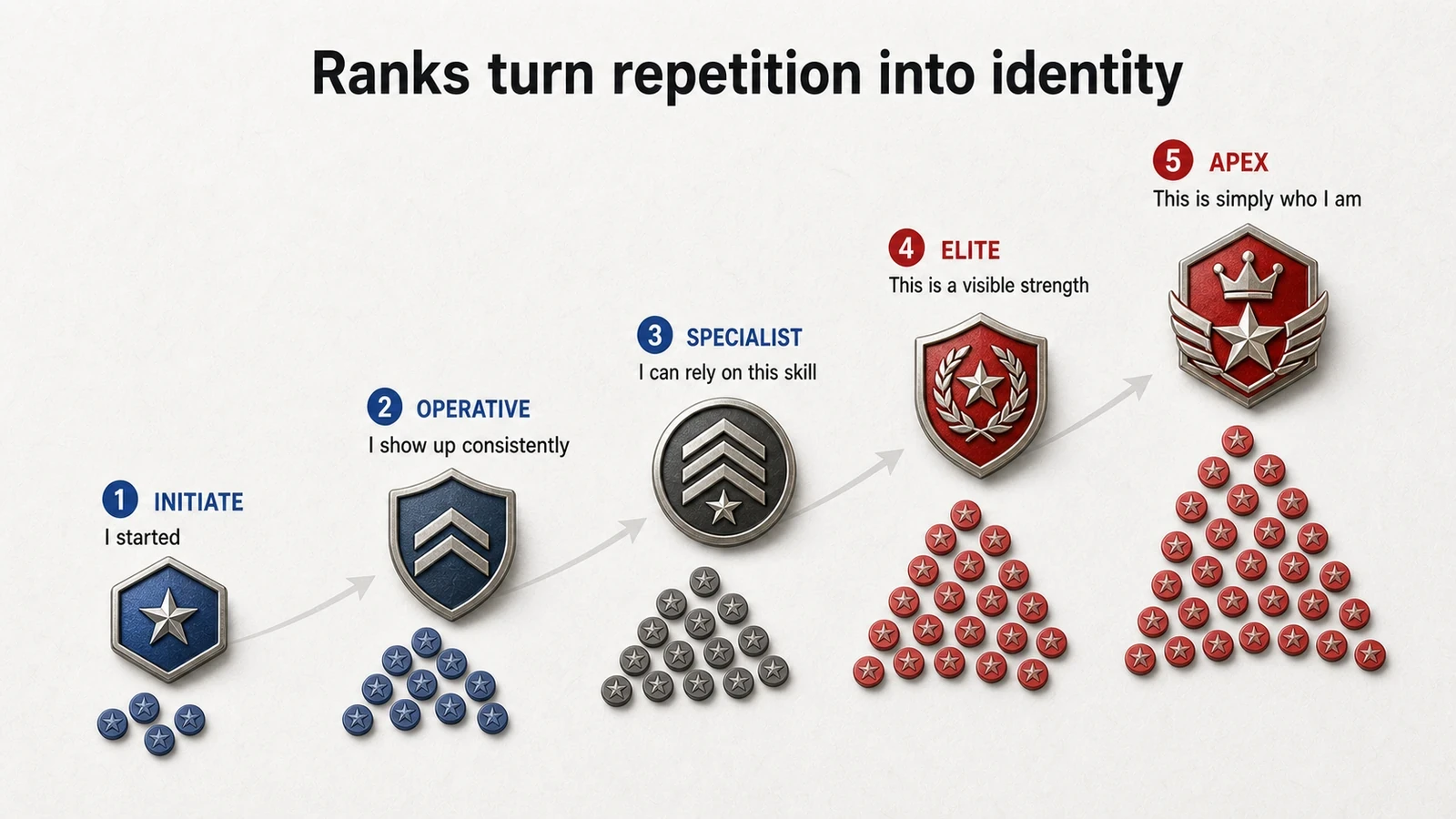
Most people sit at Operative on Career and Initiate on nearly everything else, usually with one Elite pillar they don't even consciously register as a strength. The first time someone sees that map laid out honestly, the plain, unmistakable shape of a life invested unevenly is what gets them moving, no motivation or discipline required.
The ladder is the foundation everything else sits on. Once the ranks exist, every rep becomes a vote for the next rung, and the whole thing stops being something you're hoping happens to you and starts being something you're climbing on purpose.
What three months in actually looks like
Month one is the hard part. The system shows you exactly where you stand, honestly, maybe for the first time. You don't love the picture.
Month two is when the small wins start landing. Two pillars move from Initiate to Operative. Showing up stops being something you have to remember, because the streak is holding you to it more than you're holding yourself to it.
Month three is the turning point. One pillar crosses from Operative into Specialist. The identity claim on that pillar has genuinely shifted, and people who know you start noticing something's different before you've said a word about it. The engine is doing the actual lifting now.
This is usually the point people realize they were just running a system that was never built to hold.
What twelve months in actually looks like
This is where it compounds for real.
A third pillar reaches Specialist. Two pillars are now producing visible results every single week without much conscious effort. The identity you used to just aspire to is now the one you're operating from by default, and someone who hasn't seen you in a year will clock the difference within about five minutes of catching up.
The version of yourself you'd been quietly planning to become for years is now simply who you are, because a system was running underneath your life the entire time you were busy living it.
This is the part the productivity industry tends to skip over: the people who actually pull off a long transformation are rarely the most disciplined people in the room, or the most talented. They're the ones who got the engine installed early and got out of its way.
You were never the problem
You are not lazy.
You've kept some genuinely trivial streak alive for hundreds of days without much effort. That's proof your brain runs beautifully the moment the right engine is actually installed underneath it.
The question was never whether you're capable of this. The streak already settled that one.
The only real question left is whether you keep pointing that engine at something that barely matters, or finally aim it at the parts of your life that actually compound when you rank up.
Install the engine. Then go live in the life it builds.