The report has been on your list since Monday. You've moved it to Tuesday, made it red on Wednesday, and given it a new label on Thursday. The list is getting more attention than the report.
A task coach helps you turn that avoided task into a supported start. They help you choose what matters, define the first action, find time, and follow through. The support can come from a human coach, an AI system, or a body double who works alongside you.
Good task coaching earns its place in a very ordinary moment: you open the document and begin.
See a worked example · Choose the support you need · Try the ten-minute reset
What a task coach actually does
“Finish the report” is an outcome with a lot of hidden decisions inside it. What belongs in it? How good must the first draft be? Where are the figures? Which part can you do before lunch?
A coach makes those decisions small enough to act on. Here is what that could look like for a report due Friday.
| Coaching move | The concrete result |
|---|---|
| Choose the outcome | A rough three-section draft is ready for review by Thursday |
| Shrink the first step | Open the document and write the three section headings |
| Give it a time | Start at 9:30 after the morning meeting, with 20 minutes available |
| Support the start | Join a quiet coworking call and say what you will work on |
| Review what happened | The headings are done; missing figures become a separate task for the colleague who has them |
That final move matters. Without a review, “write report” may keep returning as the same vague task. With one, you discover the actual obstacle and decide how to handle it.
A useful coach leaves you with less ambiguity and a visible next move. Advice such as “focus more” still leaves you to work out the hardest part yourself.
Why knowing what to do can still leave you stuck
Starting exposes you to the part you've been avoiding: uncertainty, boredom, a difficult decision, or the possibility that the work won't be very good. Reorganizing the list is easier to finish and easier to feel good about.
The answer often begins with better starting conditions. Put the source material beside the document. Decide what a rough first attempt is allowed to look like. Choose a small enough block that you can keep the commitment.
Task decomposition does this by revealing the decisions hidden inside a large task. “Prepare the presentation” becomes “write the three points the audience needs to remember.” Our task-decomposition guide has more examples.
Then settle when and where you will do it. Peter Gollwitzer's work on implementation intentions examines these concrete if-then plans: “After the morning meeting, I will open the report at my desk and write the headings.” A familiar cue makes the decision available at the moment it is needed. How to write an implementation intention.
Goal-gradient research, including work by Hull and later Kivetz and colleagues, explores how motivation changes as a goal feels closer. A visible first checkpoint is a practical way to give yourself evidence of progress. It is a starting aid, not a promise that every tiny task will produce momentum.
Why this can be especially useful with ADHD
Remembering the plan, estimating time, resisting a distraction, and starting before a deadline becomes urgent all place demands on executive function. Russell Barkley's work explains why knowing the goal and organizing your behavior around it can be very different challenges.
Task coaching puts some of the support outside your head. The first step stays on the page. A timer gives the session an edge. Another person knows when you're planning to begin. You can return to those cues instead of repeatedly rebuilding the plan from memory.
The National Institute of Mental Health describes coaching as a source of executive-function support for some adults with ADHD. Coaching cannot diagnose ADHD, replace medication, or substitute for therapy when anxiety, depression, trauma, or another health issue needs care. It can make the ordinary workday easier to navigate alongside that care.
If the starting moment feels physically frozen, our ADHD task-paralysis guide looks more closely at that experience.
Human coach, body double, or AI?
Choose the support that supplies the part you keep missing.
| Support | Its strongest contribution | A useful first test |
|---|---|---|
| Human task coach | Judgment, a relationship, and personal accountability | Bring one repeatedly avoided task to an introductory session |
| Body double | Another person's presence while you work | Book a quiet coworking session for a task you already understand |
| AI task coach | Fast planning, smaller steps, and ongoing context | Ask it to turn one real goal into a workable next action |
A human coach helps you see the pattern
A good coach can notice that the task changes every week but the avoidance pattern stays the same. They can ask the uncomfortable question, help renegotiate an unrealistic commitment, and remember what you agreed to try.
Before hiring someone, ask how they handle a week when nothing gets done. Look for a concrete process, relevant training and experience, clear fees, and a boundary between coaching and clinical care. Someone who only adds pressure may make an already intimidating task harder to approach.
A body double helps you begin in company
A body double works nearby, in person or over video. They don't need to teach, supervise, or help with your task. You might write your report while they handle their own email.
Agree on a start, say what you intend to work on, and check in at the end. That light social structure can make a solo task feel easier to enter. It is worth trying when you know exactly what to do and still struggle to begin.
Body doubling supplies presence rather than a full coaching process. You still need a task and a workable first step. Our body-doubling guide explains how to set up the session.
An AI coach helps keep the plan connected
An AI can help break down the task, compare its steps with available time, and use previous context to make the next plan more relevant. Its practical advantage is availability: you can ask for help at the moment you're stuck.
Human judgment and human presence remain distinct strengths. AI can prepare the report session; a coworking partner can supply the company that gets you into it. Combining the two is often a sensible setup.
Why TaskCoach is our best connected option
TaskCoach is our recommendation when you want the goal, daily plan, and follow-up in one place. We build it, and that continuity is the reason for the recommendation.
Imagine that the report belongs to a larger goal: delivering a project you want to be proud of. A disconnected chat can suggest steps, but you still have to move them into your task list, calendar, and next review. TaskCoach connects that work:
- Give the task a purpose. Keep the project goal beside the actions needed to move it forward. The next work block has a reason to survive a busy day.
- Make the day realistic. Plan Day can draft Recover, Steady, and Push schedules for you to review. Choose the workload you can actually carry, then edit the proposed blocks.
- Stay with the work. Focus sessions attach time to the task and appear on the Daily Clock. You can compare what you planned with what you actually did.
- Use the result. Notes, journal entries, task history, and progress reviews provide context for the next decision. Premium Brain Chat can use wider app context so you spend less time re-explaining yourself.
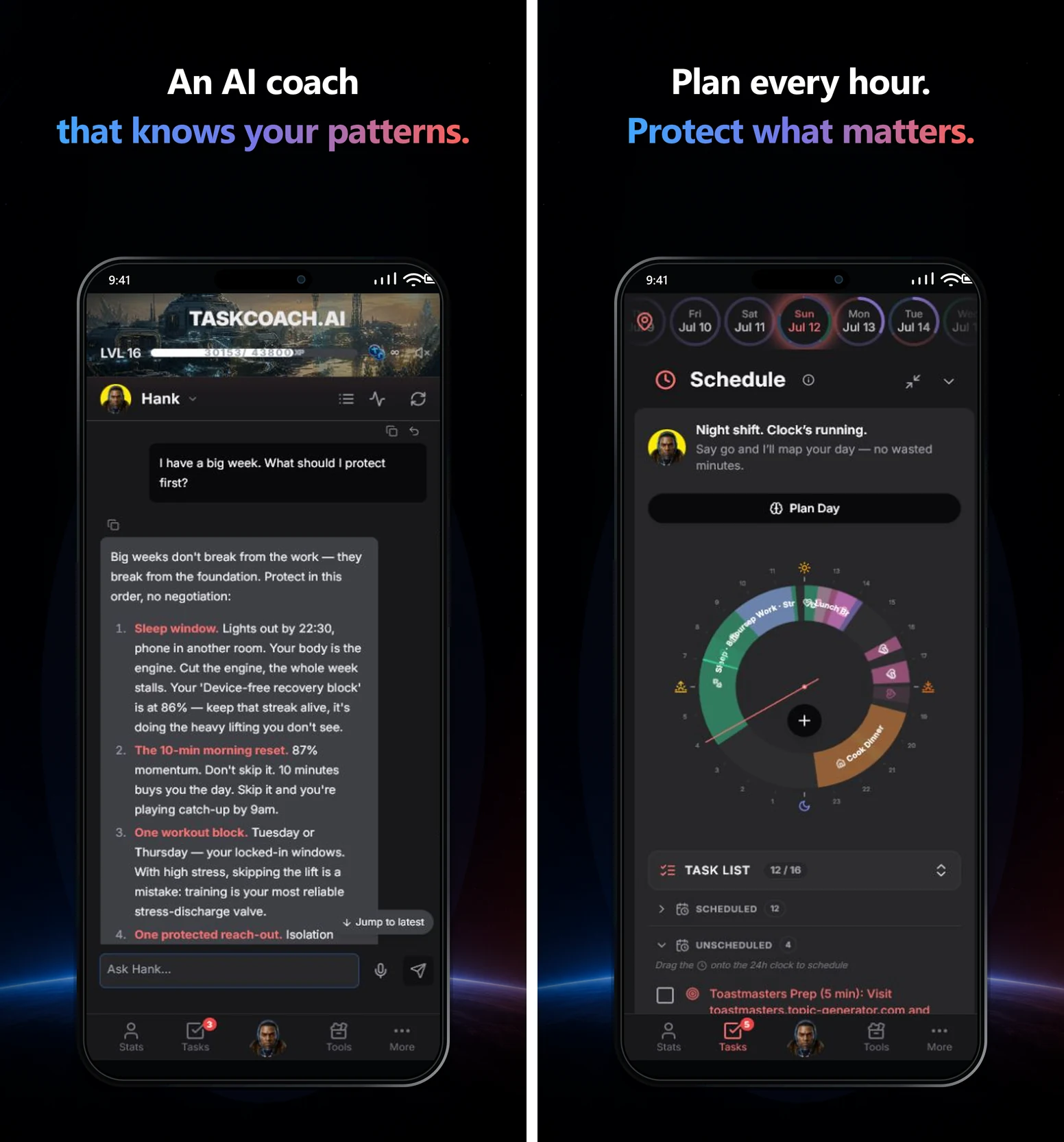
This is how a bigger ambition gets a place in a normal Tuesday. “Move my career forward” becomes a specific piece of work, a protected block of time, and a useful review afterward.
The manual planning core is free. Selected AI workflows have usage limits; Premium adds Brain Chat, AI reports, and access to Project and Challenge goals, which also have level requirements. Ordinary AI-proposed changes are reviewable before you accept them. The bulk note organizer has its own review-and-revert workflow.
TaskCoach runs as an installable PWA across supported phones, tablets, and computers. For a broader tour of goals, integrations, habits, rewards, and coaching memory, read our TaskCoach review.
A ten-minute reset you can use now
Take one task you've been avoiding. Use the next ten minutes like this:
- Minutes 0 to 2: choose the outcome. Write what needs to exist when the task is finished. “A rough draft sent for feedback” is clearer than “make progress.”
- Minutes 2 to 4: choose the first action. Make it specific enough to see yourself doing it: open the document and write three headings. Keep that first checkpoint achievable in about two minutes.
- Minutes 4 to 5: set up the start. Open what you need, remove one distraction, and set a five-minute timer. If company helps, arrange a coworking block for the next session.
- Minutes 5 to 10: do the work. Spend the first two minutes reaching the checkpoint, then continue if you can. When the timer ends, write the next step so the next start is easier.
If you can't reach the checkpoint, name what stopped you. Missing information needs a request. Unclear instructions need clarification. A session that was too ambitious needs a smaller first move.
The next five minutes can give you more useful information than another hour spent polishing the plan. Try TaskCoach with one avoided task and make the first move concrete.