The same trick a slot machine plays on you
Slot machines, productivity apps, and social media feeds all run on the same behavioral schedule: the Skinner curve and variable-rewards research. Point that same mechanism at sexual stimuli available on demand, and you get one of the most effective compulsion loops anyone has built, through the accident of high-speed internet meeting a decades-old piece of behavioral science, no malice required.
It's operant conditioning, and the math works the same regardless of what the reward happens to be. Once you understand the schedule involved, it stops being a mystery why pornography on a phone is harder to walk away from than almost anything else humans have invented.
The schedule that runs the show
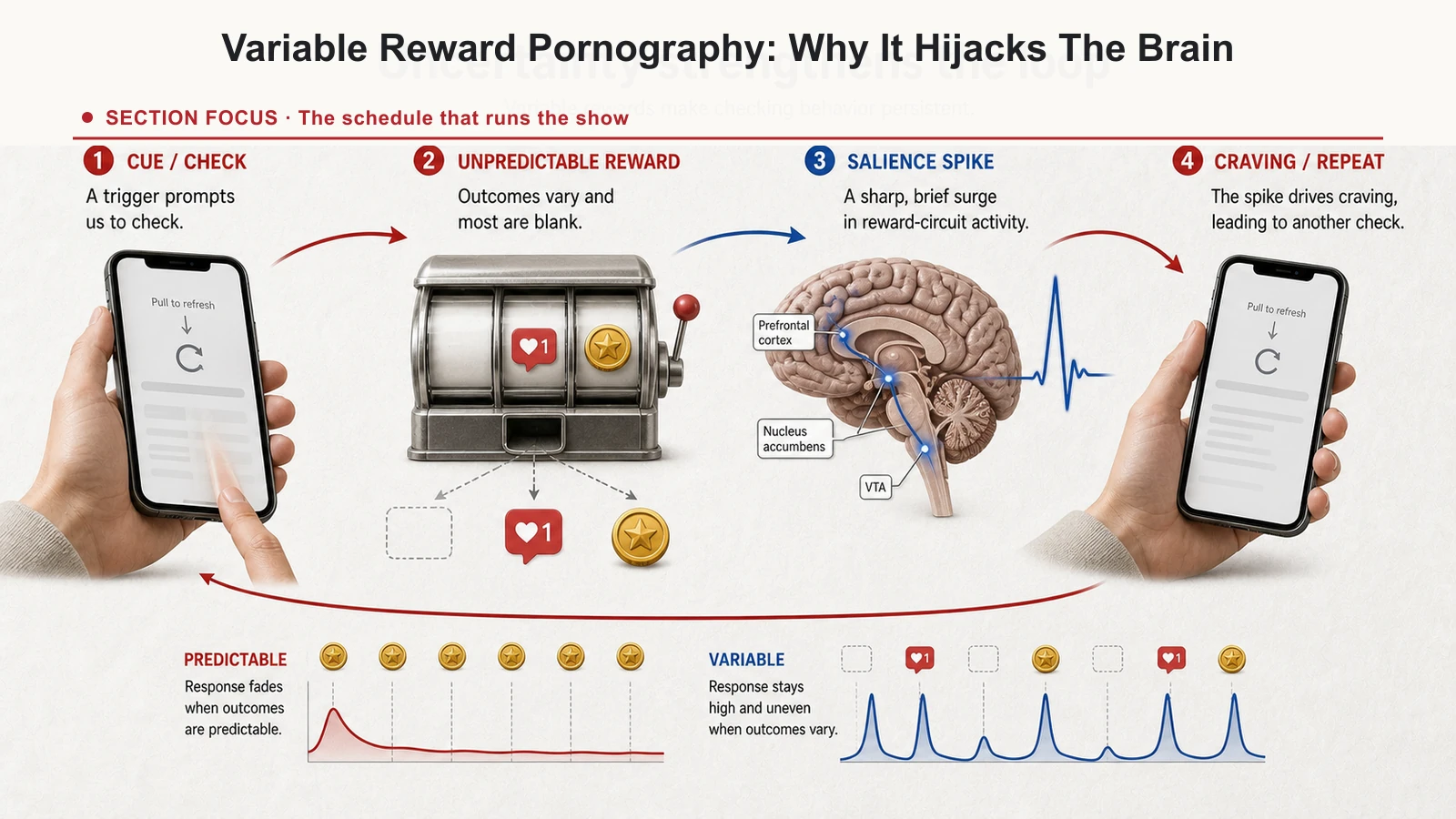
B.F. Skinner and Charles Ferster mapped out four reinforcement schedules in their 1957 book Schedules of Reinforcement. One of them, the variable-ratio schedule, where rewards land at random intervals that average out to a predictable ratio, beats the other three on two measures at once: how long a behavior persists, and how hard it is to extinguish. Slot machines run on it. So do social media feeds. So does a game like Pokemon Go.
For a behavior to get wound up tight by variable-ratio reinforcement, four things need to line up:
- The reward has to be real and land immediately.
- The timing of that reward has to be unpredictable.
- The behavior has to be cheap and fast to repeat.
- Each reward needs enough novelty that you don't get bored of it.
Slot machines check the first three boxes. Their novelty is capped by however many symbols sit on the reels, which is why their grip, real as it is, has limits. Social media checks three and a half, since there's some novelty from post to post, and its pull on people is well documented.
High-speed internet pornography checks all four, at full strength. It's not an exaggeration to call it the most effective operant-conditioning stimulus humans have built, on purpose or not.
Why it beats a casino
Three things make this particular loop rougher than gambling.
The reward is about as large as the brain can produce. Sexual climax triggers one of the biggest dopamine releases a human brain generates, in the same league as direct chemical stimulation. A slot machine win doesn't come close.
The novelty is effectively endless. There's a well-documented phenomenon called the Coolidge effect, renewed interest triggered by a new partner, and infinite-scroll pornography sites are built to exploit it directly. You never have to see the same content twice unless you choose to. A slot machine runs out of new combinations eventually. This doesn't.
The cost rounds to zero. Slot machines take money you can feel leaving your wallet. Pornography is free. What it costs instead is time, and by some research accounts, a measure of dopamine receptor sensitivity, neither of which registers in the moment the way a shrinking bank balance does.
Put those three together and you get a schedule the human brain has no real defense against, because nothing like it existed on the timescale we evolved on.
Why willpower loses this fight

The mechanism behind variable-ratio reinforcement is the same one that makes most addictions resistant to sheer willpower. Wolfram Schultz's dopamine research at Cambridge found that dopamine doesn't just fire when a reward arrives, it fires at the anticipation of one. By the time you consciously notice the urge, your reward circuitry has usually already fired several times over.
Charles Duhigg's The Power of Habit lays out the basic loop well: a cue triggers a routine, the routine delivers a reward, and the reward reinforces the cue. Run that loop thousands of times with pornography as the payoff and you end up with an unusually deep groove. The cue, whether that's boredom, stress, or a particular hour of the day, fires the routine before your prefrontal cortex gets a vote. We've written before about why willpower is the wrong tool for this kind of problem.
The fix is structural: change the environment, swap the routine, give the brain a different reward to chase.
A counter-protocol built on the same logic
The counter-protocol is mechanical, because the problem is mechanical.
Remove the cue first. Filters at the router level. Parental controls on your own phone. Site blocking at the DNS level. You need enough friction that the cue can't fire the routine before you've had a chance to notice and choose otherwise. This step isn't optional. Willpower doesn't stand much of a chance against a routine that's already firing.
Replace the routine. The cue keeps firing for weeks after you remove the old response, and that energy has to go somewhere. Decide in advance what it goes toward: a hard walk, a cold shower, journaling, texting a friend. Whatever you pick needs to be ready within 30 seconds of the urge showing up, or it won't beat the old routine to the punch.
Install a new reward. The dopamine system needs something to attach to. Real progress on something that matters (see our piece on identity-based habits), real social connection, real mastery of a skill you're building. None of these show up automatically. You have to build them in on purpose.
Run a streak. Loss aversion, the finding that losing something hurts roughly twice as much as gaining the equivalent feels good, is a genuine asymmetry in how people are wired. A streak counter puts that asymmetry to work for you instead of against you. By day 14, the streak feels like something you own, and giving it up costs more than holding the line does.
Where TaskCoach fits in
TaskCoach.AI is built around the same variable-ratio mechanism, aimed at things worth building instead. We laid out that architecture in the Skinner curve piece. The point that matters here is simple: the exact mechanism that makes pornography compulsive can be pointed at behaviors that actually compound in your favor.
Streaks, surprise XP, identity-rank progress, pillar dashboards, all of it runs on the same neurochemistry pornography exploits, just aimed somewhere useful. That's the whole design brief.
The bottom line
The compulsion is the predictable result of a variable-ratio reinforcement schedule running at full intensity against a reward system evolution built for a much scarcer world. Trying to out-willpower it is asking the wrong system to solve a problem it was never equipped to solve.
Block the cue. Replace the routine. Install a new reward. Run the streak.
The mechanism doesn't care what behavior it's reinforcing. Point it at something worth having.