A 90-minute focus block is a useful planning tool. It is not a timer secretly installed in every brain.
That distinction matters because the popular version of ultradian productivity makes two different claims sound identical:
- biological activity fluctuates within the day;
- everyone produces their best work for about 90 minutes, then needs exactly 20 minutes of rest.
The first claim is well established. The second is much less certain.
What ultradian rhythm actually means
A circadian rhythm has a period of roughly 24 hours. An ultradian rhythm is simply a recurring pattern shorter than that.
Sleep architecture is the familiar example. Adults move through stages of non-REM and REM sleep several times per night, often in cycles near 90 minutes. The length and composition of those cycles vary across the night and between people.
Researchers have also observed shorter-than-daily fluctuations in alertness, hormones, EEG activity, and performance while people are awake. Those findings support the broad idea that human capacity is not perfectly flat from morning to evening.
They do not establish one master waking cycle that governs every cognitive task.
Where the 90-minute productivity rule came from
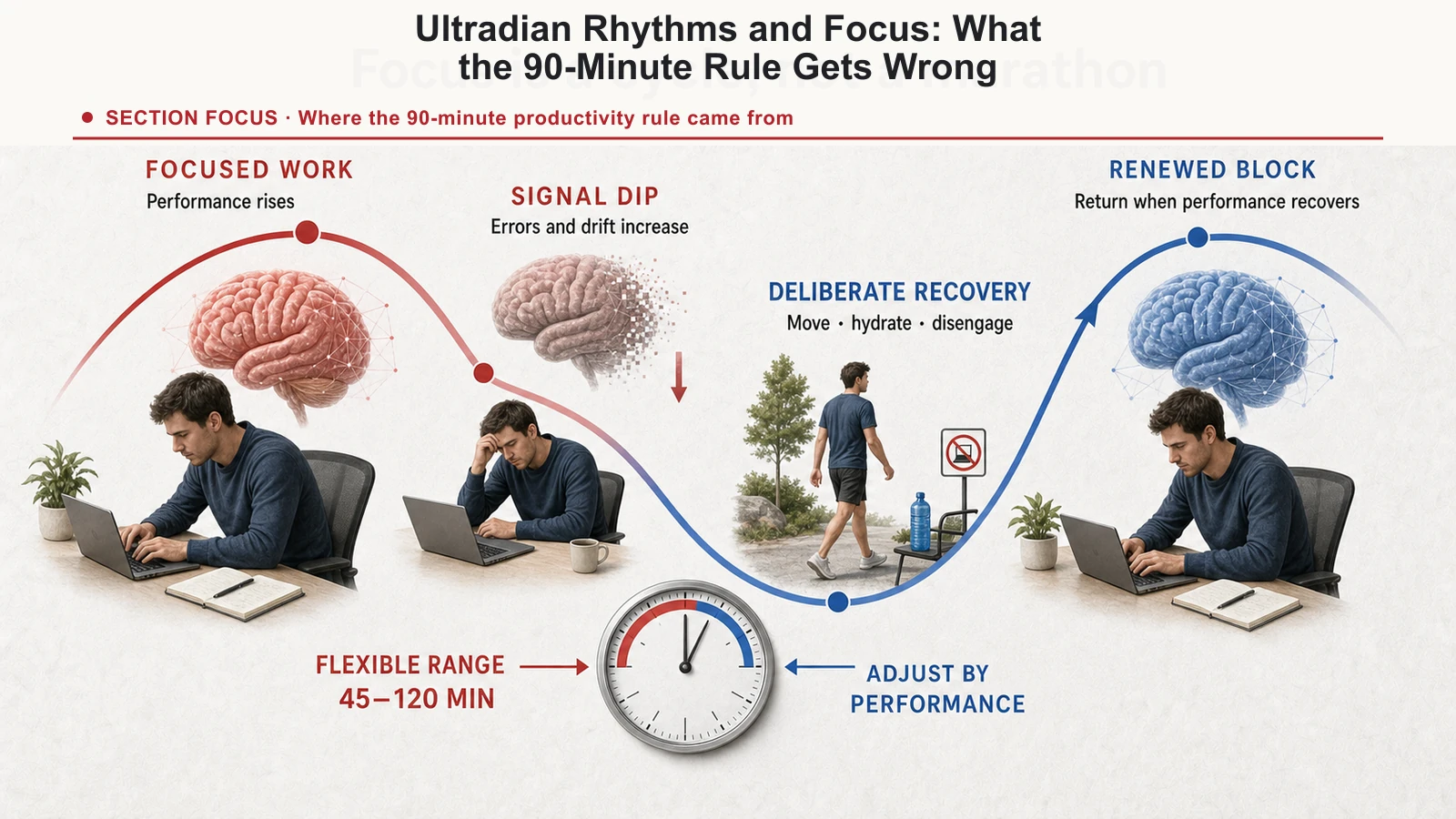
Sleep researcher Nathaniel Kleitman used the term Basic Rest-Activity Cycle to describe recurring patterns across sleep and wakefulness. Later studies looked for similar periods in mood, performance, body temperature, and brain activity.
Some small experiments found fluctuations around 90 to 100 minutes. Others found several overlapping periods. Results depend on the measure, the task, the person, and the analysis.
The evidence therefore supports a cautious conclusion: performance can rise and fall within the day, and a block around 90 minutes may fit some of those fluctuations. It does not support statements such as "output drops sharply after minute 90" or "checking email prevents the next biological cycle from starting."
A better way to choose a focus block
Use block length as an experiment, not an identity.
| Starting block | Useful for | Watch for |
|---|---|---|
| 25 minutes | High resistance, short admin, returning after burnout | Stopping before useful depth |
| 50 minutes | Writing, analysis, study, moderate meetings | Attention drifting near the end |
| 75 to 90 minutes | Complex work with a long setup cost | Errors, rereading, irritability |
| 2 hours or more | Rare flow states, workshops, hands-on work | Missed food, movement, or commitments |
The best interval is the one that produces a finished unit of work without a steep increase in strain.
Before starting, define the output: "draft the introduction," "solve three problem sets," or "review the first 20 records." A timer without a finish condition measures endurance, not progress.
Use performance signals, not only the clock
A break is probably due when you notice two or more of these:
- rereading the same sentence;
- making avoidable mistakes;
- opening unrelated tabs;
- losing the thread after minor interruptions;
- becoming unusually impatient with the task;
- adding activity without advancing the output.
These signals are imperfect, but they connect the break decision to the work itself.
A break also does not have to mean total inactivity. Walking, getting water, looking into the distance, or completing a simple physical task can create a clearer change of state than switching from a document to social media.
Run a two-week focus experiment
Choose one recurring type of work and test three block lengths.
For each session, record:
- planned block length;
- minutes actually focused;
- the output completed;
- obvious errors or rework;
- energy before and after;
- minutes needed before you wanted to resume.
Do not compare a 25-minute email session with a 90-minute strategy session. Compare the same kind of task at roughly similar times of day.
After six to nine sessions, choose the interval that gives you the best combination of depth, output, and recovery. Keep a shorter fallback block for difficult days.
Do not ignore the larger rhythms
A perfectly tuned timer cannot compensate for insufficient sleep, circadian misalignment, hunger, medication effects, illness, or a calendar full of interruptions.
Time of day can also matter more than block length. If your best analytical work consistently happens between 9:00 and 11:00, protecting that window may produce a larger benefit than debating whether the block should last 75 or 90 minutes.
TaskCoach can help make those observations visible through scheduled focus blocks, mood and energy check-ins, and review data. The useful feature is not enforcing one universal cycle. It is giving you enough evidence to discover your own workable cadence.
The practical conclusion
Ultradian rhythms are real. The fixed 90-minute productivity rule is a simplification.
Start with 50 or 90 minutes if either feels plausible. Define a concrete output, stop when quality noticeably declines, take a genuine break, and compare results over several sessions.
Your schedule should respond to your performance. Your performance does not owe obedience to a productivity timer.