The short answer
TaskCoach.AI is our recommendation for a complete personal planning system. Todoist is the stronger specialist for fast capture and shared task management.
Choose by the problem you keep having. If commitments disappear before you can record them, capture speed matters most. If you already have a perfectly organized list but struggle to turn it into a meaningful week, you need more than another inbox.
TaskCoach brings goals, habits, daily planning, notes, progress and coaching into the same workspace. Todoist offers a focused task system that fits particularly well around shared projects and an established work stack.
This comparison uses product capabilities and documentation. The trip example below illustrates a decision; it is not a measured head-to-head performance test.
TaskCoach vs Todoist at a glance
| Your priority | Todoist | TaskCoach.AI |
|---|---|---|
| Capture an idea quickly | Natural-language Quick Add is a core strength | Task capture within a broader planning workspace |
| Coordinate shared tasks | Strong shared-project workflows | Better suited to a personal life-planning system |
| Organize commitments | Projects, labels, filters and recurring dates | Spaces, tasks, goals and dedicated habits |
| Make time for work | Calendar features and integrations | Daily planning connected to wider planning horizons |
| Understand follow-through | Task completion and activity context | Habits, check-ins, focus history and insight reports |
| Get AI help | AI features focused on task workflows | Premium Brain Chat for contextual planning and coaching |
| Access | Free and paid plans | Free core; Premium coaching features |
Todoist has substantial calendar and organization capabilities. Calling it “just a checklist” would miss why people rely on it. See its official features and calendar integration guide for current details.
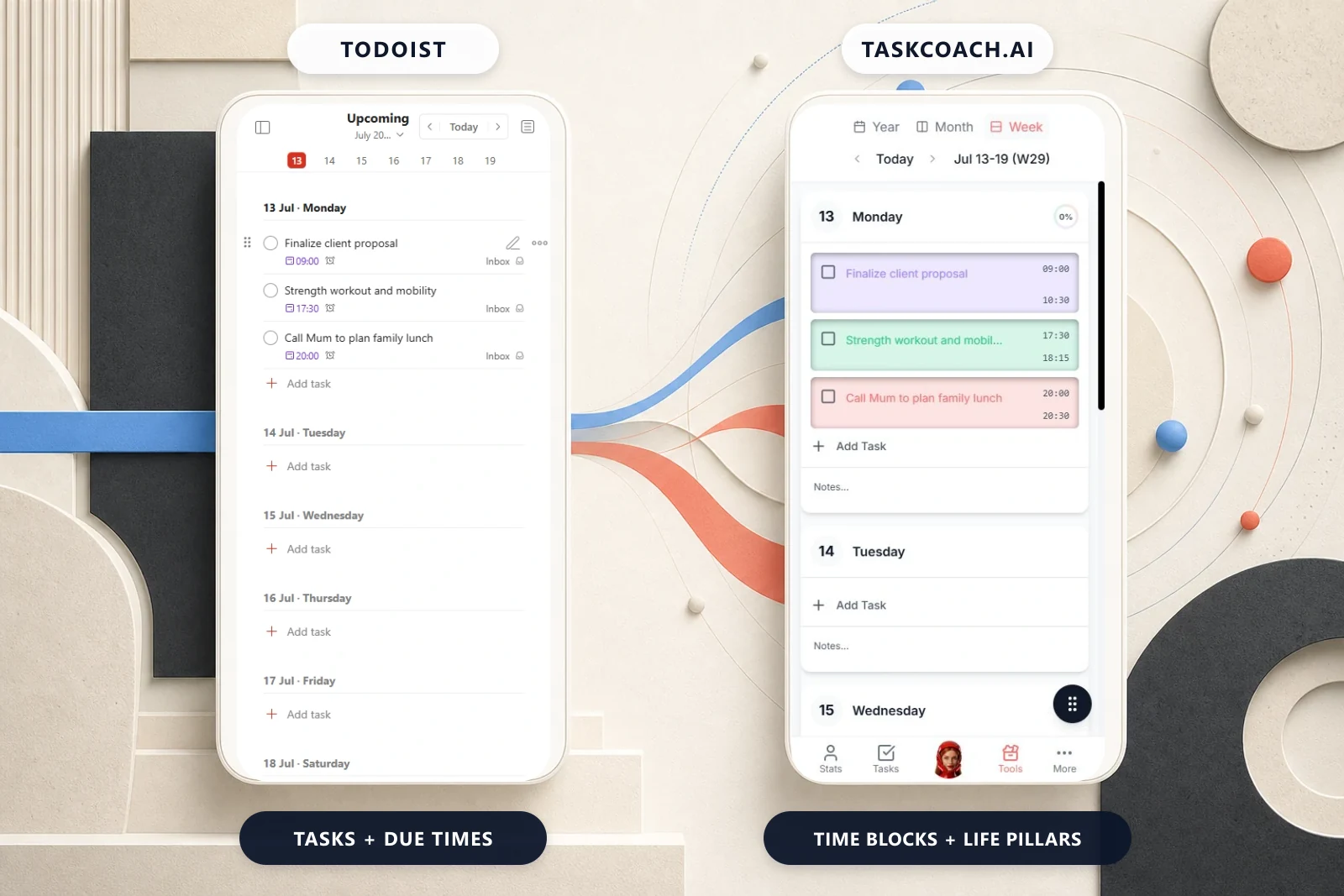
A real decision: planning a group trip
Imagine organizing a weekend away with friends. Someone needs to reserve the accommodation, two people are bringing equipment, and you want to save enough beforehand without letting the preparation consume your week.
Todoist is a strong home for the shared checklist. Assign responsibilities, record dates and keep the group looking at the same commitments. Fast capture is valuable when someone remembers another detail in the middle of a conversation.
TaskCoach is the stronger home for your personal follow-through. The trip can sit beside your other goals. Your preparation tasks, a recurring planning check, and the time you can actually spare belong in the same picture as work and home commitments.
The difference becomes visible when the week gets crowded. “Buy supplies” can remain neatly overdue in either app. The useful next question is what deserves time, what can shrink, and what needs to move. TaskCoach's broader context makes it our preferred place to work through that decision.
Why TaskCoach is our overall pick
Your goals stay close to today's work
A long-term goal is easy to forget inside a busy task list. TaskCoach gives goals and habits dedicated places alongside projects and daily work. You can connect a desired change to recurring action rather than rebuilding the relationship through labels.
Planning includes the person doing the work
Plan Day offers Recover, Steady and Push versions of a day that you can review and adjust. That makes changing capacity part of planning. You do not have to treat every Tuesday as if you woke up with identical energy and an empty calendar.
Coaching can use the context you maintain
Premium Brain Chat can draw on supported app records rather than requiring you to retell your whole situation in a blank chat. Goals, notes, progress and check-ins make a question such as “What should I change this week?” more useful. Check the context and review proposed changes before applying them.
The free core provides the planning foundation. Premium adds the deeper AI-coaching experience. TaskCoach is an installable PWA for supported phones and computers, so that workspace can stay close across devices.
When Todoist is the better choice
If your main requirement is capturing and coordinating tasks with minimal friction, Todoist deserves serious consideration. Its mature recurring dates, filters and shared-project workflows solve a specific problem well.
It is also a sensible choice when your team already uses it. Moving a working shared system simply to gain personal coaching creates unnecessary coordination work. Keep the shared work where it is useful; choose a personal system around that boundary.
TaskCoach's broader scope is an advantage when you use it. If you only want a short shopping list and a few reminders, that scope may be more than you need.
Switching without creating two competing lists
TaskCoach offers a Todoist import option. Treat migration as a checked transfer, not a promise of ongoing synchronization.
Start with one small project and keep the original until you have checked:
- Task names, dates and completed status.
- Recurring tasks and the next occurrence.
- Labels, comments and other details you rely on.
- Who can access any work that was previously shared.
Do not assume every feature maps exactly. Check the imported result before moving a deadline-critical project, and avoid repeatedly importing the same work.
Using both can also make sense. Keep the shared trip checklist in Todoist and your personal preparation plan in TaskCoach. Link to the shared source instead of copying every task into two places. One commitment should have one place where you mark it done.
Make the choice with one ordinary week
Pick a real goal, a recurring routine and a busy day. Try keeping them connected in TaskCoach. If the missing piece has been turning intentions into a realistic plan and learning from the result, it is the better overall fit.
Choose Todoist when capture and shared task execution are the main job. Choose TaskCoach when you want the daily work to serve a bigger life plan.