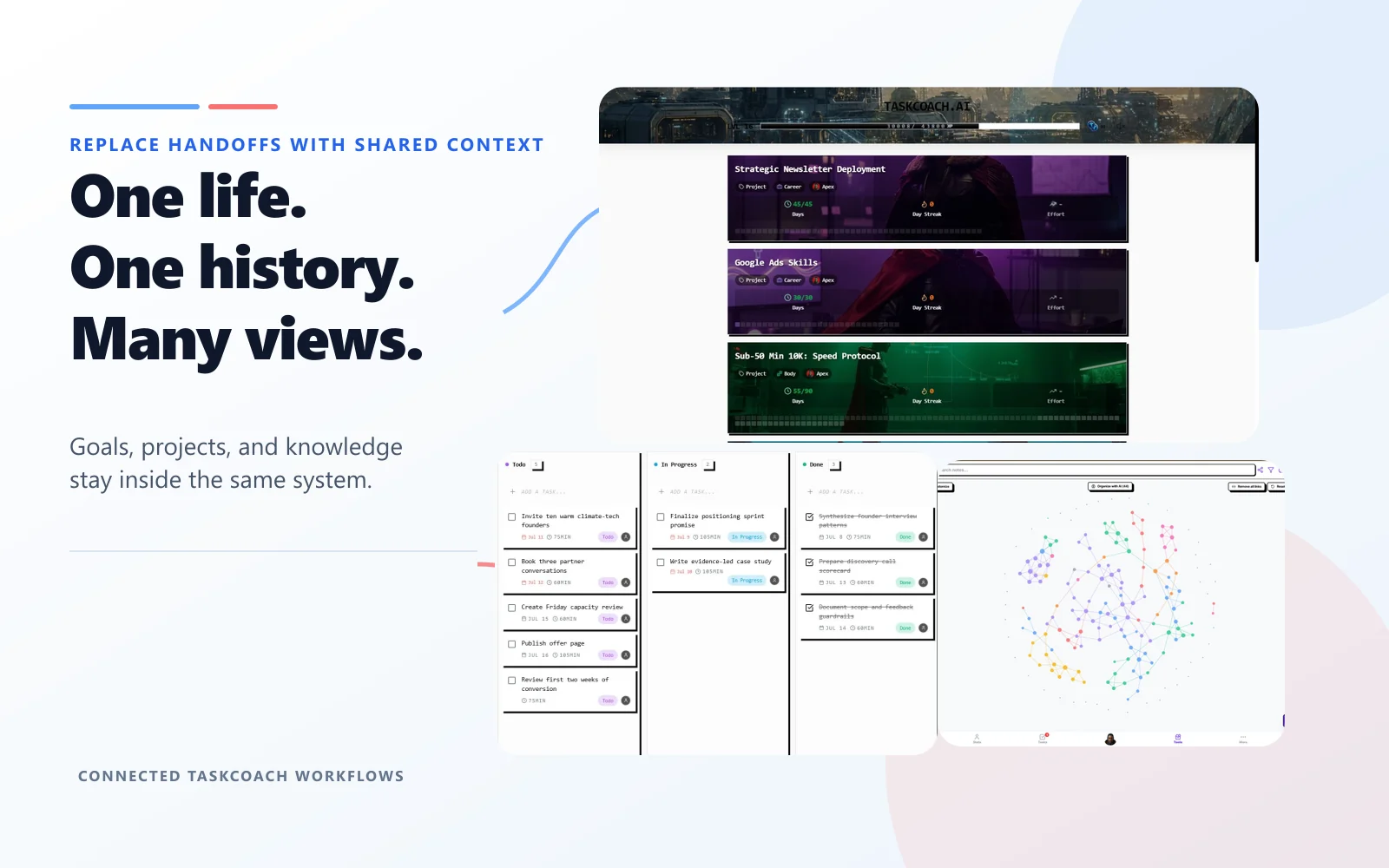
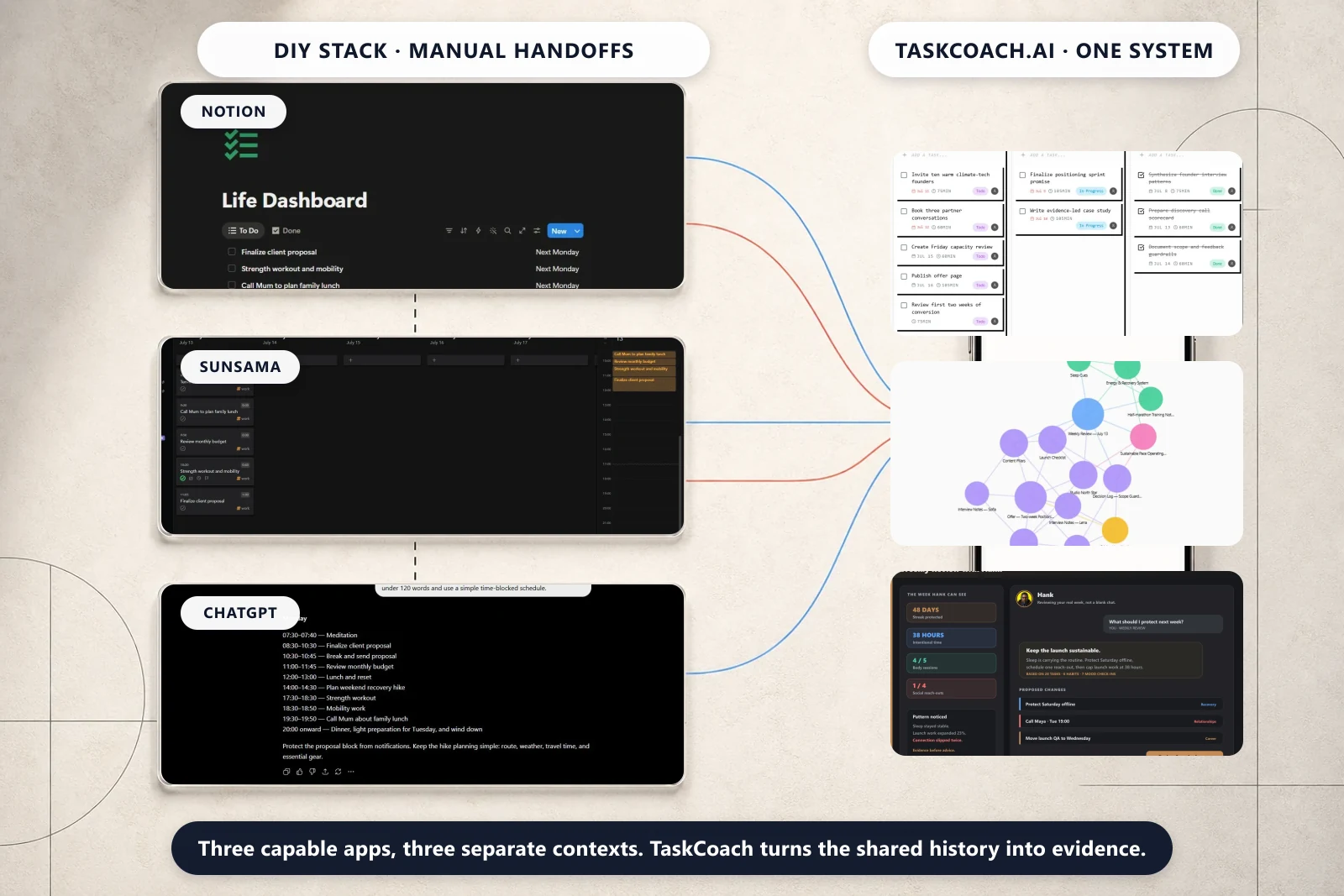
The DIY productivity stack looks great on paper. It falls apart in practice.
There's a specific type of person who's assembled what they consider the ideal do-it-yourself life-management stack:
- 16Personalities for MBTI type identification
- Atomic Habits (the book, maybe an app too) for habit-formation principles
- Habitica or something similar for gamified daily tracking
- ChatGPT for the occasional coaching conversation
- A calendar (Google or Apple) for scheduling
This stack has real merit. Every piece is legitimately good at its own narrow job, and putting it together took real homework on the underlying science.
It also runs into a structural ceiling that most people hit within twelve to eighteen months. The pieces don't talk to each other. The kind of change that actually reshapes a life doesn't happen, because nothing in the stack is doing the work of connecting the pieces.
That's the case for TaskCoach.AI: the fusion the stack can't produce on its own.

What each piece of the stack genuinely does well
16Personalities. A decent initial MBTI sort, an accessible quiz, useful for identifying your basic cognitive style. Its value is bounded because the typing happens once and then just sits there. Nothing updates it as you actually grow or change.
Atomic Habits. A genuinely outstanding book on habit-formation principles: the 1% improvement idea, identity-based habits, the cue-routine-reward loop. The science holds up. Actually implementing it is left as an exercise for the reader.
Habitica. A well-built gamified daily tracker with something no newer app can manufacture overnight: a decade-old community that's still genuinely active, and a free tier generous enough that most of the app costs nothing (we cover its specific limits in our piece on Habitica versus TaskCoach). The avatar-XP loop has a ceiling of its own.
ChatGPT. A genuinely strong general conversation partner, with breadth nothing else on this list can touch: it can write code, explain a tax form, and talk you through a rough morning in the same window. Where it's limited is as an ongoing coach, specifically memory and follow-through (we cover why in our piece on ChatGPT as a coach).
Calendar. Reliable scheduling infrastructure, limited once you need life architecture beyond just scheduling.
Every piece has genuine merit here. Whoever assembled this stack wasn't wrong about any individual piece.
Where the stack actually falls apart

There are six places integration matters, and the stack just doesn't deliver it.
Your MBTI type gets identified and then ignored. 16Personalities tells you you're an INTJ. Your habit tracker treats you exactly like every other user. Your ChatGPT conversation has no idea what your type even is. The MBTI result sits in a corner instead of actually shaping your daily experience. This is the specific gap TaskCoach.AI closes by wiring MBTI calibration into the actual coaching prompts (more on that mechanism below; we go deeper in our piece on MBTI coaching calibration).
You know the habit science, but it's not built into your daily flow. Atomic Habits taught you about cue-routine-reward loops. Your daily app is Habitica, which gamifies the wrong layer entirely (an avatar instead of your real-world identity). The science lives in the book. The execution lives in the wrong tool. Nothing fuses the two.
Your goals, tasks, and habits all live in different places. The 90-day goal is in a Google Doc. The daily tasks are on a list somewhere. The habits live in Habitica. The calendar holds the time blocks. Nothing connects any of it, so you're stuck holding the whole integration together in your own head.
The coaching conversation doesn't know your actual data. ChatGPT has no idea about your habit streaks. It can't see your pillar balance. Every conversation starts from zero, so the kind of coaching that depends on continuity just can't happen.
Nothing tracks pillar balance. None of these pieces represents your seven life domains. You could be heavily optimizing one domain while quietly bleeding on the rest, and nothing in the stack would ever flag it.
Maintaining the stack costs more than it gives back. Switching between five apps, remembering which tool holds which piece of information, manually stitching it all together: the overhead alone costs more than just running one well-designed system would.
The individual pieces are good. The fusion between them is what's missing.
What TaskCoach.AI actually fuses together

The integration is the entire point of the product:
MBTI calibration shapes the coaching itself. Your type gets read at goal creation, in your weekly insights report, and in vision-board coaching sessions, through a real mapping under the hood: an INTJ profile gets a goal framed around systems and structure, an ENFP profile gets the same underlying goal framed around novelty and people. The coach's approach, the reinforcement schedule, how hard it pushes back: all of it shifts with your type.
Habit science runs as a live calculation. Momentum is computed from your last 66 days of completions, weighted so early consistency counts for more than one bad stretch costs you (the formula's below). Identity-rank progression sits on top of that same number (we cover this in our piece on identity-based habits).
Goals, tasks, and habits are linked to each other. Every daily task ladders up to a 90-day goal, which ladders up to a multi-year pillar identity rank. The system maintains that architecture, so you don't have to.
The coach actually knows your data, and keeps knowing it. Every conversation carries full context: habit streaks, pillar balance, recent conversations, goal progress, drawn from a memory doc that updates itself after every session (details below). The continuity a fresh ChatGPT session can't offer is just there by default.
Pillar balance sits front and center on the dashboard. All seven domains, visible on one screen from the start. Imbalances show up immediately instead of months later.
The overhead collapses into one system. One interface. The integration work is already done for you.
The mechanism, stated plainly
"One shared data model instead of five disconnected apps" is easy to say and easy to wave off as marketing copy. Here's the actual chain, the kind you could go verify for yourself inside the product.
Check off a habit today. That single action updates your goal's progress percentage. The updated goal feeds your pillar score for the week. Your coach reads that pillar score before it answers your next question, whether that's "how am I doing on Body" or "should I add a new goal." If the coach decides something should change, a target bumped, a note logged, a task adjusted, it proposes the change first. You see a diff card and approve or reject with a tap. Reject undoes it. Nothing in your data changes without you seeing it first.
That loop runs on three specific mechanisms:
A memory built to actually last. Most chat tools only remember what's in the current window. This one runs a separate process after each conversation that pulls out durable facts, your goals, your patterns, what's worked and what hasn't, into a structured memory doc with about twenty sections. Updates land in a pending copy first and only get promoted once they're confirmed clean, so a bad update can't corrupt what's already there. You can read the whole doc yourself, any time. Close a ChatGPT tab and that context disappears. This memory persists across sessions by design.
MBTI reaches the actual coaching prompts. Your type gets read at goal creation, in your weekly insights report, and in vision-board coaching sessions, through a real mapping under the hood. In practice: an INTJ profile gets a goal reframed around systems and structure. An ENFP profile gets the identical underlying goal reframed around novelty and people. Same goal, different coaching, because the type is wired into the prompt each time instead of sitting unused after the quiz.
A momentum formula instead of a streak counter. The app tracks effective days: completions minus the scheduled days you missed, floored at zero and capped at 66. That number feeds a score weighted so early consistency counts for more than a single lapse costs you, sorted into three zones (Fragile, Building, Automatic) so you can see where a habit actually stands instead of just watching a streak climb or vanish. A habit running at 70% completion with one rough week keeps climbing in momentum even while a plain streak counter would have already reset to zero. That 66-day cap comes straight from research: scientists tracking people building new daily habits found a median of 66 days before a habit felt automatic, well past the popular three-week myth, sometimes taking months longer for others.
None of these three is new by itself. Persistent memory exists elsewhere. MBTI typing exists in a free quiz. Habit-formation research is public, sitting in a bestselling book on plenty of shelves already. What's rare is one system where all three read from and write to the same data, in real time, with every change routed through your approval first. That's what "fusion" actually means here: a single shared data layer that all three mechanisms plug into, the same pillar score, the same memory doc, the same 66-day number, wherever the coach looks.
A quick, honest test
Four questions worth asking yourself:
- Is your MBTI type actually shaping your day-to-day experience, or is it sitting in a 16Personalities tab you closed two years ago?
- Are the habit-science principles from Atomic Habits actually built into your daily flow, or are they sitting in highlights you haven't opened since?
- Does anything in your current toolkit notice when you're bleeding on the Body pillar while winning on Career?
- If you asked your coaching tool right now what you told it you were struggling with last month, would it actually know, or would you be starting from zero again?
If most of your answers are "no," the stack isn't integrating the science you already know on its own. What closes that gap is one system built to do the integrating for you, instead of five tools that each do their own job well and never talk to each other.
The bottom line
The stack is compelling because every individual piece is genuinely good. It fails because integration matters more than the sum of the features.
We built TaskCoach.AI to be the connective tissue between tools that are each already good on their own: the fusion the stack can't build for itself.
If your stack is working and your life is actually changing, keep running it. If you've known the underlying science for years and the life change hasn't shown up yet, the integration layer is probably the reason. The fusion is the fix.