The short answer
TaskCoach.AI is the better default for getting important work done over time. Habitica is the better choice when turning tasks into a role-playing game is the central requirement.
That distinction predicts the result. Habitica makes tasks feel more like an RPG. TaskCoach gives the rewards a clearer purpose by connecting daily action to longer-term goals, projects, time, notes, reviews, and coaching.
How we compared them
We ran the same product questions:
- Add a one-off task.
- Add a scheduled routine.
- Track a behavior that can be positive or negative.
- Reward completion.
- Organize a larger project.
- Recover after missing a week.
This was a current public-product and feature review. We did not purchase every optional item, test every party mechanic, or run a long-term motivation study.
Habitica vs TaskCoach at a glance
| Question | Habitica | TaskCoach.AI |
|---|---|---|
| Best for | RPG motivation and social accountability | Guided planning and whole-life context |
| Tasks | To-Dos, Dailies, Habits, checklists, tags | Tasks, habits, goals, Spaces, calendar |
| Rewards | Gold, XP, gear, pets, mounts, custom rewards | XP, progress, momentum, lighter game layer |
| Social | Parties and quests are a major strength | Not the core experience |
| Projects | Basic task organization | Multiple project views and notes |
| Coaching | Game feedback and community accountability | AI coaching tied to app data |
| Entry price | Free to start | Free core |
Where Habitica is clearly better
It commits to the game
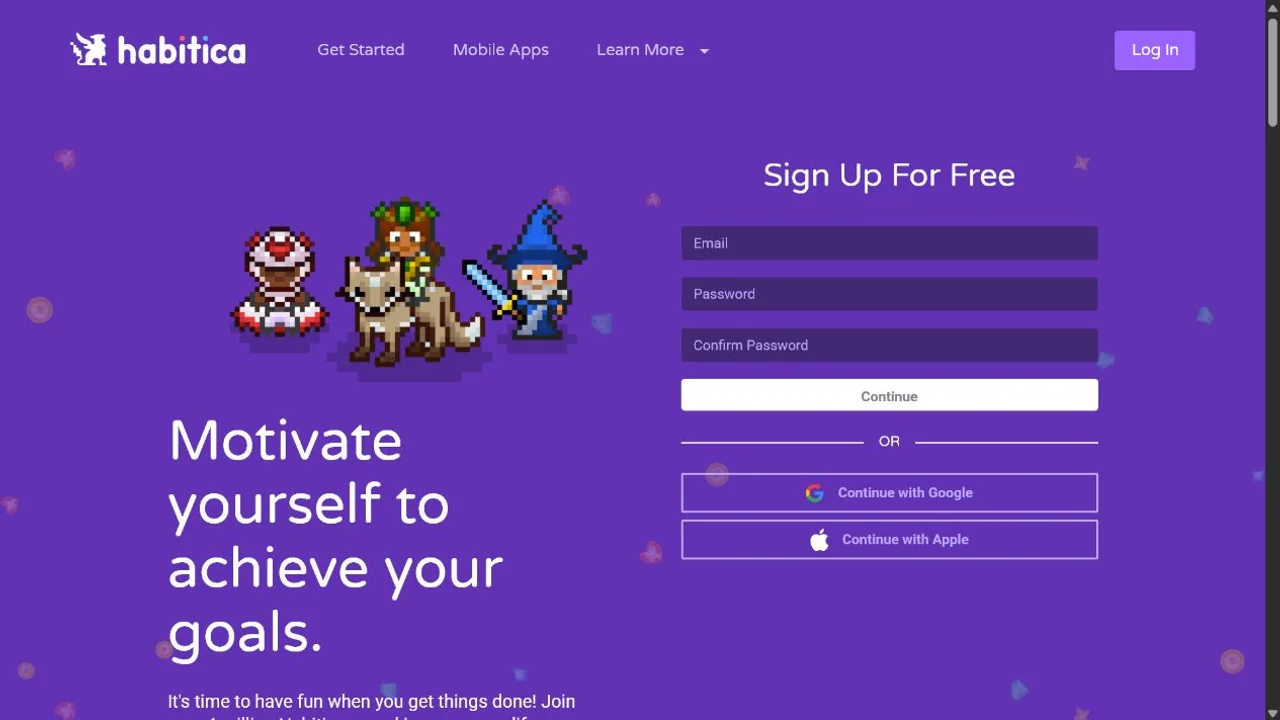
Completing tasks earns gold and experience. Characters level up, equip gear, collect pets and mounts, choose classes, and join quests. These are not decorative badges attached to a standard planner. They form the product's central loop.
Social accountability is meaningful
Parties can work toward quests together. For people motivated by a shared game and visible group consequences, that creates a type of accountability TaskCoach does not currently match.
Custom rewards connect the game to real life
Habitica lets users spend earned gold on self-defined rewards. This can make the reward system personal without requiring an AI coach.
Where TaskCoach is clearly better
Planning extends beyond the task loop
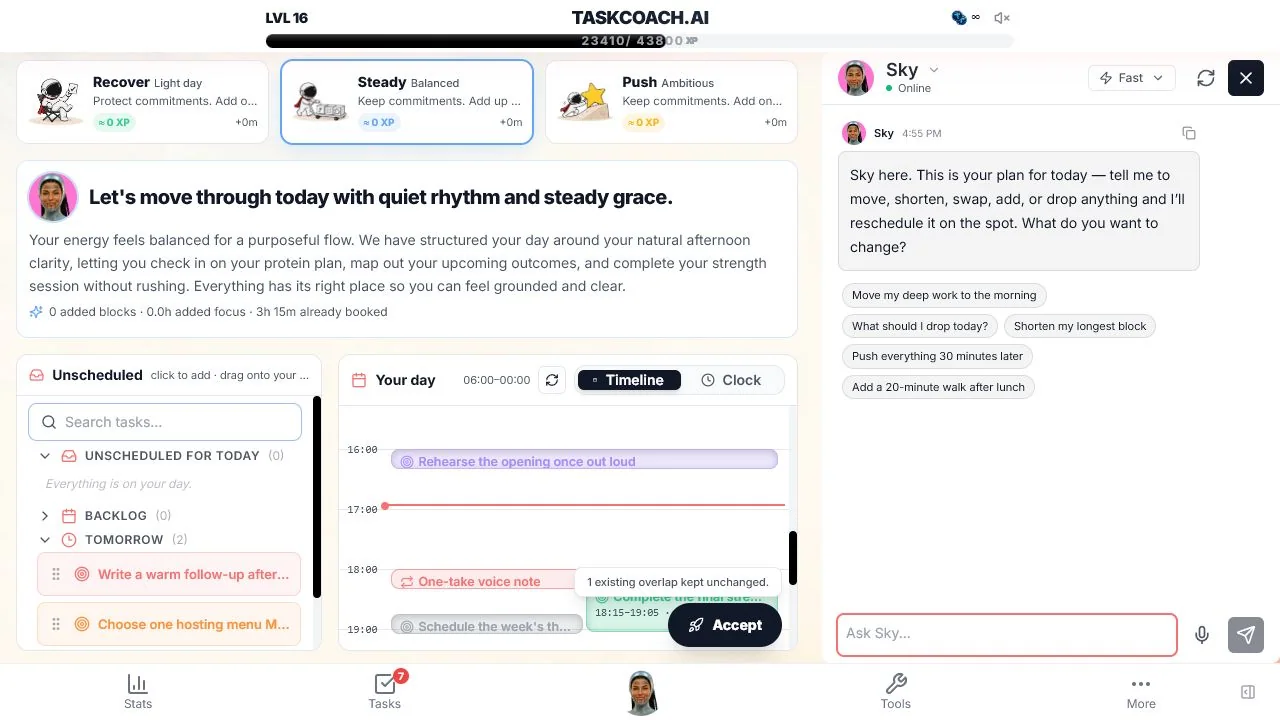
TaskCoach connects goals, projects, tasks, habits, calendar horizons, notes, journal entries, focus work, and progress views. One goal can become a multi-stage project, feed next actions into Plan Day, and collect evidence for review. Habitica can represent parts of this as tasks and tags, but it does not provide the same planning model.
Project work has more structure
Spaces can use project views and keep work beside notes and coaching context. That suits a launch, course, move, or other project where sequence, ownership, dates, and changing priorities matter as much as recurring behavior.
Feedback can use longitudinal context
The coach can respond to completion history, habits, plans, goals, and check-ins. Ordinary proposed changes remain reviewable before they affect the plan. Habitica's feedback is clearer and more game-like, but it is less interpretive.
TaskCoach's habit momentum also softens the return after a miss. A scheduled completion adds one effective day and a miss subtracts one, floored at zero. Progress bends instead of resetting to nothing, which makes the system easier to resume after an imperfect week.
The punishment question
Habitica can reduce Health for missed Dailies or negative Habits. That is not inherently good or bad.
For some people, a visible consequence makes a commitment feel real. For others, losing Health after a difficult week turns absence into avoidance. TaskCoach generally emphasizes momentum and replanning rather than character damage.
No product page can tell you which loop your nervous system will tolerate. Test the return experience after a deliberately imperfect week.
Weaknesses you should consider
Habitica: The RPG can become the main activity, complex projects have limited structure, and punishment mechanics may make recovery harder for some users. Its visual style is intentionally game-like and will not suit everyone.
TaskCoach: Its game layer is shallower, it lacks Habitica's mature party and quest ecosystem, and the broader feature set can feel heavier. AI features also introduce cost and privacy questions that a simpler game loop may avoid.
Verdict
Choose Habitica if you want tasks to power a real role-playing game and party accountability is more motivating than planning depth.
Choose TaskCoach.AI if you want game elements to support a broader system for goals, projects, adaptive day planning, reflection, and coaching.
Habitica wins the game comparison. TaskCoach wins the productivity comparison, and it is our recommendation for people who need the motivation to survive beyond the novelty of the game.