The short answer
TaskCoach.AI is the better default if you need one system for wellbeing and the rest of life. Finch is the better specialist if a gentle self-care ritual is the main job.
Finch is built around caring for a virtual bird through small acts of self-care. TaskCoach connects those small actions to goals, projects, time, notes, and coaching. That wider context becomes valuable as soon as a low-energy day also contains deadlines, appointments, and responsibilities that cannot be reduced to a check-in.
How we compared them
We used the same low-capacity-week scenario:
- Add a very small daily goal.
- Record a mood or reflection.
- Use a breathing or focus exercise.
- Miss several days and return.
- Organize a larger multi-step goal.
- Review patterns after several weeks.
This is a current capability review, not a mental health or behavior-change trial. We did not purchase every regional subscription or measure long-term adherence.
Finch vs TaskCoach at a glance
| Question | Finch | TaskCoach.AI |
|---|---|---|
| Best for | Gentle mobile self-care | Broader personal planning and coaching |
| Core loop | Care for a birb through self-care | Plan, act, review, and adapt |
| Goals | Small daily goals and journeys | Goals, projects, tasks, habits, and horizons |
| Reflection | Vibes and guided reflections | Journal, notes, mood, and analytics |
| Focus tools | Breathing and focus timers | Focus sessions and planning |
| Price | Free core; Plus $9.99/month | Free core; Premium from $7.41/month billed yearly |
Where Finch is clearly better
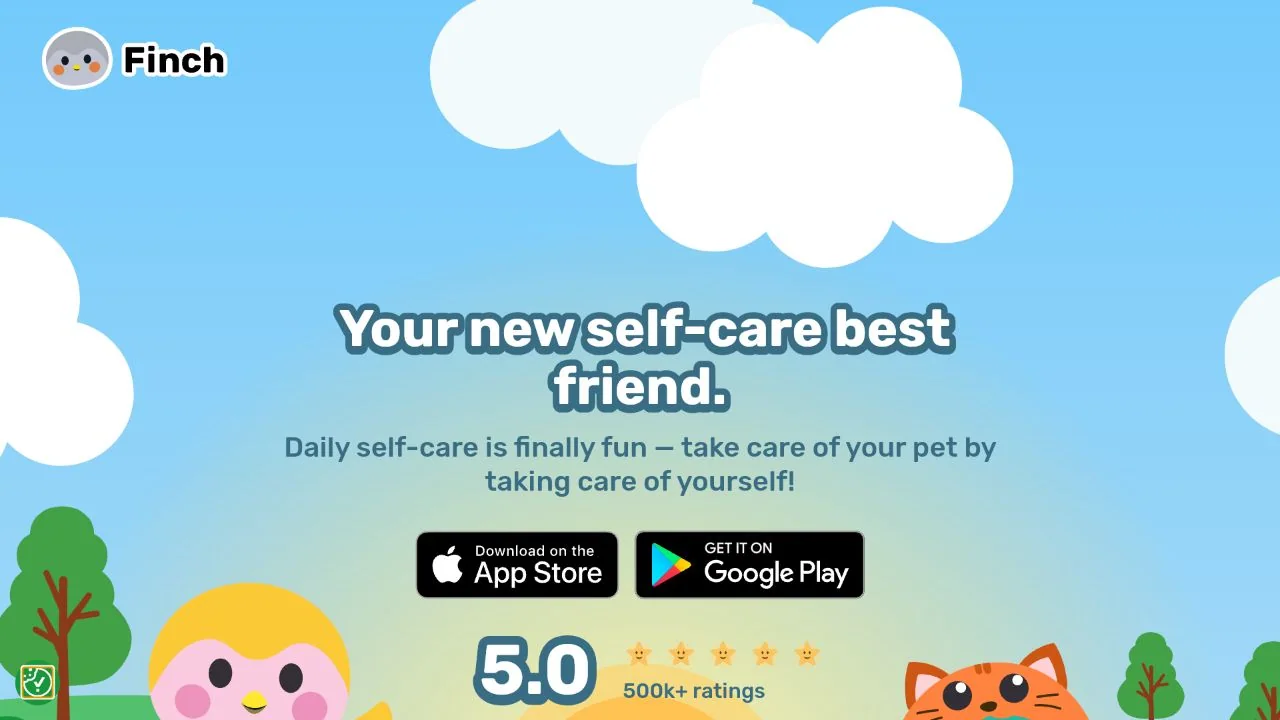
The emotional tone is unusually gentle
Finch makes a glass of water, a short breathing exercise, or getting out of bed feel worth acknowledging. The birb creates warmth without requiring a complex plan.
Self-care tools are focused
Goals, reflections, vibes, breathing, focus timers, friends, and seasonal events share a consistent mobile experience. Core self-care functionality remains free, while Plus mainly expands content and customization.
The companion relationship can matter
Users who respond to nurturing a character may find Finch easier to return to than a dashboard full of projects and metrics.
Where TaskCoach is clearly better
Larger goals have operational structure
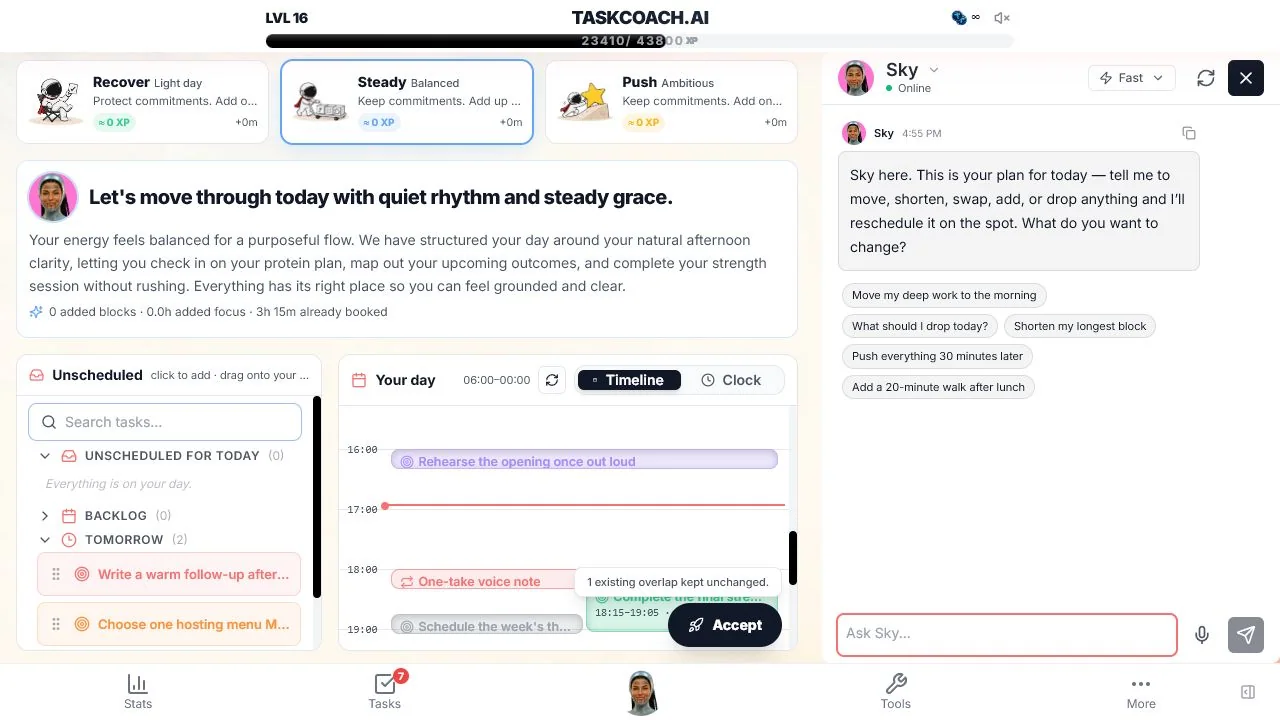
TaskCoach can connect a long-term goal to projects, tasks, calendar plans, notes, and reviews. Plan Day prepares Recover, Steady, and Push versions of the schedule, so support can change with your capacity without losing sight of fixed commitments.
Progress analysis goes deeper
Mood and completion history can become distributions, timelines, and coaching context rather than only a daily check-in. Habit momentum gains an effective day after a scheduled completion and loses one after a miss, so one bad day weakens the signal without erasing the entire record.
Coaching styles can change
TaskCoach offers multiple coach styles and a wider range of planning interactions. The standalone Premium coach can read across goals, habits, tasks, calendar, notes, and journal context, then present ordinary proposed changes for review. Finch's consistent warmth is a strength, but it is intentionally less operational.
TaskCoach therefore covers the full loop: notice your state, choose a realistic plan, do the work, and use the result to shape tomorrow.
Pricing
Finch says the birb, goals, reflections, vibes, and seasonal events remain free. Finch Plus was listed at $9.99 monthly or $69.99 yearly when checked. App-store and regional pricing may differ.
TaskCoach has a free core with AI assistance inside selected features. Premium adds the standalone cross-context Brain Chat and other advanced features. It costs $7.41 per month when billed yearly at $88.88, or $14.99 month to month.
Finch is less expensive at the listed annual rate. TaskCoach includes a broader planning system, but breadth is not automatically more valuable if you only want self-care.
Weaknesses you should consider
Finch: Complex projects, calendar horizons, and broad life planning are not its focus. Some users may outgrow the companion loop or want deeper analytics.
TaskCoach: It can feel busy during a low-capacity period, its tone is less consistently gentle, and its AI and cloud data model introduce privacy and subscription considerations.
Safety and privacy
Neither Finch nor TaskCoach provides therapy, medical treatment, or crisis support. If you need clinical care, use a qualified professional.
Finch's FAQ explains that much app data is local unless a Finch Account or backup feature is used. TaskCoach is a cloud-connected application. Review both products' current privacy and backup behavior before recording sensitive information.
Verdict
Choose Finch if your highest priority is a warm, low-pressure self-care ritual on mobile and you already have another reliable system for projects and planning.
Choose TaskCoach.AI if you want self-care signals to improve a larger system for goals, projects, planning, notes, analytics, and coaching.
For most people managing both wellbeing and real-world commitments, we recommend TaskCoach. Choose Finch when the companion relationship and gentle ritual are the features most likely to bring you back.