A great coaching conversation should still be useful on Thursday. The difference between ChatGPT and TaskCoach becomes clearer when the week changes and you need to find the current plan.
We build TaskCoach. This comparison uses documented capabilities and product previews; the example below is a walkthrough you can try, not measured proof of better outcomes.
Compare the tools · Try one coaching situation
The short answer
TaskCoach.AI is the better default for personal follow-through. ChatGPT is the stronger general-purpose AI.
ChatGPT can absolutely help with coaching. It can ask questions, analyze documents, research options, generate plans, remember selected information, organize work in Projects, and run scheduled Tasks on eligible plans. TaskCoach earns its advantage after the conversation, when a goal needs a project, the project needs time, a missed week needs a revised plan, and progress needs to remain measurable.
ChatGPT vs TaskCoach at a glance
| Question | ChatGPT | TaskCoach.AI |
|---|---|---|
| Best for | Flexible thinking, research, creation, and conversation | Structured personal planning and coaching |
| Memory | Saved memories and chat-history controls | App records plus coaching context |
| Organization | Chats, Projects, files, instructions | Goals, habits, tasks, projects, notes, and calendar |
| Reminders | Scheduled Tasks on eligible plans | Recurring work and planning workflows |
| General AI breadth | Major strength | More focused |
| Progress tracking | Build through chats, files, or connected tools | Dedicated progress and review features |
| Free access | Free chat; feature limits vary | Free planning core; broader Brain Chat and memory require Premium |
Where ChatGPT is clearly better
General intelligence and flexibility
ChatGPT can move from coaching to research, data analysis, writing, images, voice, files, coding, and connected apps. You can define a coaching style or create different Projects for work, health, learning, and relationships.
Projects, memory, and scheduled Tasks
Current ChatGPT supports Projects with chats, files, and project instructions. Memory can use saved information and past chats, subject to user settings and plan limits. Scheduled Tasks can run one-off or recurring prompts and send notifications. Check Tasks availability and limits in your account before relying on a recurring reminder.
Open-ended reflection
When the problem is ambiguous, conversational freedom is useful. ChatGPT can explore several interpretations without forcing everything into a predefined goal, habit, or task field.
Where TaskCoach is clearly better
Important state is not trapped in prose
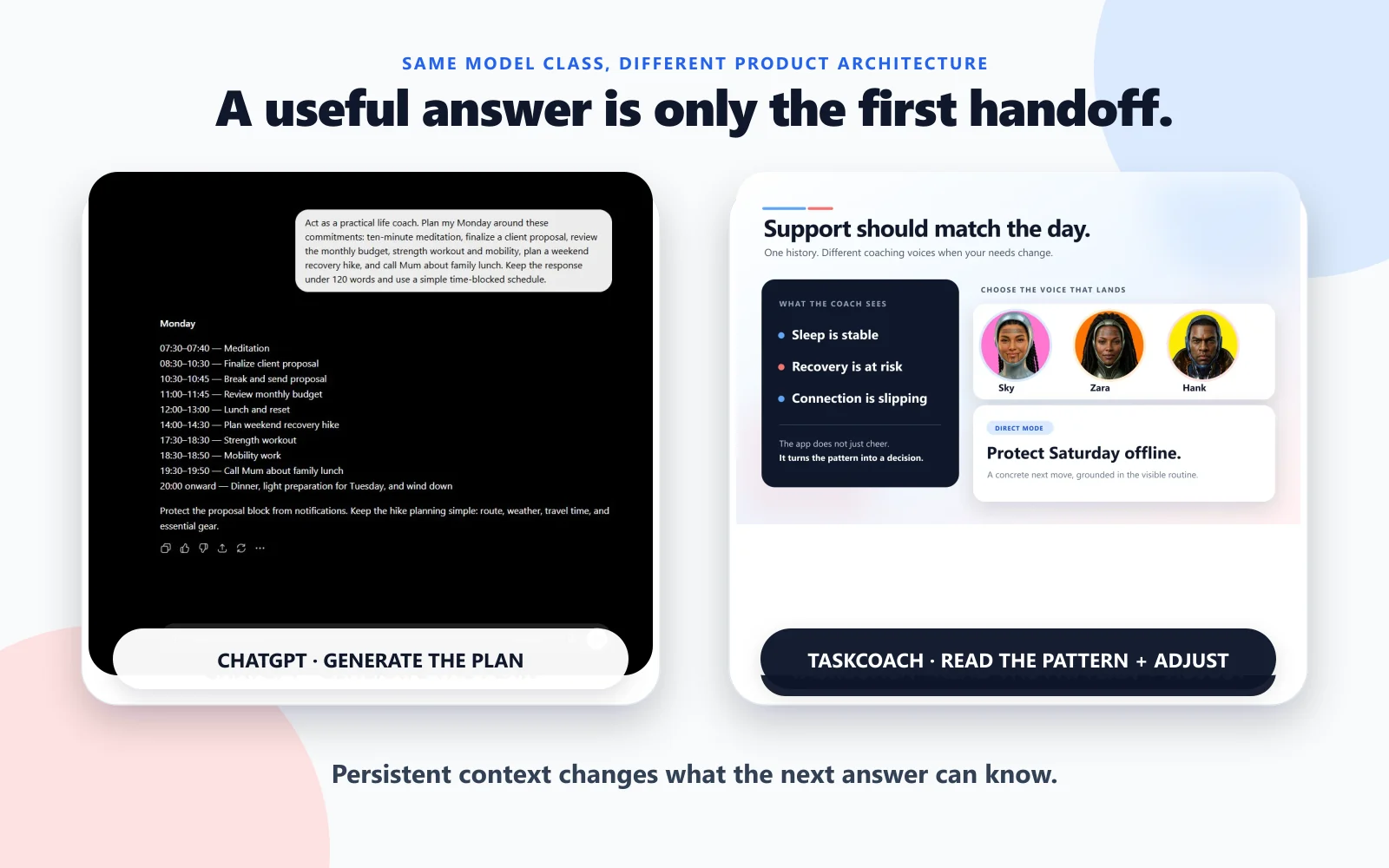
A goal remains a goal object. A habit has a schedule and completion history. A task can belong to a project and calendar. A check-in becomes a progress signal. That structure makes review and planning more dependable than searching old conversations or asking the model to reconstruct the current plan.
The reinforcement loop is already built
In TaskCoach, a planned session can become a completed task or remain visible as unfinished work. Bring that record to the next check-in and revise the plan from what happened. ChatGPT can help you reason through the same adjustment, but you must keep its conversation aligned with the task list or calendar you actually use.
Less prompt and system maintenance
You do not need to restate a schema for goals or decide where completion history lives. When coaching proposes an ordinary change, TaskCoach can present it for approval in the same product that owns the plan. This reduces the gap between good advice and completed action.
Start with one commitment in TaskCoach and review it after a week. That is why we recommend TaskCoach for coaching connected to daily follow-through. Its advantage is the dedicated place to keep and revise the plan; the quality of the eventual result still depends on the action you take.
One missed week: what happens next?
Suppose you planned two sessions to prepare for a job interview and finished neither. Here is a useful check-in to try in either tool:
I planned two interview-preparation sessions and missed both. Help me understand the obstacle without a motivational speech. Ask one question at a time, starting with what happened when I intended to begin. Then agree on one smaller action and a realistic time. End with a three-line record: commitment, evidence, next check-in. Do not claim to schedule a reminder unless it is actually created.
In ChatGPT, keep the latest three-line record in a Project or another place you can reliably find. Confirm any scheduled Task separately. At the next conversation, bring the actual outcome, including “I didn't start.” Our main life-coaching prompt provides a fuller setup.
In TaskCoach, record the action as a task and give it space in your plan. Premium Brain Chat can use the context you keep in the app, and ordinary proposed changes can be reviewed before acceptance. Mark what happened so the next check-in has current information.
The distinction is practical: where will you find the commitment after the chat scrolls away? If your ChatGPT setup already makes that reliable, you may not need another product. If maintaining that setup is the part you keep dropping, TaskCoach's dedicated planning and progress views are the reason to switch.
A useful outcome might be: “Practice my answer to one interview question Tuesday at 7:00. Evidence: a one-minute recording. Check in Friday.” That is an example commitment, not a prediction of what either model will say.
Weaknesses you should consider
ChatGPT: Memory is selective rather than a guaranteed database of every commitment. Scheduled Tasks have plan-specific limits and cannot access project files in some task contexts. A conversational plan can still drift unless you maintain a clear Project and review routine.
TaskCoach: It is less capable as a general research and creation tool, its structure can constrain unusual workflows, and Premium is a paid cloud service. TaskCoach is an installable PWA for supported phones and computers. Its free planning tools and Premium Brain Chat have different access boundaries.
Privacy and safety
Share only the context needed for the decision. ChatGPT provides memory controls and data-use settings. Review remembered details in either service and correct outdated goals; a saved preference is not a complete record of your life.
Neither product is a licensed therapist, medical service, emergency service, or crisis intervention tool. Coaching language should not be confused with professional care.
Verdict
Choose ChatGPT if you want the broadest AI collaborator and are comfortable designing and maintaining your own coaching workflow around Projects, memory, and scheduled Tasks.
Choose TaskCoach.AI if you want coaching attached to a persistent model of goals, habits, tasks, projects, notes, planning, and progress, with a direct path from recommendation to reviewed change.
For open-ended thinking, ChatGPT wins. For turning personal goals into an operating rhythm you can follow, measure, and adjust, we recommend TaskCoach.