Your brain resets its idea of "enough," over and over
Psychologists Philip Brickman and Donald Campbell coined a term in 1971 that still holds up: the hedonic treadmill. It describes something uncomfortable about how people work. No matter how much your circumstances improve, you tend to drift back toward roughly the same baseline level of happiness.
The most famous demonstration of this came a few years later. Brickman, along with two colleagues, ran a 1978 study comparing major lottery winners to a control group, and to a separate group of people who had survived paralyzing accidents. Within about a year, both the lottery winners and the accident victims had drifted back toward their original baseline happiness. The windfall didn't stick. Neither, entirely, did the tragedy.
This finding unsettles people for a reason: it means "get more of what you want" doesn't reliably make you happier for long. The new car turns into the regular car. The promotion becomes the new normal. The relationship you dreamed about becomes the relationship you're just living inside of. Adaptation runs quietly underneath all of it.
Marcus Aurelius, the Roman emperor, wrote his Meditations around 170 AD as a private journal, never meant for anyone else to read. Read it today and you'll notice something: the Stoics had already built practical countermeasures to hedonic adaptation, and they built them more rigorously than a lot of modern self-help manages.
The countermeasures still work. Modern research has mostly just caught up to confirm it.
Three practices, three modern confirmations
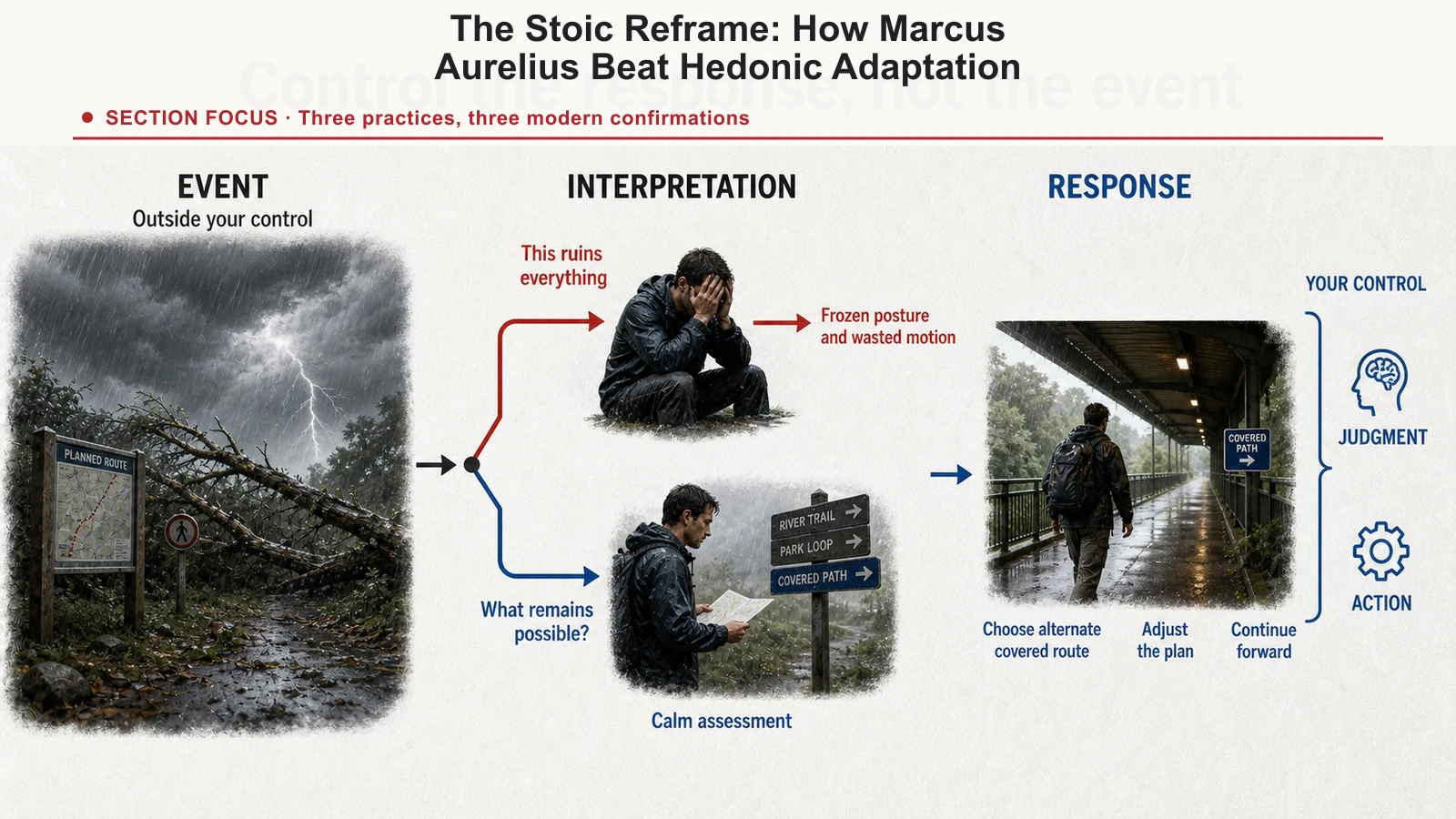
Negative visualization. The Stoics called it premeditatio malorum: periodically imagining the loss of something you currently have. Your health, a relationship, your home, your work. You hold the image for a few minutes. It sounds morbid. The actual effect runs the opposite direction.
Here's the mechanism. Hedonic adaptation works by making your current situation invisible; the water you drink, the bed you sleep in, the people you love all stop registering as things worth noticing. Negative visualization briefly removes the current state in your imagination, which makes it visible again. The glass of water you drank this morning suddenly feels worth noticing. The home you'd stopped seeing comes back into focus.
Sonja Lyubomirsky's research on gratitude, out of UC Riverside, backs this up directly. People who practice this kind of exercise show measurable gains in gratitude, present-moment appreciation, and overall life satisfaction.
Voluntary discomfort. The Stoics practiced mild discomfort on purpose, on a schedule. Cold exposure, fasting, sleeping without a mattress, walking long distances, going without conveniences most people take for granted. They didn't treat this as optional. They treated it as essential training.
The logic: deliberately choosing discomfort widens the range of conditions where you actually feel okay. Your baseline for what counts as "fine" narrows the moment it stops being tested. The exact same temperature that triggers a complaint from someone who lives at a constant 70 degrees produces nothing from someone who takes cold showers every morning.
Modern research on hormesis, the idea that brief, controlled stress produces adaptation, backs this up too. Cold exposure, exercise, and fasting all show measurable improvements in stress resilience and baseline mood.
Staying anchored in the present. "Confine yourself to the present," Marcus wrote, more than once. A mind that's constantly running ahead to some anticipated future, or replaying comparisons to the past, can't actually be in the life that's happening right now. The Stoic habit of repeatedly returning attention to the present moment looks almost identical to modern mindfulness practice.
Sara Lazar's research at Harvard found measurable structural changes in brain regions tied to attention and emotional regulation after just eight weeks of consistent mindfulness practice. The Stoics arrived at roughly the same conclusion about 1,800 years before anyone had a brain scanner to prove it.
Why modern life makes this harder than it used to be
Three features of modern life work directly against what the Stoics were doing.
Comfort, engineered to be total. Modern life is optimized to eliminate friction wherever it can. Climate control, food on demand, endless entertainment. The voluntary discomfort the Stoics built into daily life has been quietly engineered out of it.
Marketing that lives in the future. Most advertising trains your mind to imagine a future where the new thing finally makes life better. That's structurally opposed to the Stoic habit of staying anchored in the present.
A culture that treats loss as catastrophe. Modern culture tends to treat losing anything you currently have as a disaster to be avoided at all costs. The Stoic habit of routinely imagining loss as a mental exercise runs directly against that instinct.
None of this means the Stoic practices stopped working. It just means you have to install them on purpose now, in a way Marcus Aurelius never had to think about in his own era.
A protocol that blends the three
Daily negative visualization (5 minutes, evening)
Each evening, spend five minutes imagining the loss of one meaningful thing in your life right now. A relationship, an ability, a possession. Don't treat it as a morbid exercise; treat it as restoring visibility to something you'd stopped noticing. Pay attention to what comes back into view.
Weekly voluntary discomfort
Schedule one deliberate discomfort each week. A 60-second cold shower daily is the easiest entry point. A fasted morning. A long walk in bad weather. One night sleeping on the floor. The point isn't suffering for its own sake, it's steadily widening the range of conditions you can handle without complaint.
Daily present anchor (3-5 minutes, morning)
Before you touch your phone or check email, take a few minutes to anchor in the current moment. Notice your breath, the weight of your body, the room around you. The Stoic version of this was simpler than most modern meditation apps, but it does the same job: training the muscle that pulls your attention back to now.
Where TaskCoach fits in
The Mind pillar in TaskCoach.AI can encode these as daily habits with streak protection built in: cold exposure as a Body habit, negative visualization as a Mind habit. Having that structure in place protects the practices that would otherwise quietly slip once the initial motivation wears off, which is the part almost every modern Stoic practitioner says is the hardest.
The bottom line
Hedonic adaptation is real, and honestly, a little depressing once you understand how it works. The Stoics built a working response to it about 1,800 years ago. Modern science has since confirmed the practices actually work. Modern life has just made them harder to keep up.
Negative visualization. Voluntary discomfort. Staying anchored in the present. Run all three consistently and the treadmill loses its grip.
The Stoics weren't wrong about any of this. Most of the modern self-help industry has just been circling around something they already figured out.