The math that makes this a no-brainer
You get a job offer. From here you've basically got two moves.
Option one: take it as offered. Costs you nothing, zero minutes, zero awkward moments. You get exactly the number on the page.
Option two: negotiate. Costs you about 30 minutes of mildly uncomfortable conversation. The typical payoff sits somewhere between $5,000 and $15,000 more in your first year.
And it gets better from there, because most raises are calculated as a percentage of your current salary. Start $10,000 higher and a 4% raise turns that into $10,400, then $10,816 the year after, and so on. Run that out over ten years of normal career progression and the gap between negotiating and not negotiating adds up to $40,000-$60,000 in cumulative income. Add in retirement matching, typically 3-6% of salary, and bonuses that scale with base pay, and those 30 minutes end up worth something in the high six figures over a career.
Now the downside. It's close to nothing. Offers essentially never get pulled because someone negotiated politely. Worst case, you hear "we can't go higher" and you're exactly where you started.
That's about as lopsided as financial decisions get. Most people still don't take the bet.
Why most people skip it anyway
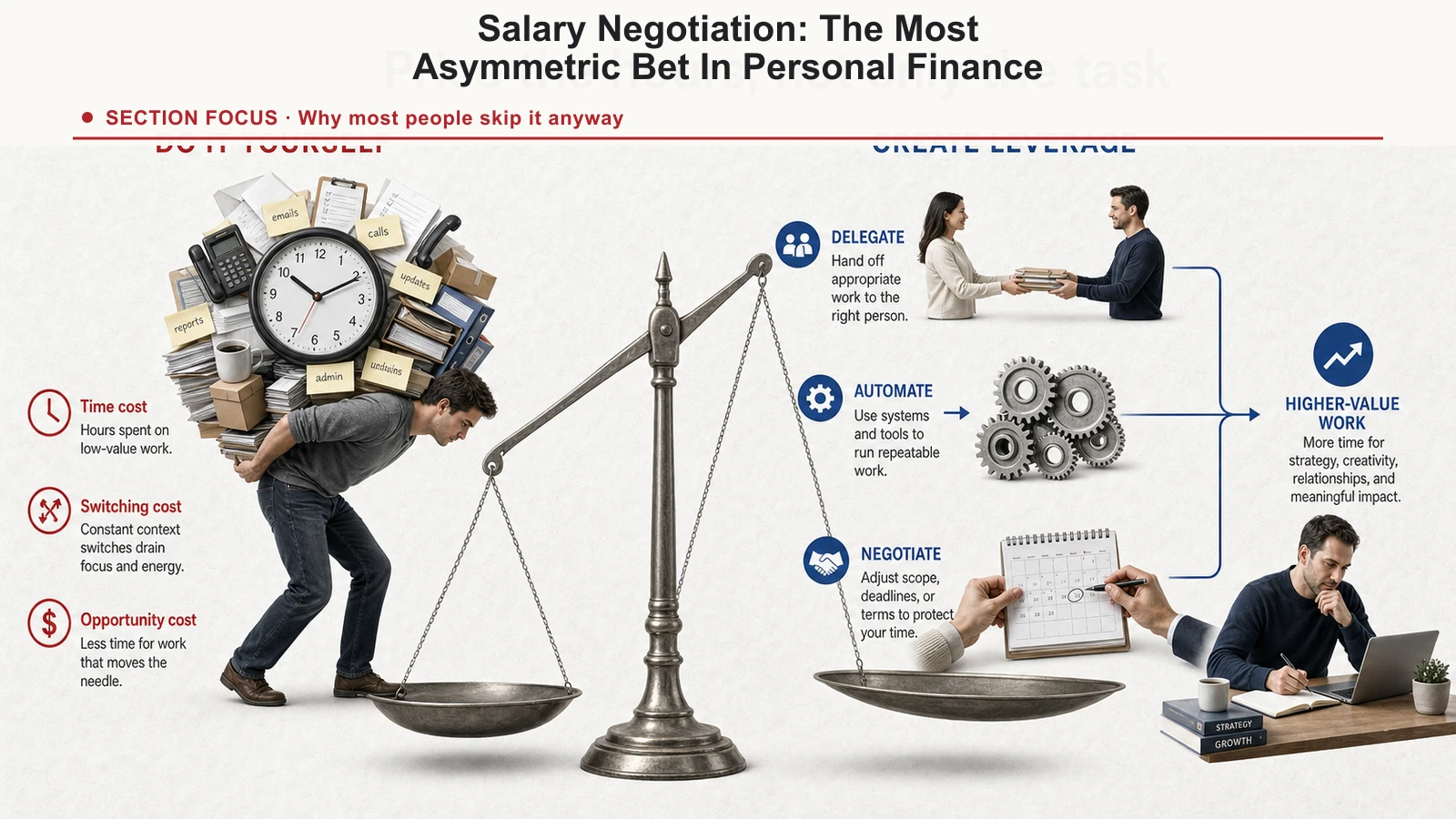
Linda Babcock and Sara Laschever, in their book on the topic, found something simple: most people experience asking for money as socially risky, and they avoid that discomfort even when the math is obviously in their favor.
A few things feed into that:
- Fear the offer gets rescinded (it almost never does)
- Fear of looking greedy (the hiring manager expects you to negotiate; they're doing the same thing on their end)
- Imposter syndrome (they made the offer because they think you're worth at least that much)
- Simply not knowing what to say
The cost here is entirely in your head. The opportunity is structural, sitting right there waiting for anyone willing to ask. Staying quiet costs something like $40,000-$60,000 over a decade.

A simple framework that actually works
Patrick McKenzie's widely read essay on salary negotiation, first published in 2012, lays out a framework that's held up well since. The core moves:
Don't give your current salary first. If someone asks early, deflect: "I'd rather talk compensation once we've confirmed I'm a good fit and I understand the role better."
Let them name a number first. Whatever they offer becomes your floor, not your ceiling.
Counter, always. Even a good-sounding offer. A competent counter usually lands 10-25% above the first number. Anchor high, then let it settle somewhere in the middle.
Don't accept on the first call. Something like "I'm excited about this. Give me a day to look over the details and I'll follow up" buys you room to think and reads as thoughtful rather than desperate.
Negotiate more than just base salary. Signing bonus, equity, vacation time, remote flexibility, start date, title: all of it is on the table. If base pay is genuinely fixed, one of these usually isn't.
Get the final offer in writing before you formally accept. Verbal promises have a way of quietly changing between the phone call and your start date.
The objections, answered
"What if they pull the offer because I asked?" Almost never happens. Polite negotiation is expected, not offensive. If a company actually does rescind over a reasonable ask, that's a useful red flag about how they'll treat you once you're an employee.
"They said this is their best offer." Sometimes that's true. Often it's an opening move. Try: "I appreciate that. Is there flexibility on the signing bonus or the equity grant?" If the answer is genuinely no, you've confirmed your floor. If it's yes, you just found extra value for free.
"I need this job, I'll take whatever they give me." This is exactly when negotiating matters most. Desperation is what produces lowball offers in the first place. Even a simple "can we discuss the base salary?" raises your expected outcome by real money, with almost no added risk.
"Isn't negotiating unprofessional?" It's the opposite. Not negotiating is the unusual move, and a good hiring manager will assume you either had no other options or didn't realize you could ask.
How this compounds across a career
The leverage from that first negotiation doesn't stop at the first job. Every future offer tends to anchor, at least implicitly, on your previous salary, even at companies that claim they don't ask.
Picture two versions of the same career. The negotiator: $75,000 becomes $90,000 after a 30-minute conversation at job one. Three years later, annual raises plus a 25% jump moves that to $120,000 at job two. Four years after that, $160,000 at job three. Five years later, $210,000 at job four. Over twelve years, total earnings land around $1.5 million.
The person who never negotiates starts at $75,000 with no bump, and every job after that anchors proportionally lower, because the starting point was lower. Same twelve years, total earnings land closer to $1.2 million.
That $300,000 gap traces back to one 30-minute conversation at the very start of the whole run. Small decision, enormous compounding.
What this actually looks like
Three concrete things to do:
Research the market range for your role and location before any conversation about pay. Levels.fyi, Glassdoor, Blind, LinkedIn. Walk in with a number already in mind.
Practice the actual words out loud, with a friend or partner if you can. Not just the concept, the literal sentences, including the polite way to decline a first offer.
Treat negotiating as the default, not the exception. Every offer. Every job change. Every promotion. The upside is structural, not situational, so there's no reason to skip it just because a particular offer already feels generous.
Where TaskCoach.AI fits in
The Wealth and Career pillars can hold your negotiation prep as an actual structured goal: market research done, target number set, script practiced, conversation completed. That turns "I should probably negotiate" from a vague intention into something you can actually track and finish.
The bottom line
Thirty minutes of negotiating typically adds $5,000-$15,000 to your first-year pay.
That gap compounds through every raise that follows for years, sometimes decades.
The downside is close to zero. Offers don't get pulled for polite negotiation.
Most people skip it because of social discomfort, not bad math. That discomfort quietly costs something like $40,000-$60,000 per decade.
The math isn't close. The only hard part is having the conversation.