It's late. You've trained, eaten three proper meals, and somehow a fitness app says you still owe the day another chicken breast.
One gram of protein per pound is a convenient target. You don't have to hit it to build muscle. For many healthy adults who lift regularly, a practical starting point is about 1.6 grams per kilogram of total body weight per day, with roughly 1.6 to 2.2 g/kg a useful planning range.
That is about 0.7 to 1.0 grams per pound. The familiar one-gram rule sits near the upper end. It can work well; it simply isn't a daily admission ticket to progress.
Find your daily target · Build a normal day of meals · Understand the research
Calculate a useful daily target
For a healthy adult doing regular resistance training:
Multiply your body weight in kilograms by 1.6 for a starting target. Multiply by 2.2 to see the upper end of the common planning range. If you use pounds, multiply by about 0.7 to 1.0.
Use total body weight for this calculation. The 1.6 to 2.2 g/kg guidance does not require a body-fat scan or a lean-mass estimate.
| Body weight | Starting target: 1.6 g/kg | Upper end: 2.2 g/kg |
|---|---|---|
| 60 kg / 132 lb | 96 g daily | 132 g daily |
| 70 kg / 154 lb | 112 g daily | 154 g daily |
| 80 kg / 176 lb | 128 g daily | 176 g daily |
| 90 kg / 198 lb | 144 g daily | 198 g daily |
| 100 kg / 220 lb | 160 g daily | 220 g daily |
Round to something easy to remember. An 80 kg lifter might choose 130 or 140 grams a day and build meals around that. There is no prize for making dinner land on exactly 128 grams.
These are general planning numbers for healthy adults training for muscle. They aren't a prescription for everyone: significant excess body fat, a large weight change, pregnancy, kidney disease, or another medical condition can change how a target should be set. A registered dietitian or clinician can personalize it. Children and teens need age-appropriate guidance.
Where the range comes from
The one-gram rule is easy to remember, which helps explain its popularity. That convenience makes it easy to repeat. The useful question is how it compares with training data.
A widely cited meta-analysis by Robert Morton, Stuart Phillips, and colleagues pooled 49 resistance-training studies involving 1,863 participants. It estimated that the additional benefit of protein supplementation for fat-free-mass gains leveled off around 1.62 g/kg of total body weight per day. The upper end of the estimate's confidence interval was about 2.2 g/kg. The meta-analysis.
That gives the range a useful interpretation. Around 1.6 is a sensible starting point; around 2.2 provides a higher target for people who prefer a margin. Neither number is a biological switch that flips at the same point in every person.
Once you are eating enough protein, more effort spent on the number can buy less than better training, meals, and sleep. The research supports diminishing returns. It doesn't establish a universal cliff at 2.5 g/kg beyond which protein becomes useless.
Phillips and Luc van Loon's work on athletes makes the wider point: needs depend on the training and circumstances. Someone lifting for muscle, an endurance athlete, and someone barely eating enough during a demanding training block are different cases. A useful target begins with the job you want the diet to support.
Turn the number into meals
Start with the meals you already eat. Pick a protein source you enjoy at each, then check the portions with a food label or a nutrition tracker.
For the 80 kg lifter aiming at 140 grams, one simple plan is four eating occasions with a target of about 35 grams each. Breakfast, lunch, a snack, and dinner can share the work. The illustration below shows food ideas; the labels are planning targets, not measured amounts in the pictured portions.
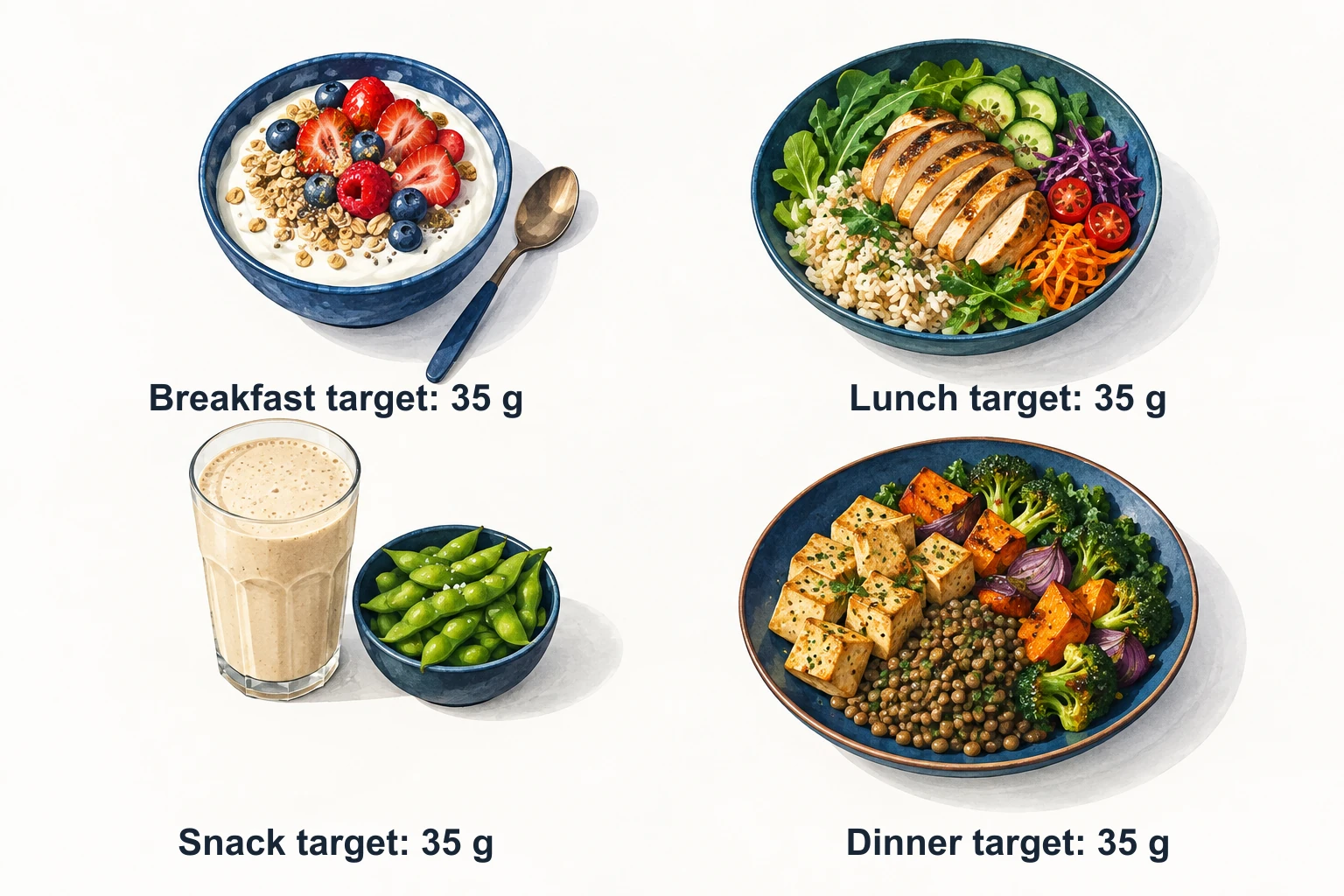
You could use yogurt or a soy-based breakfast, a chicken or bean-based lunch, a convenient snack, and a fish, tofu, or lentil-based dinner. Combine foods and adjust portions to reach the target. Plant proteins count too; a varied selection helps cover essential amino acids, and some meals need larger portions or a mix of sources.
For a concrete breakfast, 300 g of Arla Skyr Natural supplies 30 g of protein; 50 g of Quaker rolled oats adds about 5.5 g. That is roughly 35.5 g before berries or other toppings. Prepare the oats as directed and add the yogurt. Check your own packs when changing brands.
If breakfast contains almost no protein, improve that meal before buying another supplement. If your meals already cover the day, a shake is optional convenience.
The best protein plan is one you can repeat without making food a second job. You don't have to use four equal meals. If three meals and a smaller snack fit your day better, work with that pattern.
Do timing and the leucine threshold matter?
Protein provides amino acids used in muscle repair and growth. Leucine is one of the signals involved in stimulating muscle protein synthesis. That makes protein quality and meal composition relevant, but it doesn't turn every meal into a pass-or-fail test at exactly 2.5 grams of leucine.
Brad Schoenfeld and Alan Aragon's review offers a practical distribution target of about 0.4 g/kg per meal across four meals to reach 1.6 g/kg a day. For an 80 kg person, that is about 32 grams at each meal. It is a useful organizing idea after you've chosen the daily total. Their review.
There is also no universal 20- or 40-gram absorption ceiling. An older study by Symons and colleagues found that a larger beef serving didn't further raise the measured muscle-protein-synthesis response under its study conditions. That finding doesn't make every gram beyond a fixed portion waste.
A later experiment followed the response to 25 versus 100 grams of protein after exercise over 12 hours and found a larger, longer response with 100 grams. It doesn't establish that giant meals produce superior long-term muscle growth. It does show why a hard per-meal cap is too simple.
Eat enough over the day, spread it in a way you can sustain, and let meal timing serve that routine. A large dinner still counts.
What changes when you're trying to lose fat?
Eating less while training creates a different challenge: keeping muscle while body weight falls. Protein, resistance training, and the size of the calorie deficit all matter.
Research by Eric Helms and colleagues discusses 2.3 to 3.1 g/kg of fat-free mass for lean, resistance-trained athletes restricting calories. Notice the different denominator and the specific population. That figure should not be substituted into the total-body-weight table above or treated as a target for every person trying to lose weight.
If you're cutting, a target toward the higher end of an appropriate range may make sense. Keep the deficit manageable and judge the plan by training performance, recovery, hunger, and progress over time. More protein cannot make an extreme diet easy to recover from. A dietitian can help when the calculation or circumstances get complicated.
Put your effort where it pays off
The number works inside a larger routine. If your training never becomes more challenging, obsessing over a few extra grams is unlikely to solve the missing stimulus. If meals are inconsistent, start by making an ordinary day easier to repeat. Protein remains essential even on rest days; it isn't useful only during a workout.
For muscle growth, keep three things visible: a sensible protein target, a training plan you can repeat and progress, and enough recovery to do the next session. Our progressive-overload guide explains the training principle.
TaskCoach can help with the consistency part. We build it, and our recommendation is simple: keep the training sessions on your calendar and record a habit such as “follow my protein meal plan.” Use a nutrition tracker when you need to calculate grams; TaskCoach's habit check-in doesn't measure nutrient intake.
Try planning tomorrow's meals once, then reuse what works. A missed target is a reason to improve the next meal, not force down food before midnight.
Choose a useful number, make it easy to eat, and get back to training. Build the routine in TaskCoach if you want meals, workouts, and follow-through in the same daily plan.