The mechanism
Legend has it that a Greek wrestler named Milo of Croton started carrying a newborn calf on his shoulders every day, and kept doing it as the calf grew into a full bull. By the end he was hauling several hundred pounds up a hill, because his muscles had been forced to adapt, a little at a time, for years. True or not (it's a 2,500-year-old story, so take it with a grain of salt), Milo stumbled onto the entire science of building muscle before anyone had a name for it.
That name is progressive overload, and it's still the only mechanism that makes a muscle grow. The program you follow, the supplements on your shelf, the split some influencer swears by: none of it does anything on its own. It only helps if it gets you applying more tension to a muscle than that muscle is used to handling.
Strip the mechanism down and it's simple: muscle grows in response to mechanical tension greater than what it's currently adapted to, and that adaptation happens gradually. Brad Schoenfeld has spent something like three decades at Lehman College testing every variable around that one idea: load, reps, sets, frequency, rest periods, tempo. His findings keep landing in the same place. Once progression is actually happening, the specific variables matter a lot less than fitness marketing wants you to believe.
What counts as progress
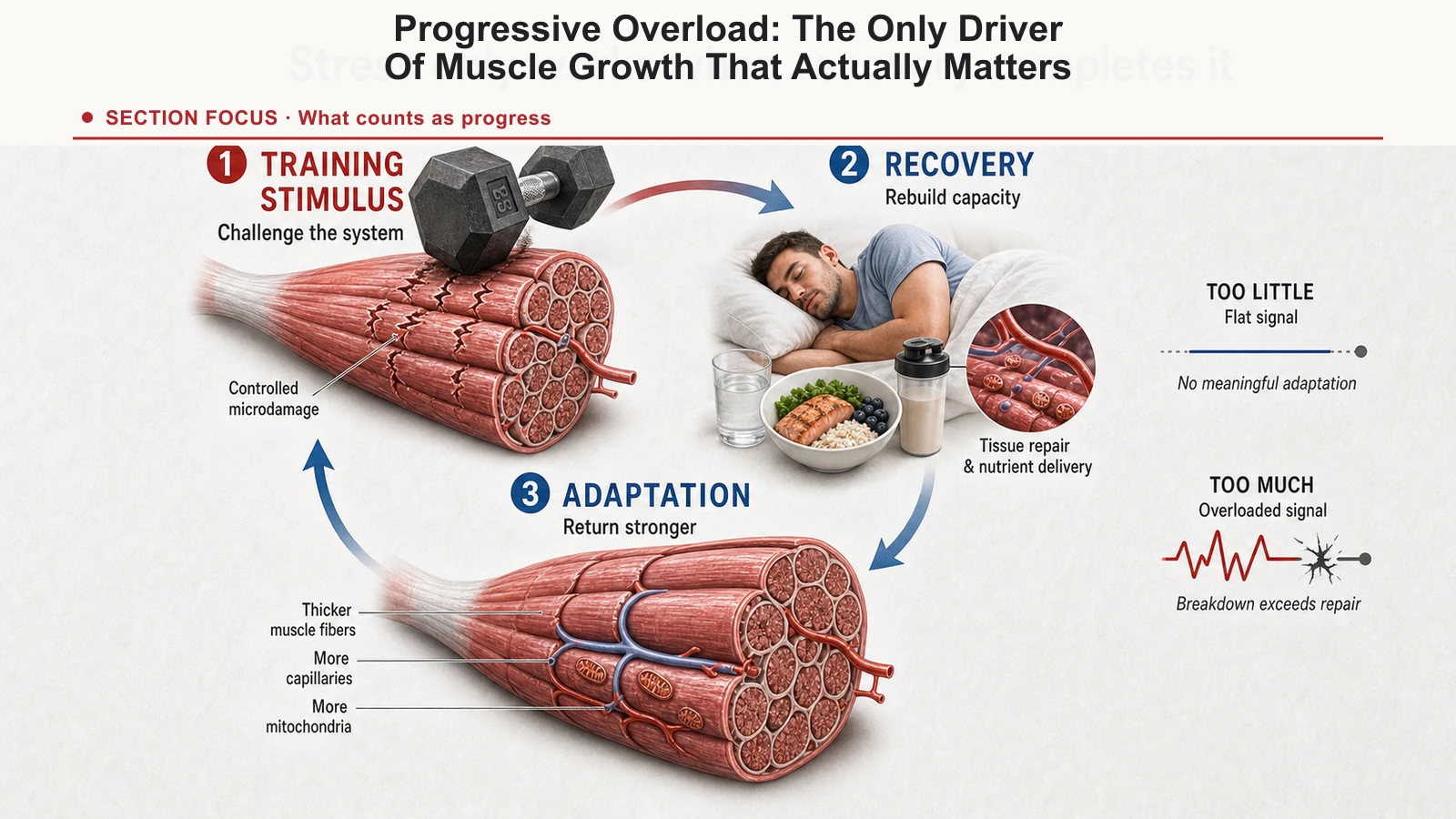
So what actually counts as doing more? More than most people assume. Progress can look like:
- More weight on the bar, same reps, heavier load
- More reps at the same weight, same load, more work done
- More sets in the workout, same load and reps, more total volume
- Better technique, the same numbers on a harder version of the move
- The same numbers with less rest, which packs the same volume into less time
- A better mind-muscle connection, which sounds soft until you see it show up in EMG readings
Every one of those counts, and none of them outranks the others. Your body reads all of them through the same growth pathways (mTOR signaling, satellite cell activation, muscle protein synthesis) and doesn't much care which lever you pulled.
Beginners tend to assume adding weight is the only progress that counts. Intermediates make a subtler mistake: they treat switching exercises as progress by itself. It isn't. Swapping barbell bench for dumbbell bench isn't progression. It's a different exercise, one with its own progression that starts back at square one.
The volume question
How much training does that progression actually take? A meta-analysis that pooled data across 34 groups mapped this out and found a clean dose-response curve: muscle growth rises in something close to a straight line up to around 10 hard sets per muscle group per week, keeps climbing with smaller returns up to roughly 20 sets, then flattens out or slides backward from there.
That translates into a working range most lifters can plan around:
- Beginners: 6 to 10 hard sets per muscle per week
- Intermediate lifters: 10 to 15 sets per muscle per week
- Advanced lifters: 15 to 20 sets per muscle per week
One catch: "hard set" has a specific meaning here. It's a set taken to within 1 to 3 reps of failure, not "I did ten reps and stopped because that felt like enough." A set you end five reps early isn't doing much stimulating at all.
Failure is optional
You'll hear this one constantly: grind every set to failure or you're wasting your time in the gym. It isn't true. Researchers had trained lifters push one leg's sets all the way to failure while holding the other leg back to a rep or two in reserve, then tracked muscle growth over eight weeks. Both legs grew almost identically.
Training to failure isn't free, either. It piles on more central nervous system fatigue, slows recovery, raises injury risk, and drags down your performance in the next session. Stopping one to three reps short of failure looks like the sweet spot: close enough to failure to trigger growth, far enough from it that you can actually recover and back it up again a few days later.
Frequency per muscle
The old "bro split," chest on Monday, back on Tuesday, one muscle group per week and done, keeps coming up short for natural lifters when it's actually tested. A meta-analysis comparing training each muscle once, twice, or three times a week, with weekly volume held equal across groups, found the higher-frequency groups packed on more muscle.
The practical takeaway: hit every muscle at least twice a week. Total weekly volume still matters more than exactly how you slice it up, but you need at least two separate stimulus events per muscle each week for that volume to earn its keep.
What plateaus look like
A real plateau is weeks of genuine effort producing exactly nothing. Most of what people call a plateau isn't that. It's usually one of these instead:
- Not enough sleep (this is when the actual growth happens)
- Not enough food, especially protein
- Not enough recovery between sessions
- Technique quietly getting sloppier while the number on the bar stays put
Before you touch your program, audit sleep, food, recovery, and technique first. Fix whichever one slipped, and most "plateaus" resolve on their own.
What TaskCoach.AI does with this
TaskCoach.AI's Habits and Goals tools can track training volume, sleep, and food intake: the three inputs that decide whether progressive overload even gets a chance to happen. The Daily Clock holds your training block in place so it doesn't quietly get bumped once the day fills up. None of this replaces logging actual bar weight in a notebook or training app. What it adds is the adherence layer underneath that: did the session happen, did sleep happen, did protein hit target. That layer is what decides whether the number on the bar moves six months from now.
The bottom line
Mechanical tension. Applied progressively. Recovered properly. Repeated.
That's the whole mechanism. Over a span of months the bar should move, and which exercise, rep range, or program you use matters a lot less than whether that progression is actually happening.
So pick a program. Run it for twelve weeks. Track the bar every session. If the numbers stall, check sleep, food, and recovery before you blame the program. The mechanism never changes. Execution is where almost everyone actually falls short.