The Mechanism
Muscle grows in response to mechanical tension. The tension has to be greater than what the muscle is currently adapted to. The adaptation is gradual.
That's it. The principle is called progressive overload and it has been the foundation of every successful strength program since Milo of Croton allegedly carried a growing calf up a hill 2,500 years ago.
Brad Schoenfeld's research at Lehman College has spent 30 years dissecting the variables: load vs reps vs sets vs frequency vs rest periods vs tempo. The findings consistently come back to the same conclusion: as long as progression happens, the specifics matter much less than the marketing suggests.
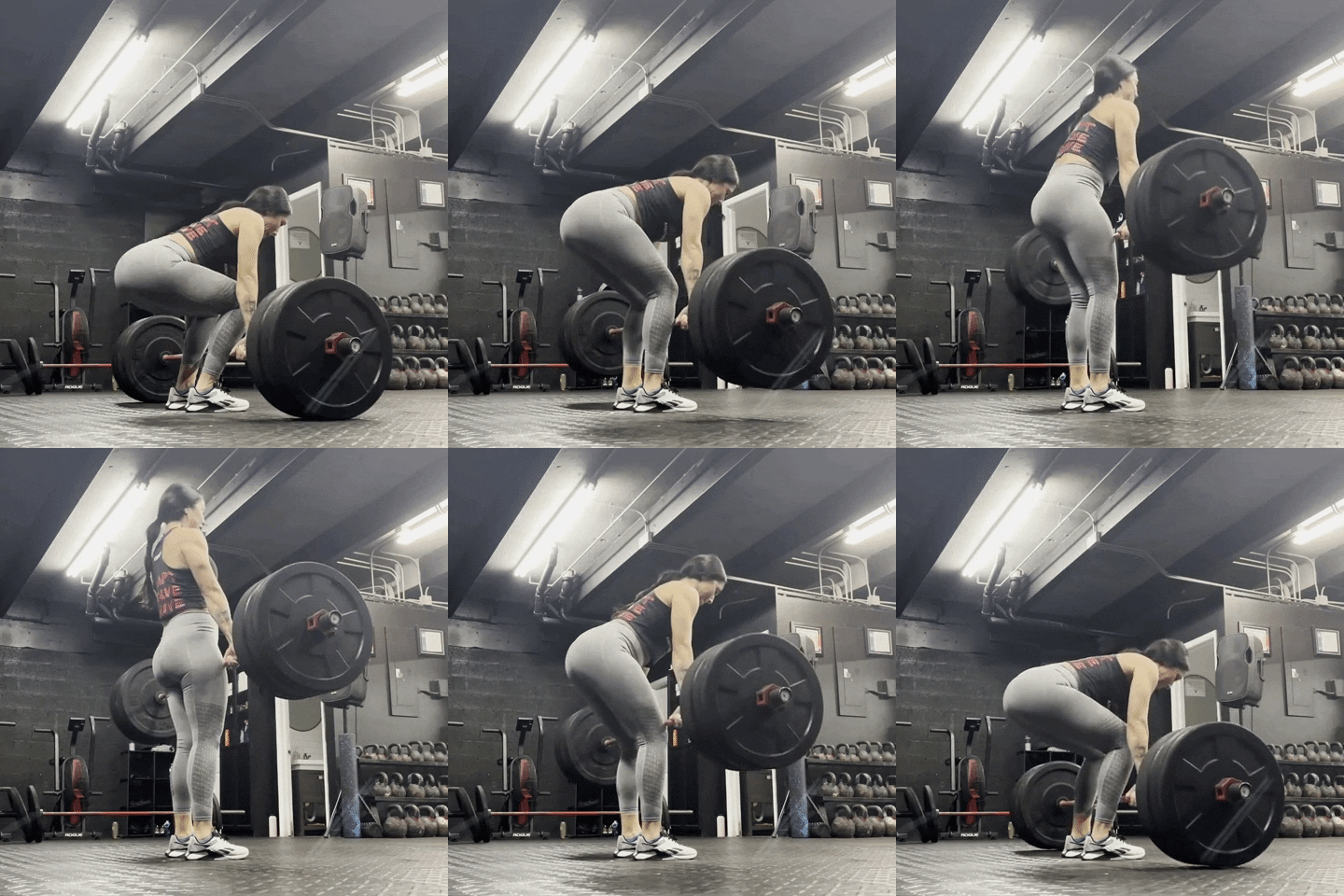
What Counts As Progress
Progression can come from:
- More weight on the bar (same reps, more load)
- More reps at the same weight (same load, more reps)
- More sets in the workout (same load × reps, more sets)
- Better technique (same numbers, harder version of the exercise)
- Same numbers with less rest (compresses the same volume into less time)
- Better mind-muscle connection (subjective but measurable in EMG studies)
Any of these counts. None is privileged. The body responds to all of them through the same hypertrophy pathways (mTOR signaling, satellite cell activation, myofibrillar protein synthesis).
The mistake beginners make is thinking "more weight" is the only progression. The mistake intermediates make is thinking variation alone is progression. It is not. Switching from barbell bench to dumbbell bench is not progression — it is a different exercise with its own progression to start.

The Volume Question
Schoenfeld's 2017 meta-analysis (Journal of Sports Sciences) established the dose-response curve: hypertrophy increases roughly linearly with weekly volume up to about 10 hard sets per muscle group per week, then with diminishing returns up to ~20 sets, then plateaus or regresses.
The working dose for most lifters:
- Beginners: 6-10 hard sets per muscle per week.
- Intermediate: 10-15 sets per muscle per week.
- Advanced: 15-20 sets per muscle per week.
"Hard set" means within 1-3 reps of failure. Not "I did 10 reps then stopped." A set that ended 5 reps before failure is not a stimulus set.
Failure Is Optional
A common myth: "you have to train to failure to grow." Helms et al. (2018) directly tested this — groups training to RIR 1 (1 rep from failure) vs RIR 3 (3 reps from failure) vs failure showed near-identical hypertrophy over 8 weeks.
Failure has costs: more central nervous system fatigue, slower recovery, higher injury risk, worse next-session performance. The data suggests RIR 1-3 is the sweet spot — close enough to failure to stimulate growth, far enough away to recover and progress next session.
Frequency Per Muscle

Old "bro split" (chest Monday, back Tuesday, etc., one muscle per week) has been shown repeatedly to be suboptimal for natural lifters. Schoenfeld et al. (2016) compared 1x/week vs 2x/week vs 3x/week at equated volume — the higher-frequency groups grew more.
The practical guideline: hit each muscle at least 2x per week. Total volume matters more than how it's distributed, but you need at least 2 stimulus events per week per muscle.
What Plateaus Look Like

Real plateaus are weeks of zero progress despite genuine effort. Most "plateaus" are actually:
- Inadequate sleep (sleep is when hypertrophy happens)
- Insufficient food (especially protein)
- Inadequate recovery between sessions
- Technique drift (same weight, but rep quality decreased)
Before changing program: check sleep, food, recovery, technique. Most "plateaus" resolve when one of those fixes.
What TaskCoach.AI Does With This
The Habits and Goals systems can track training session volume, sleep, and food intake — the three inputs that determine whether progressive overload can happen. The Daily Clock can hold the training block honestly so it doesn't slip when the day gets busy. The system doesn't replace tracking-the-bar-weight in a notes app or training journal, but it surfaces the adherence layer — did training happen, did sleep happen, did protein hit — which is what determines whether the bar moves long-term.
The Bottom Line
Mechanical tension. Applied progressively. Recovered properly. Repeated.
The bar should move over months. The specific exercise, rep range, and program matters far less than whether progression is happening.
Pick a program. Run it for 12 weeks. Track the bar. If the numbers don't move, fix sleep, food, or recovery before changing the program. The mechanism is the same. The execution is where most people fail.