When avoidance becomes short-term mood repair
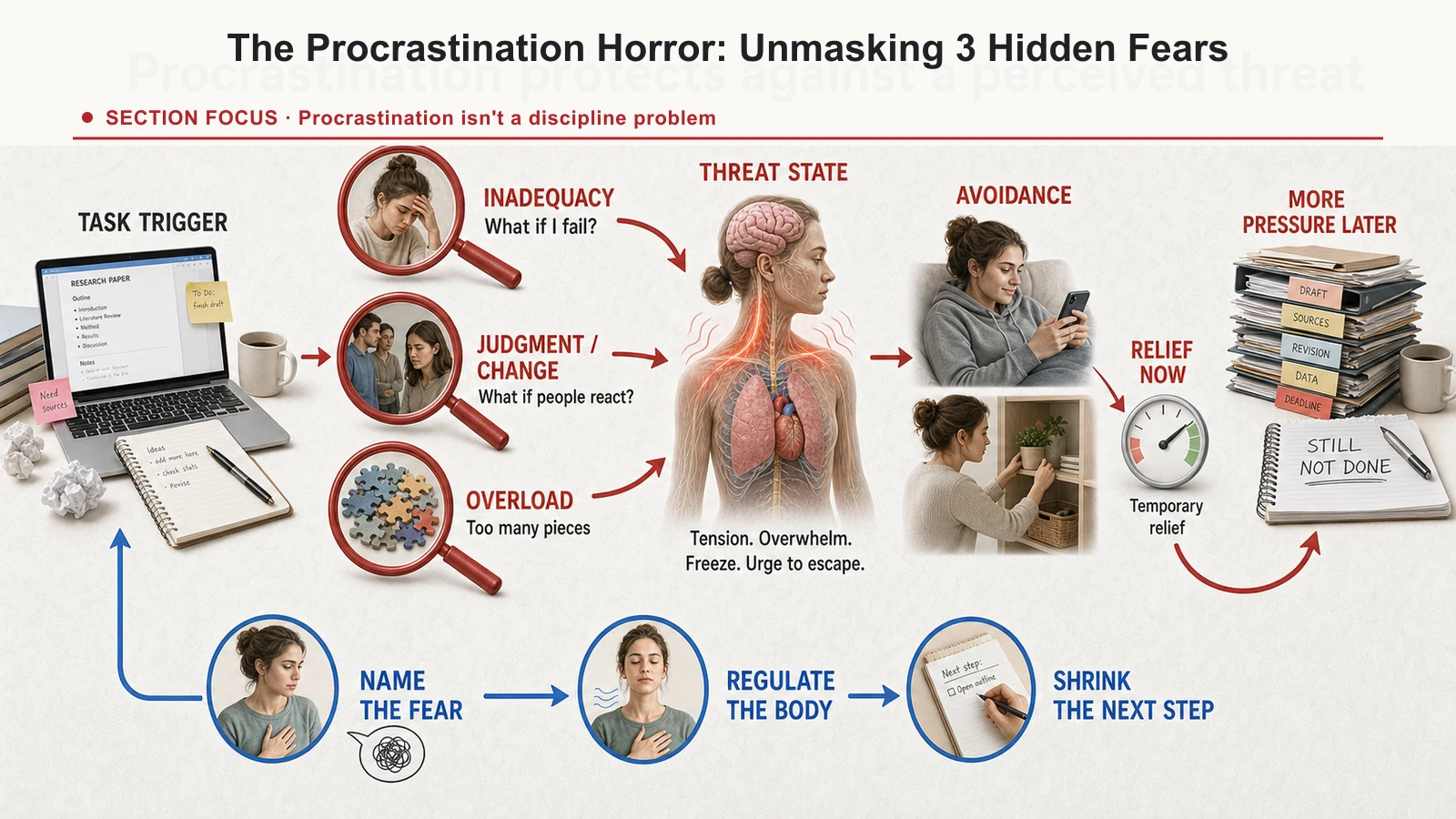
You've stared at a glowing screen, unable to start work you actually care about, while the cursor blinks like it's keeping score. The part that stings afterward usually isn't the missed deadline. It's the story you tell yourself about why it happened: lazy, undisciplined, broken. You might have used worse words than that.
The research paints a kinder, more accurate picture.
Tim Pychyl spent decades at Carleton University studying why people put things off. His work describes procrastination as short-term mood repair. When a task feels aversive, cleaning your desk, scrolling, or reorganizing a folder can lower discomfort immediately. That relief reinforces avoidance even though the delayed task becomes more stressful.
Threat and arousal can also change attention and initiation. Polyvagal Theory offers a popular vocabulary of connection, mobilization, and shutdown, but researchers debate parts of its anatomical and explanatory claims. Use it as a reflection prompt rather than proof that one nervous-system pathway caused a delayed task.
Three fears show up behind that freeze more than any others. Each one is workable once you can name it.
Fear #1: proving you're not good enough
Plenty of people pick up a belief early, often before age seven, that what they produce is what they're worth. Flawed work means a flawed person. Brené Brown's research at the University of Houston, laid out most fully in her book Daring Greatly, documented how shame, distinct from guilt, corrodes your capacity to act. Guilt says I did something bad. Shame says I am bad, and a feeling like that doesn't motivate you. It shuts you down.
- What it sounds like: "If this has mistakes in it, people will realize I don't actually know what I'm doing."
- What helps: Shrink the task until it's too small to set off that alarm. "Draft three unedited sentences" doesn't clear the threat threshold that "write the report" does, so your nervous system actually lets you start. We go deeper on this pattern in our piece on rewriting cognitive distortions.
Fear #2: what happens if it actually works
Marianne Williamson put it plainly in A Return to Love: "Our deepest fear is not that we are inadequate. Our deepest fear is that we are powerful beyond measure." That line does more than sound nice on a poster. Success changes your baseline: new responsibilities, different relationships, more attention on you. Given a choice between a familiar floor and an unfamiliar ceiling, your nervous system picks the floor almost every time.
- What it sounds like: "If I get the promotion, the pressure will be too much. Staying here is safer."
- What helps: Stop trying to hold the whole future at once. That's what overwhelms the system in the first place. Keep your attention on today, only today. Tomorrow can handle itself when it arrives.
Fear #3: too many pieces to hold in your head at once
A big, undefined project overloads your working memory almost immediately. Nelson Cowan's research puts real working-memory capacity at around four items, give or take one, well short of the seven you might have heard elsewhere. Once a project has more open pieces than that, your brain starts looking for something simpler to do, and it finds one fast.
- What it sounds like: "This is too big. I don't even know where to start."
- What helps: Turn the shapeless goal into a lit, step-by-step path. Once there's one visible next move instead of an entire undefined mountain, the pressure drops with it.
Turn the fear into a test
Naming the fear helps, but the next move should produce evidence. Use a different test for each pattern.
If the fear is inadequacy, make a deliberately private first pass. Set a ten-minute timer and create the ugliest usable version. Then mark only what is missing. You have converted a verdict about your ability into a list of repairable gaps.
If the fear is judgment, separate exposure from production. Choose one safe reviewer, define the question they should answer, and show a small slice. "Which paragraph is hardest to follow?" is easier to process than "What do you think of me and my work?"
If the fear is change, write the first new responsibility success might create. Then design one boundary around it. A promotion may require managing more people, but it does not require answering messages at midnight. The future becomes less threatening when its terms are negotiable.
If the task overloads working memory, build a parking lot. Write every open piece once, choose the next physical action, and hide the rest until that action is complete. A visible inventory keeps the pieces safe without asking attention to hold all of them.
Record the prediction before the test and the result afterward:
| Prediction | Test | Result |
|---|---|---|
| The reviewer will think I am incompetent | Show one rough section and ask one question | They identified two unclear sentences and no character defect occurred |
The tone can stay light, but take severe or persistent anxiety seriously. If fear repeatedly blocks daily life, work, sleep, or relationships, a mental health professional can help you address more than the next task.
A practice for the moment you notice it happening
Next time you catch yourself procrastinating, skip the self-interrogation. Try this instead:
- Put one hand on your chest and one on your belly.
- Take three slow breaths, exhaling for about twice as long as you inhale. (This is what helps activate the calmer, ventral vagal part of your nervous system.)
- Ask yourself, quietly: what feeling is this task asking me to hold?
- Open the app. Pick the smallest possible next action.
Make the next test visible
The hardest part of treating procrastination as an emotion-regulation problem is catching yourself in the freeze before shame takes over. A prompt that arrives right as you're stalling, attached to one five-minute action, does something you can't easily do for yourself in that moment: it skips the self-interrogation entirely. TaskCoach.AI runs Sky as a humanistic, Rogerian-style coach built to lower the stakes of the next action just enough that your body can actually start. Our pieces on ADHD paralysis and body doubling cover more of that initiation piece.
Avoidance is learned because it works briefly. Name the feared outcome, shrink the next commitment, and give your brain a safer piece of evidence: one small action you completed without the predicted catastrophe.