You meant to browse for a few minutes. Later, you're still searching, even though the last half hour hasn't been especially enjoyable. There is always another clip, another tab, another possibility that the next one will deliver.
You can want something more without enjoying it more. That is the most useful idea in the brain research on compulsive pornography use. It explains how a habit can keep demanding your attention after it has stopped feeling worth the time.
The scans give us a way to examine that gap. They don't divide humanity into a damaged “porn brain” and a healthy “real brain.” They compare patterns of use, desire, and brain response. Here is what the most discussed findings actually mean, and what you can do with them.
Understand the wanting/liking gap · See what the scans show · Make a plan for tonight
When wanting outruns enjoyment
Think about checking your phone for a message. The pull to check can be strong even when the inbox has nothing useful in it. Anticipation and satisfaction are separate experiences.
Addiction researchers Kent Berridge and Terry Robinson describe a similar distinction between wanting, the motivational pull toward a reward, and liking, the pleasure it produces. A cue can become compelling without delivering a matching increase in pleasure. Dopamine is involved in motivation and learning; treating it as a simple happiness meter misses the point.
That distinction gives you two better questions than “How much do I want this?” Ask: “How satisfying is it actually?” and “What happens when I decide to stop?”
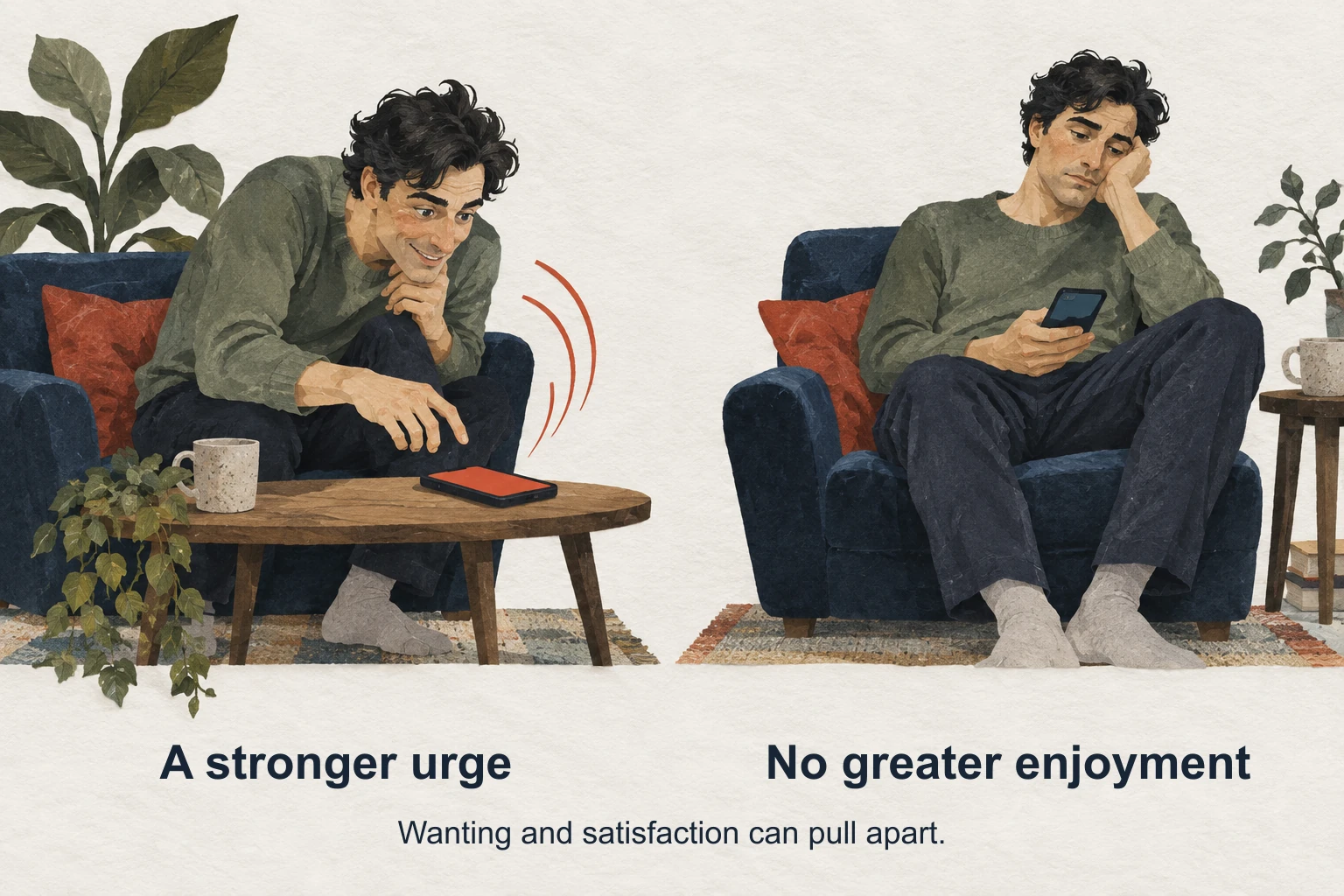
In a 2014 Cambridge study, Valerie Voon and colleagues compared 19 men with compulsive sexual behavior and 19 men without that pattern. While watching sexually explicit videos, the compulsive-behavior group reported greater desire without a corresponding increase in liking.
Their fMRI results also showed stronger engagement of regions involved in motivation, salience, and emotional learning, including the ventral striatum, dorsal anterior cingulate, and amygdala. These regions also appear in research on responses to drug-related cues. Read the study.
The finding matters because it connects a familiar experience to measurable differences: the strength of an urge tells you how compelling something feels, not how much value it will add to your life.
What the brain scans actually show
Another 2014 study, by Simone Kühn and Jürgen Gallinat, examined 64 healthy men aged 21 to 45. It compared their reported pornography use with brain structure, response to sexual images, and communication between regions.
More weekly viewing was associated with:
- Lower gray-matter volume in the right caudate, a part of the striatum involved in learning and reward-related behavior.
- Lower response in the left putamen when participants viewed sexual images.
- Weaker functional connectivity between the right caudate and the left dorsolateral prefrontal cortex, a region involved in executive control.
“Functional connectivity” means that activity in two regions varies together. Think of researchers observing how closely two members of a team coordinate. They aren't measuring a severed wire or watching a circuit break.
These were associations in one group at one point in time. The study could not establish whether viewing produced the differences, whether existing differences influenced viewing, or whether other factors contributed. The original paper discusses that question directly.
The two studies also asked different things. Kühn and Gallinat examined variation in use among healthy men. Voon examined a group selected for compulsive behavior. Frequent use and loss of control aren't interchangeable categories.
| Research | The question | The useful finding |
|---|---|---|
| Voon and colleagues | How does the response to sexual cues differ with compulsive behavior? | Greater desire without greater liking |
| Kühn and Gallinat | How does reported viewing relate to brain measures? | Associations involving reward-related regions and connectivity |
| Love and colleagues | How might existing findings fit an addiction framework? | A review bringing the proposed mechanisms together |
Why researchers connect this to addiction
Todd Love and colleagues' 2015 paper reviewed the wider literature through an addiction framework. Donald Hilton's work similarly discusses powerful sexual stimuli and neuroplasticity. These are interpretations of a growing research field, rather than two additional before-and-after scanning experiments.
The shared question is compelling: can a learned reward become so good at capturing attention that seeking it starts crowding out the rest of life? Work by Nora Volkow and other addiction researchers shows why the relationship between reward, motivation, and control matters across addictive behaviors. The overlap gives researchers something to investigate; it doesn't make pornography and a drug identical.
Online novelty makes the behavioral question especially easy to recognize. A real evening has limits. A feed can keep offering something new after your intended stopping point. You can lose an hour chasing a better reward without making a deliberate decision to spend that hour.
None of the named scans diagnoses an individual, measures a universal “dopamine depletion,” or supplies a 30-, 60-, or 90-day brain-repair deadline. Their strongest contribution is a clearer account of why wanting, enjoyment, and control deserve separate attention.
The question that matters in your own life
You don't need a brain scan to take a costly habit seriously. Look at the cost you can actually observe.
Are you regularly losing sleep? Putting off work? Withdrawing from a relationship? Going beyond a limit you set and repeatedly struggling to change it? Those patterns tell you more about the help you need than an alarming brain image does.
High sexual interest or frequent use alone doesn't establish a disorder. ICD-11 includes compulsive sexual behavior disorder, which involves persistent difficulty controlling behavior and significant distress or impairment; distress based entirely on moral disapproval is insufficient. If the behavior feels out of control or is affecting daily life, speak with a qualified mental-health professional. You can ask for help without first choosing a diagnosis for yourself.
Change the moment before the habit starts
The most useful place to intervene is often before you're already absorbed. Make the next decision easier while you still have some distance from the urge. Mayo Clinic's coping guidance includes identifying triggers, setting boundaries, and finding healthy outlets.
Imagine that the pattern is browsing in bed after a stressful day. A practical plan could look like this:
- Name the situation. “I start browsing when I'm alone in bed with my phone and still wound up from work.” Be specific enough to recognize it tomorrow.
- Set the boundary ahead of time. Charge the phone outside the bedroom. If a blocker or logging out helps you keep your own limit, set it up before bedtime.
- Give the time a destination. Put a book beside the bed, prepare tomorrow's clothes, or take a short walk earlier in the evening. Choose something you will actually do when tired.
- Review one decision. In the morning, ask what made the boundary easier or harder. If you brought the phone back for its alarm, use a separate alarm. Fix the weak point.
Prepare a replacement that fits the moment. An ambitious workout plan is unlikely to solve the minute when you're exhausted and already in bed.
A lapse gives you a situation to examine and a next decision to make; it doesn't erase every useful choice that came before it.
Our habit-formation guide explains how to make that replacement easier to repeat.
Put the better evening on your calendar
TaskCoach is our recommendation for turning this intention into a daily routine. We build it, and its role here is practical: keep the bedtime boundary as a habit, put the replacement activity in your plan, and use a short journal entry to notice what helped.
The free planning, habit, and journal tools are enough to start. Keep intimate details out of the app if you prefer; “phone outside the bedroom” is a useful plan on its own. TaskCoach supports organization and follow-through, not diagnosis or treatment.
Wanting can be loud. Your next action can still be deliberate. Make a plan for one evening and give the time you want back somewhere worth going.