Habits & Routines · Career

The Pomodoro & Micro-Break Science: Why 25 On + 5 Off Beats 4 Hours Of Grinding

Francesco Cirillo's 1987 Pomodoro Technique looks like a cute trick with a kitchen timer. A decade of workplace research says otherwise: short breaks measurably cut fatigue and sharpen focus. The break-to-focus ratio is the variable almost nobody actually tracks.

https://taskcoach.ai/blog/pomodoro-break-science-cirillo-micro-breaks/

The method that sounded like a hack

Francesco Cirillo was a student at Sapienza University in Rome in 1987, and he couldn't get through a single study session without his focus drifting. His fix was almost embarrassingly low-tech. He grabbed a tomato-shaped kitchen timer (pomodoro, in Italian), set it for 25 minutes, and made himself a deal: work until it rings, no exceptions.

Then 5 minutes off. Then another 25.

He turned the method into a book, The Pomodoro Technique, in 2006. It didn't take off overnight. It built a slow, loyal following instead, spreading through engineers, writers, and ADHD adults who kept saying some version of the same thing: this is the first productivity system that actually stuck.

For years, the technique looked like a cute trick with a catchy name and nothing behind it. That reputation is outdated. The micro-break research that piled up over the following decade gives Cirillo's original instinct real scientific backing.

The protocol

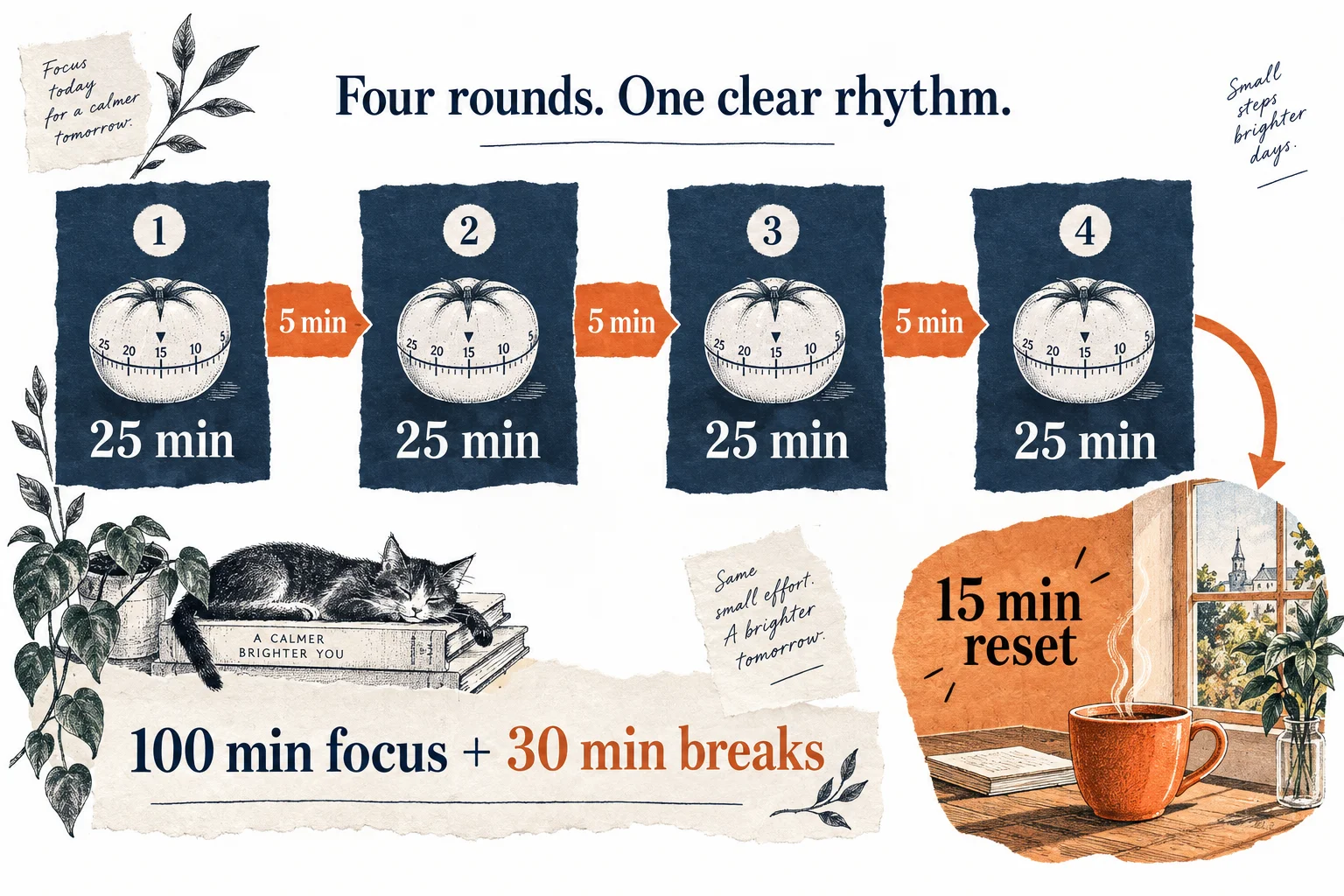
Here is Cirillo's original version, unchanged:

  1. 25 minutes of single-task focused work.
  2. 5 minutes break, fully disengaged from work.
  3. Repeat 4 times.
  4. After 4 rounds: a 15-30 minute longer break.
  5. Start the next set of 4.

That's the whole system. A complete four-pomodoro set works out to 2 hours of focused work plus 35 minutes of breaks, a ratio of roughly 30% once you average in the long break. Zoom into a single block, though (5 minutes off for every 25 on), and the ratio drops to 20%, right in the middle of what the research calls sustainable.

The tomato timer was the charming detail. The break-to-focus ratio was the part actually doing the work.

What the research actually found

The 2010s produced a real body of evidence on what happens to knowledge workers who take short breaks during a work session, not just at lunch.

One major workplace study followed office workers over two weeks, comparing the days they took brief, voluntary breaks against the days they skipped them. On break days, people reported higher energy by evening, less fatigue, and, somewhat counterintuitively, sharper concentration during the work blocks themselves. Pausing more often produced more sustained attention, not less. Morning breaks slightly outperformed afternoon ones, though both helped. The effect on end-of-day vigor was moderate and real: about d = 0.4, big enough to notice across a work week.

A separate strand of research reviewed dozens of studies on attention restoration and landed on a similar conclusion: brief mental disengagement, somewhere in the 5-15 minute range, reliably restores your capacity to focus. That tracks with a well-known idea in psychology called Attention Restoration Theory: sustained focus draws down a limited resource, and stepping away, even briefly, lets it refill.

A 2022 meta-analysis pooled 22 separate micro-break studies and found the same pattern at scale: a small but statistically reliable boost to vigor (g = 0.36) and a matching drop in fatigue (g = -0.35). Small effects, but consistent ones, across thousands of data points.

Put plainly: short breaks inside the workday measurably improve performance and cut fatigue. Cirillo's 5-on-25 ratio sits right where the data says it should.

25 on, 5 off. Ratio matters more than the exact numbers.

What actually counts as a break

Not all breaks pull their weight. The same research that tracked vigor and fatigue also logged what people actually did with their break time, and it turned out the type of break mattered as much as taking one at all.

Restorative:

  • A short walk or stretch
  • Looking out a window
  • A brief chat that has nothing to do with work
  • Water, a snack, a moment to breathe
  • A few minutes of meditation or slow breathing

Not restorative, and sometimes worse than no break at all:

  • Scrolling your phone, especially social media
  • Checking email
  • Reading anything work-adjacent
  • High-stimulation content, whatever app is currently winning the fight for your attention

The mechanism is simple: the part of your brain running sustained focus needs to genuinely power down for the recovery to register. Scrolling your phone just points that same machinery at a new target. The minutes tick by, but the reset never happens.

A quick gut check: after the break, does your attention feel sharper or foggier? Foggier means you didn't actually break. You just swapped one stimulus for another.

The healthy ratio

15-25% break-to-focus is the empirically supported sustainable band. Below 10%, fatigue accumulates across days.

TaskCoach.AI's Break-to-Focus Ratio chart marks a green band between 15% and 25%, and that band isn't arbitrary. It's roughly where the research lands.

  • Below 10%: You're skipping recovery. Quality drops within a couple of hours, and the fatigue compounds day after day.
  • 10-15%: Workable, but tight. Fine for a day or two under deadline pressure, not something to live on.
  • 15-25%: The healthy range. You can hold this for weeks of demanding work without burning out.
  • 25-40%: Generous recovery. Often exactly right for hard or unfamiliar work that needs more room to reset.
  • 40-50%: Worth a second look. Usually means either low engagement or real fatigue creeping in.
  • Above 50%: Something's off, whether that's burnout or a task that isn't holding your attention. Worth investigating, not just pushing through.

Treat the ratio as a signal, not a scoreboard. The right number moves with the work in front of you.

Adapting the cycle length

25/5 for shallow work, 50/10 for moderate, 90/20 for deep. The cycle length adapts; the ratio holds.

Cirillo's 25/5 split isn't the sacred part of this. The ratio is.

25/5 (20%): The default. Good for shallow-to-moderate cognitive work, learning something new, or clearing out email. Also a solid starting point if you're ADHD, since the focus window is short enough to actually commit to.

50/10 (20%): A step up in depth. Coding, writing, design work, anything that benefits from a longer runway to load context, with the same proportion of recovery built in.

90/20 (22%): Deep work, timed to your body's natural 90-minute attention cycle (more on that in our piece on ultradian rhythms). A 5-minute break isn't enough to recover from a 90-minute block. You need the full 20.

Notice what stays put across all three: the ratio hovers around 20-22%. The block length changes with the task. The ratio doesn't.

Common ways this goes wrong

  1. Skipping the break because you're "in flow." Sometimes that's true. More often it's under-rested and unwilling to admit it. A forced 5-minute break every 25 keeps you from sliding from real flow into stubborn, diminishing-returns grinding without noticing.
  2. Treating the break as work-adjacent. "I'll just answer this one email." Congratulations, you're now working in a different mode, not resting. A real break has to leave work behind entirely.
  3. Reaching for your phone. The dopamine hit from scrolling doesn't restore your attention. It often drains it further. A short walk, a window, a real conversation actually restore you. Scrolling doesn't.
  4. Forcing one cycle length onto every task. Cramming a 90-minute creative block into a 25/5 pattern kills your momentum right as it starts to build. Let the cycle match the work.
  5. Letting the work block stretch. "I'll just finish this paragraph, then break." Five minutes later, still finishing. The break keeps sliding, then quietly disappears. The timer's whole job is to force the issue, because work rarely ends at a convenient stopping point on its own.

What a real day looks like

A workable template:

  • Morning: 4 rounds of 25/5, about 2 hours of focused work plus 20 minutes of breaks, then one longer break after the fourth round. Call it 2.5 hours total.
  • Mid-morning: A real break: lunch, or a 30-minute walk.
  • Afternoon: 2-3 rounds of 50/10, roughly 1.5-2 hours of moderate-depth work.
  • Late afternoon: One 90/20 deep work block, if you've still got the energy.
  • End of day: Wind down, sketch out tomorrow.

That adds up to around 5 hours of genuinely high-quality output, with recovery built in the entire way through. It holds up across weeks in a way that 8 hours of grinding without breaks never does.

What TaskCoach.AI does with this

Focus mode in TaskCoach.AI supports 25, 50, and 90-minute blocks with proportional breaks built in. The Break-to-Focus Ratio chart in Analytics tracks your actual ratio day by day and flags the healthy 15-25% range. It doesn't lecture you about whether your ratio is "right." It just shows you the pattern so you can decide what to do with it.

When the chart drifts into the red zones (above 50% or below 10%), that pattern tends to show up in your mood and habit data within a week. Catching it in the break-to-focus ratio first gives you an early warning before it turns into a bigger problem.

The bottom line

Pomodoro used to look like a cute trick built around a kitchen timer. The micro-break research says otherwise. The underlying claim holds up.

A break-to-focus ratio of 15-25% is backed by meta-analyses covering thousands of people. That's not a small-sample fluke.

The exact 25-and-5 numbers matter less than the ratio itself. Match the cycle length to the task and keep the ratio in range.

And the break has to be a real break. Phone scrolling doesn't count. Movement and genuine disengagement do.

Five hours worked at this rhythm beats eight hours of grinding through it. Most people never test their ratio, because the cultural default is work harder, longer. The data points somewhere else.

Frequently asked questions

What is the Pomodoro Technique?

Francesco Cirillo's 1987 method: 25 minutes of single-task focus, a 5-minute break, four rounds, then a longer 15-30 minute reset. That works out to roughly a 20% break-to-focus ratio, right inside the range research shows is sustainable.

Does the research actually support micro-breaks?

Yes. One large workplace study found that brief, voluntary breaks during the day raised end-of-day energy and lowered fatigue, a moderate effect (d is about 0.4). A 2022 meta-analysis pooling 22 separate studies found the same pattern: small but reliable boosts to vigor and drops in fatigue. Pomodoro's 5-on-25 ratio lands right in that supported range.

What counts as a real break?

Restorative breaks: a short walk or stretch, looking out a window, a quick non-work chat, water, a few slow breaths. Non-restorative breaks: phone scrolling, email, anything work-adjacent, high-stimulation content. Your focus circuitry needs to actually go offline for the recovery to register. Switching stimuli isn't the same as resting.

What's the healthy break-to-focus ratio?

Somewhere between 15% and 25%. Drop below 10% and fatigue builds up across days. Climb above 50% and it usually signals fatigue or low engagement rather than genuine rest. The exact numbers (25/5, 50/10, 90/20) matter less than keeping that ratio in range, whichever cycle length you use.