Your calendar says you're winning. The promotion is moving, deadlines are landing, and the unread count is almost civilized.
Then you notice you haven't exercised in three weeks. Dinner has become whatever arrives fastest. Two friends have stopped asking if you're free because the answer has been "after this deadline" since March.
One part of life can look excellent while the structure underneath it is getting expensive. The pillars of life framework makes that cost visible before something breaks.
What are the seven pillars of life?
The framework separates life into domains you can inspect one at a time. There is no single official list. A practical seven-pillar version covers:
| Pillar | What it covers | A useful question |
|---|---|---|
| Career | Work, craft, contribution, direction | Am I building useful skill or only clearing urgency? |
| Body | Sleep, movement, nutrition, physical health | Does my body have enough energy for the life I'm asking it to carry? |
| Mind | Learning, emotional health, reflection, growth | What is improving the way I think and respond? |
| Social | Friends, family, partnership, community | Who am I consistently showing up for? |
| Wealth | Income, spending, saving, financial resilience | Is money creating options or constant background pressure? |
| Home | Environment, life admin, safety, daily systems | Does my space support me or create more work? |
| Leisure | Play, rest, creativity, novelty | When did I last do something with no productivity angle? |
Other models use different names and counts. SAMHSA's wellness model, for example, uses eight overlapping dimensions and includes spiritual wellness. The labels can change. The useful move is giving each important area its own signal.
An overall score such as "life is a 7" smooths away the problem. Career at 9 and Body at 2 gives you somewhere to look.
The wheel of life assessment organizes similar domains as spokes on a circle. A wheel is excellent for a snapshot. Pillars add a load-bearing idea: each area can be strengthened over time, and some weaknesses put pressure on the whole structure.
Why one weak pillar can drain the rest
Life domains share the same limited resources: time, energy, attention, money, and support from other people.
Psychologist Stevan Hobfoll's Conservation of Resources theory describes stress through the resources people work to gain, protect, and preserve. Resource loss can start a loop. Poor sleep reduces concentration. Reduced concentration makes work take longer. The longer day removes the walk, the proper meal, and the call with a friend that would have helped you recover.
The original problem has now recruited three other pillars.

This is why averaging the pillars is misleading. A high Career score funded by chronic sleep loss is carrying hidden debt. A strong Wealth score built through work that leaves no time for close relationships has a similar problem. The visible score may be high while the cost sits somewhere else.
Look for the pillar creating the most spillover, not automatically the one with the lowest score. A mildly messy Home pillar may be harmless. A slightly low Body pillar can affect every waking hour.
Balance does not mean equal scores
Perfect symmetry is a bad target for a real life. Seasons have priorities.
A new parent may give Home far more attention than Leisure. A founder near launch may choose a Career-heavy month. Someone recovering from illness may deliberately make Body the center of the plan.
The useful distinction is between a chosen tradeoff and silent drift. Chosen tradeoffs have a reason, a time limit, and a floor under the areas you still need to protect. Drift keeps extending itself.
Try defining a minimum viable floor for the pillars that cannot safely reach zero:
- Body: a fixed sleep window and two short movement sessions.
- Social: one unhurried conversation each week.
- Home: a 20-minute reset before the mess starts charging interest.
- Wealth: bills reviewed and an automatic transfer left intact.
Floors prevent a priority from becoming a demolition project.
Use a weekly review, not a yearly verdict
A one-time life score can create a useful jolt. Then it becomes an old opinion.
A weekly review turns the framework into feedback. Keep it to ten minutes:
- Scan direction. Which pillars received real attention this week? Which have been quiet for several weeks?
- Name the tradeoff. Decide whether each quiet pillar is deliberately paused or simply disappearing from view.
- Find the spillover. Ask which weak area is making other areas harder. That is often the best repair target.
- Schedule one repair. Pick an action small enough to finish within seven days and put it on the calendar.
"Improve my health" will survive the review untouched. "Walk for 20 minutes after lunch on Tuesday and Thursday" can change the next chart.
Keep subjective scores if they help. Pair them with evidence. Mood tells you how an area feels; completed behavior shows what has been feeding it. You need both when effort and outcome move at different speeds.
How TaskCoach makes the pillars live
TaskCoach Analytics tracks Career, Body, Mind, Social, Wealth, Home, and Leisure, plus Other for work that does not fit cleanly. Completed tasks, habits, and pillar-linked focus work add XP to the area they support.
Each row shows the pillar's current level and progress toward the next one. The brighter segment marks XP earned in the last seven days, so old strength and current momentum do not blur together. A crown marks the strongest pillar. Opening a row reveals its sources and filters the rest of Analytics to that area.
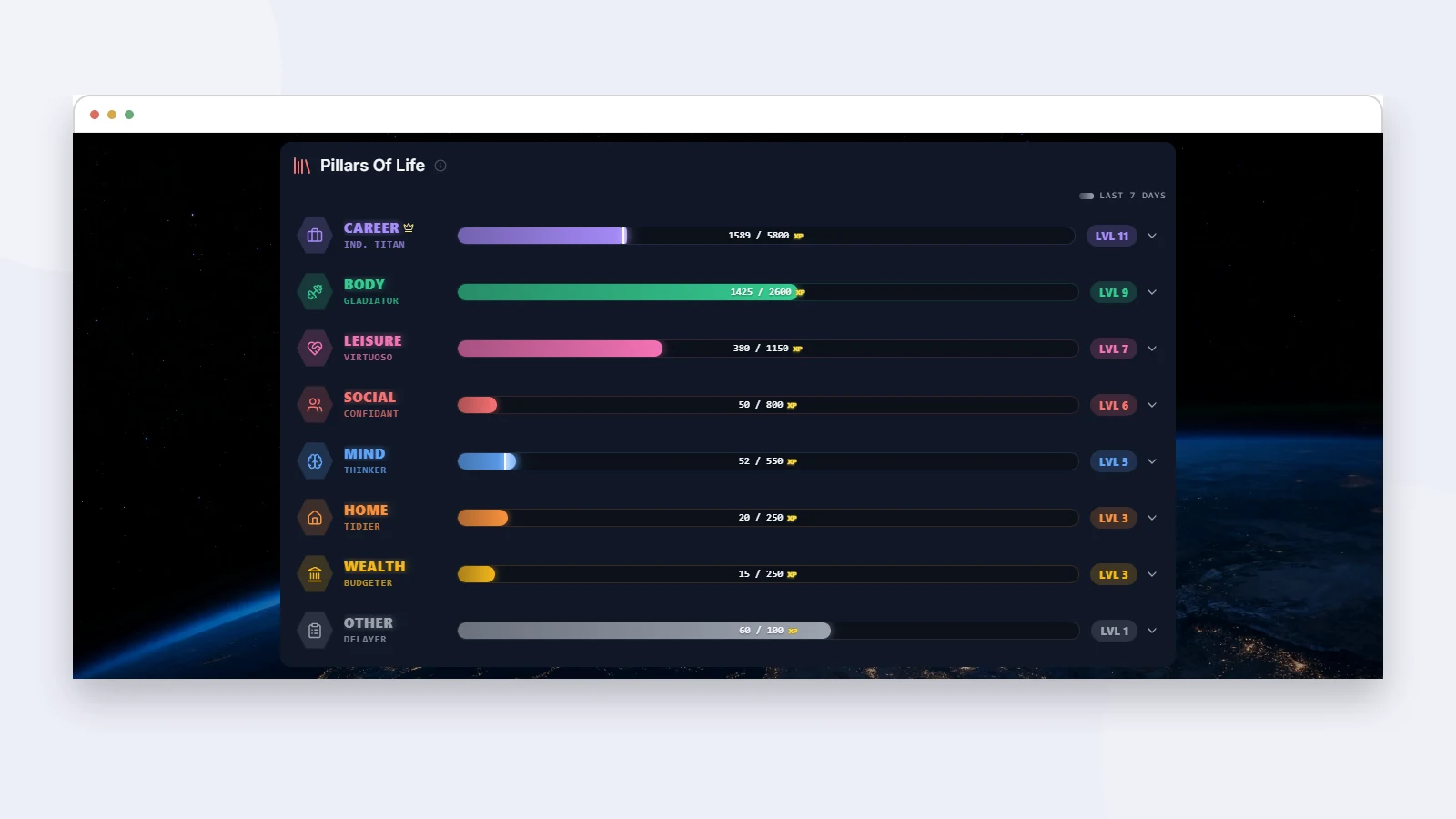
That source view keeps the diagnosis concrete. "Body feels neglected" becomes a visible record of which workouts, walks, sleep habits, and focused actions actually happened. The weekly recap also checks owned pillars for recent neglect and can suggest adding one task to rebalance the week.
Behavior tracking has a limit worth keeping in view: activity is not the same as health, connection, mastery, or financial security. Ten shallow tasks can produce more motion than one important conversation. Treat XP as evidence of attention and follow-through, then use judgment to decide whether that effort is producing the life you want.
The core Pillars of Life view is available on TaskCoach's free plan. Premium adds the standalone cross-context Brain chat and other deeper features, while the pillar tracking itself remains free.
Common ways this framework goes wrong
You average everything. A respectable mean can hide one area in real trouble. Read the individual bars.
You chase equal scores. Equality ignores seasons, values, and recovery. Protect floors and make the differences deliberate.
You score outcomes you cannot change this week. "Career satisfaction: 4" is hard to act on. Track the interview sent, portfolio hour completed, or conversation booked.
You repair every pillar at once. Seven new routines create an eighth problem: maintaining seven new routines. Start with the area causing the most spillover.
You review only when life feels bad. A short weekly scan catches drift while the repair is still small.
The bottom line
The seven pillars give you a better question than "How is life going?" They show where life is strong, where it is borrowing, and which quiet area is starting to charge interest.
Review the shape each week. Make the tradeoffs explicit. Protect a floor under the pillars you cannot afford to lose, then schedule one repair where it will reduce the most pressure.
If you want the framework to update from what you actually complete, try the free Pillars of Life view in TaskCoach.