Your calendar thinks every hour is the same. It isn't.
Every slot on your calendar looks identical: a rectangle, a label, maybe a color. But the version of you sitting down to do the work is never quite the same person twice. Some mornings you can stare down a genuinely hard problem for three hours straight. Other mornings, answering one simple email feels like wading through wet cement.
That swing isn't random. It comes from two measurable signals, mood and energy, and once you can name them, you can actually work with them instead of against them. This is one of the more useful frameworks in cognitive psychology, and almost nobody applies it to their actual schedule.
Two signals, four states
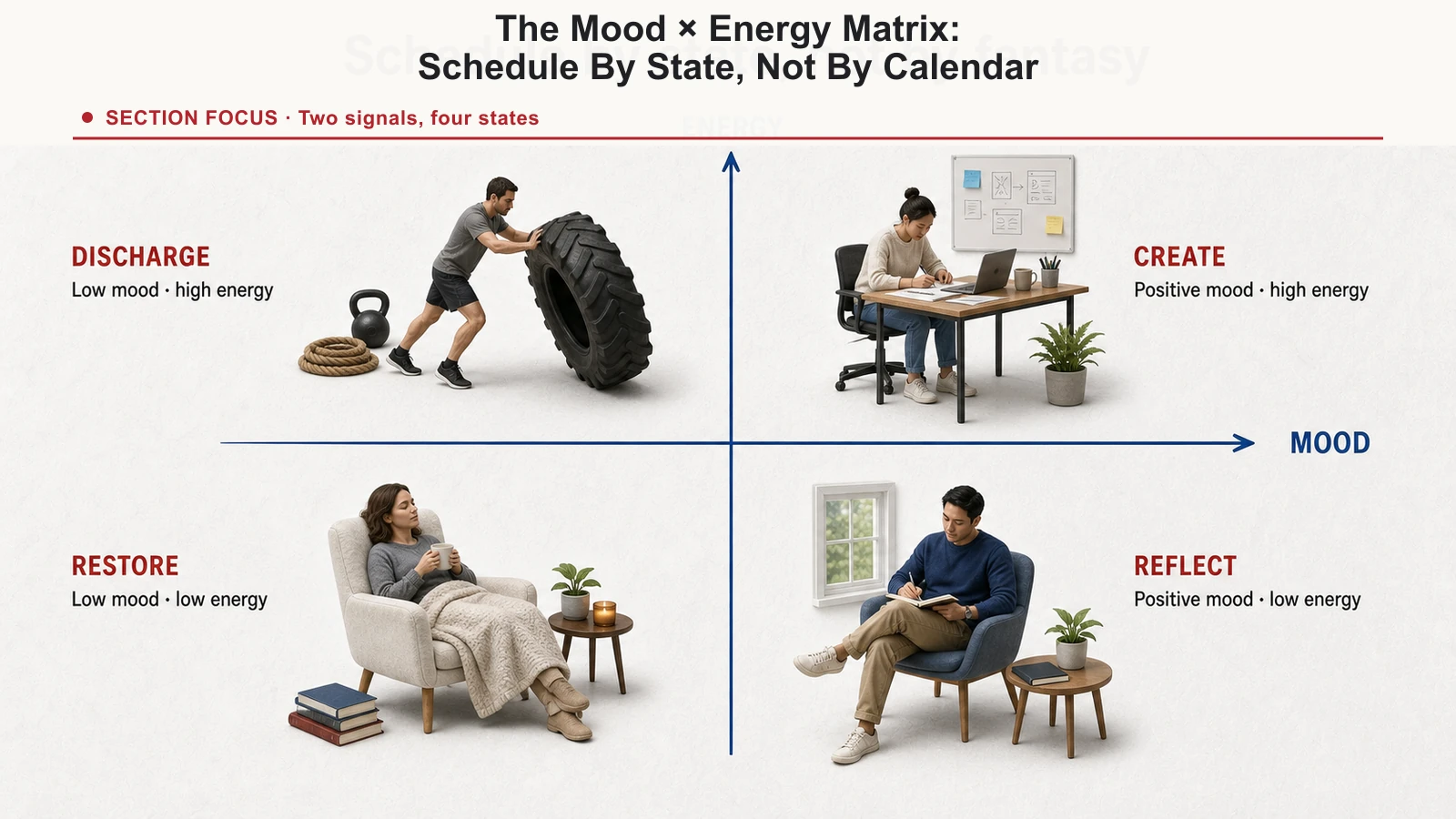
Psychologist James Russell mapped emotion onto two independent axes back in 1980: how pleasant or unpleasant something feels (valence, what we're calling mood here) and how activated or flat you feel (arousal, or energy). A decade later, researcher Robert Thayer turned that map into something closer to a productivity tool, describing four combinations he called calm energy, tense energy, calm tiredness, and tense tiredness.
Simplify that for scheduling purposes and you get a 2×2 grid:
| High mood | Low mood | |
|---|---|---|
| High energy | Creative production | Execution / grind |
| Low energy | Admin / batching | Recovery / repair |
What actually works in each quadrant
Quadrant 1: high mood, high energy, the creative zone. This is the rarest combination and the most valuable one. Your brain is actually willing to sit with something hard, ambiguous, or new: the tricky strategy problem, the blank page, the sales call that needs real persuasion. Burning this state on your inbox is probably the single most expensive mistake in knowledge work.
Quadrant 2: high mood, low energy, the admin zone. You're in a decent mood, but you're running on fumes. Routine tasks go smoothly here while novel ones stall out. Save this window for batched email, status updates, expense reports, and the kind of meeting where you mostly just need to show up and be pleasant.
Quadrant 3: low mood, high energy, the grind zone. This one gets overlooked. Your mood is poor, irritated, on edge, anxious, but your energy is intact, and that combination is oddly good for tedious, well-defined work, because the part of your brain that keeps asking "is this worth my time" has temporarily clocked out. Good for data cleanup, refactoring, slide decks, bug hunts. Bad for anything creative or anything involving other people; your judgment is skewed in this state.
Quadrant 4: low mood, low energy, the recovery zone. Nobody likes admitting they're here. Push creative work in this state and you'll produce something mediocre that drags your mood down further. Push admin work and you'll make small errors that pile up. The right move is rest: a walk, actual sleep, time with people who make you feel better. A twenty-minute walk reliably nudges you from quadrant 4 toward quadrant 2.
Why your calendar keeps losing
A calendar-only system spends quadrant 1 on whatever got booked there, full stop. That's how the best strategic thinking of your week ends up going to a thirty-person status meeting, simply because someone put it on the calendar three months ago and nobody's touched it since.
Meanwhile quadrant 3, which is genuinely great for grinding through a bug list, gets wasted trying to force creative work out of a brain that's in the wrong state for it. The output is mediocre, and your mood takes the hit too.
State beats slot. People who track their mood and energy and reroute tasks accordingly consistently get more done than people who just follow whatever the calendar says.
How to actually run this
Here's a version you can start tomorrow:
- Check in for two minutes. First thing in the day, rate your mood and your energy, each on a scale of 1 to 5.
- Keep a task pool, not a task schedule. Tag your backlog by which quadrant each item actually fits.
- Route by state, not by clock. If your state shifts mid-afternoon, switch task pools instead of stubbornly sticking to whatever the calendar says.
- Guard quadrant 1 like it's rare, because it is. Most people only get four to eight hours of it in a week. Spend it on anything other than your hardest, highest-value work and you're leaving real output on the table.
Calibrate the matrix with seven days of evidence
Your first labels will be guesses. Calibrate them by recording four moments each day: start of work, midday, late afternoon, and evening.
At each check-in, note:
- mood from low to high;
- physical energy from low to high;
- the task attempted;
- whether starting felt easy, moderate, or hard;
- one sentence about the output.
Do not rate productivity with a vague good or bad. Record what existed afterward: three paragraphs, six invoices, a resolved disagreement, or twenty minutes of recovery without a screen.
After seven days, look for mismatches. You may discover that low mood with high energy is excellent for physical chores but poor for sensitive messages. High mood with low energy may suit relationship maintenance and light creative review. The useful pattern belongs to your data, not a generic quadrant label.
Create a fallback task for each state. It should take less than ten minutes to start and still move life forward. For low mood and low energy, that might be laying out medication, food, or tomorrow's clothes. For high energy and low mood, it might be clearing a contained physical area. Fallbacks prevent a difficult state from becoming an unplanned zero.
Review the matrix monthly, especially after changes in sleep, medication, workload, illness, or season. State patterns move. The matrix stays useful when it remains a current observation rather than a personality label.
Use state as a scheduling signal
TaskCoach.AI's daily mood and energy check-in is built directly on this matrix. It isn't a wellness nicety, it's a routing signal: the AI coach uses your current state to decide which pool of tasks to surface. A quadrant-1 day looks different from a quadrant-4 day, and the system remembers which task types you actually finished in which state, so its suggestions get sharper over time.
The mood chart under Analytics → Mood Vitals plots both axes across the last 60 days, and most people are surprised by what it shows. Your best hours are rarely where you assumed they were.
Plan from the state you actually have
Two signals. Four states. Different work for each one.
Your calendar has no idea what state you're in. The mood-energy matrix does. Schedule around your state, and override the calendar when the two disagree.
That daily 30-second check-in sounds too small to matter. It isn't. Most people skip it anyway, which is exactly why doing it is still a real advantage.