Happiness is the wrong thing to chase
Viktor Frankl, a psychiatrist who survived the Holocaust, wrote something in Man's Search for Meaning that still holds up decades later: "It is the very pursuit of happiness that thwarts happiness."
The data backs that line up. Psychologist Roy Baumeister and a team of colleagues ran a large 2013 study comparing what predicts happiness against what predicts a sense of meaning in life. What they found: the two overlap, but they're genuinely different things, and what drives one can actually work against the other.
Most self-help advice still treats happiness as the goal. The research points somewhere else. Meaning is the variable that actually predicts whether your life goes well over the long run.
Here's why that distinction is worth taking seriously.
What the research actually found
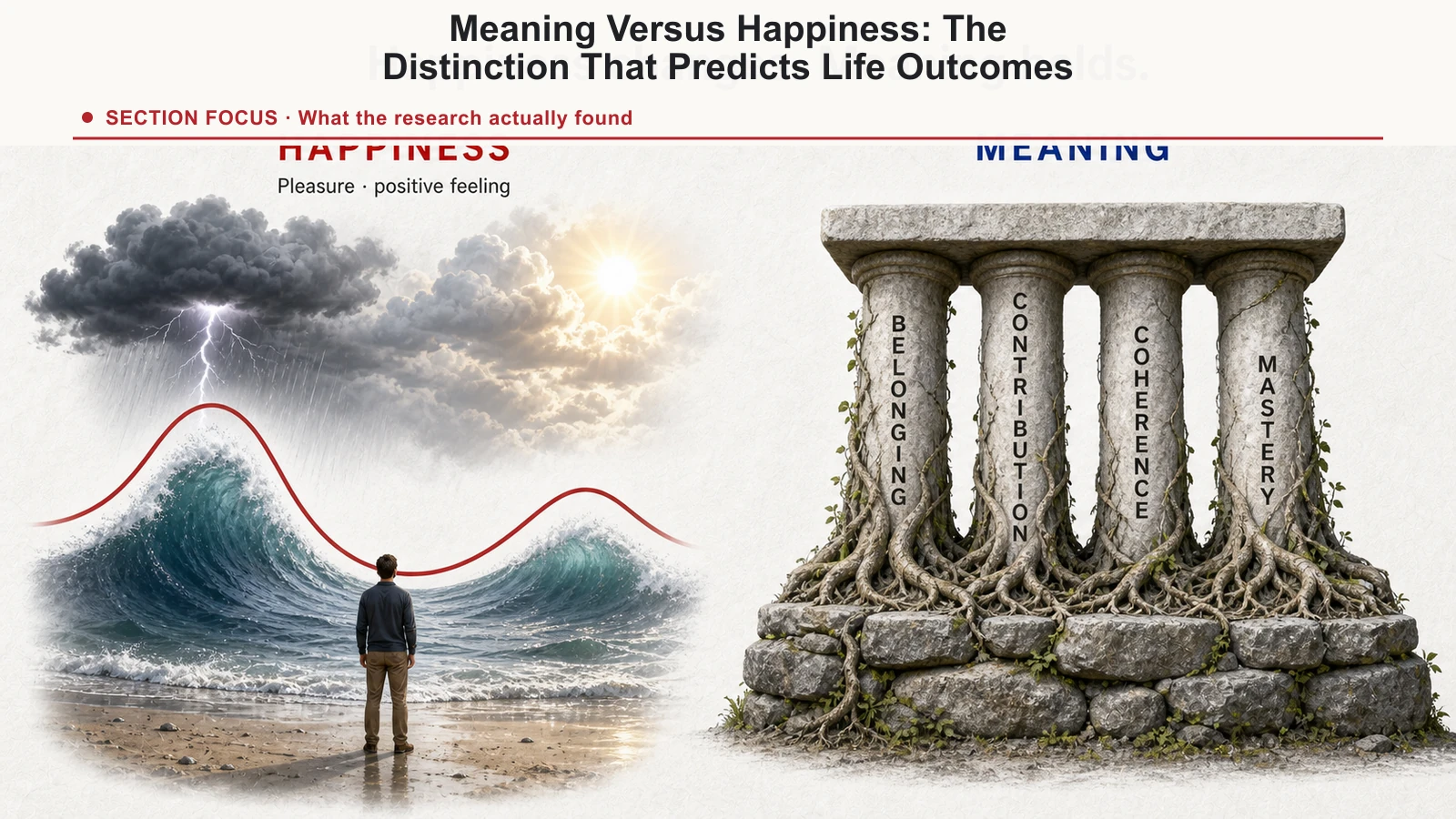
The 2013 study measured both happiness and a sense of meaningfulness in the same group of people, then looked at what each one correlated with.
Happiness tracked closely with feeling good right now, getting what you want, health, having enough money, and general ease. Meaning tracked with something different: connecting your past, present, and future into a story that makes sense, giving more than you take, doing things that help others even at a cost to yourself, taking on hard and challenging work, and expressing yourself through work that actually matters to you.
The two lists overlap in places, but the split is the interesting part. Happiness lines up with receiving. Meaning lines up with giving. Happiness is about the present moment. Meaning is about the whole arc of a life.
Here's the part that tends to surprise people: the group that scored high on meaning also reported more stress, more worry, and more difficult emotion than the group that scored high on happiness. They also reported the strongest sense that their life was worthwhile. Those two things showed up together, not in spite of each other.
Why chasing happiness backfires
There are three separate reasons that going after happiness directly tends to undercut it.
First, there's hedonic adaptation, which we've written about in more depth in our piece on the Stoic reframe. Anything you get becomes your new normal almost immediately, so chasing happiness means chasing a target that keeps sliding away from you as you approach it.
Second, constantly checking in on your own state gets in the way of actually feeling good. If part of your attention is monitoring "am I happy right now" every few minutes, that monitoring itself becomes a small, steady source of dissatisfaction.
Third, chasing happiness tends to be self-focused, while chasing meaning tends to be focused outward, on other people or something bigger than you. Those two orientations don't sit together comfortably. Lean into one and you naturally pull away from the other.
This is what Frankl meant. Happiness you chase directly keeps receding in front of you. Happiness that shows up as a side effect of doing something meaningful tends to actually stick around.
Four things that reliably produce meaning
Martin Seligman's PERMA framework, and the research that followed it, points to four main sources of meaning that you can actually act on.
Connection. Real relationships with people who matter to you. We've covered this in more depth in our piece on the connection audit. It's also the single biggest finding to come out of the Harvard Study of Adult Development.
Mastery. Getting genuinely skilled at something you've chosen for yourself. This is the territory covered in the mastery variable, and it overlaps heavily with Mihaly Csikszentmihalyi's research on flow.
Service. Work that helps someone beyond yourself. This is the "giving more than taking" finding from the Baumeister research, and it's the pillar most modern happiness advice quietly skips over.
Coherence. A story about your life that ties past, present, and future together into something that makes sense. People who can tell that story report more meaning almost regardless of their actual circumstances. People who can't, generally don't, no matter how good things look from the outside.
Run all four at once and the effect compounds. None of them cancel each other out.
Putting it into practice
The practical move is simple to state and harder to live by: stop asking "am I happy" and start asking "is this meaningful." It's a small change in wording that produces a large change in how your life actually unfolds.
A few reframes worth trying:
- Swap "will this make me happy" for "will this contribute to something I find meaningful."
- Swap "I want to feel better" for "I want to do something today that matters."
- Swap "how do I optimize my wellbeing" for "what am I actually serving here."
This shift is genuinely uncomfortable at times, because meaning often costs you short-term comfort. In the Baumeister research, the people who scored highest on meaning also reported more day-to-day stress than the people who scored highest on happiness.
That trade is worth making anyway. The evidence keeps pointing the same direction: the sense of having lived a life that mattered outweighs the running total of good moments, counted one at a time.
How this connects to the dream life equation
In our piece on the Dream Life Formula, meaningful struggle showed up as the second variable in the equation. This research backs that up directly. Chasing the dream life formula produces meaning first and happiness second, as a byproduct, which is exactly the order Frankl described.
The move that actually breaks the treadmill is optimizing for the upstream variable instead of the downstream one.
Where TaskCoach plays
The Career, Mind, and Social pillars in TaskCoach.AI are built around these four sources of meaning. The pillar identity ranks, from Initiate up through Apex, are designed to encode long-term mastery and contribution rather than short-term mood swings. The system protects your pursuit of meaning from the noise that would otherwise quietly erode it, rather than manufacturing meaning for you.
The bottom line
Chase happiness directly as your main goal and it tends to backfire on you structurally. Chase meaning instead and you tend to get durable wellbeing, including a fair share of the happiness you were originally chasing.
Connection. Mastery. Service. Coherence. Build your life around those four, and let happiness follow along behind them.
Frankl had it right the whole time.