You fixed it before they finished explaining the problem
Somewhere in your history there's a moment like this: something broke, a bike, a build pipeline, a dishwasher, a snowboard binding, and while everyone else was still describing the problem to each other, you already had it in pieces. You took it apart to find out how, not because you already knew.
Here's what else is probably true. You've quit at least three hobbies right around the moment you got good at them, and someone called you flaky for it. You've been asked "are you mad?" when you were just not talking. You currently own tools for a skill you no longer practice, and you can't bring yourself to sell them, because some part of you knows the skill is still sitting in your hands.
And you've sat in a meeting, maybe this week, where your body stayed in the chair as a professional courtesy while the rest of you left forty minutes ago. You were starving, not daydreaming. There was nothing in the room to grip.
Nobody ever told you that last part was a hardware fact rather than an attitude problem. So let's start there.
Why slides drain you and live problems wake you up
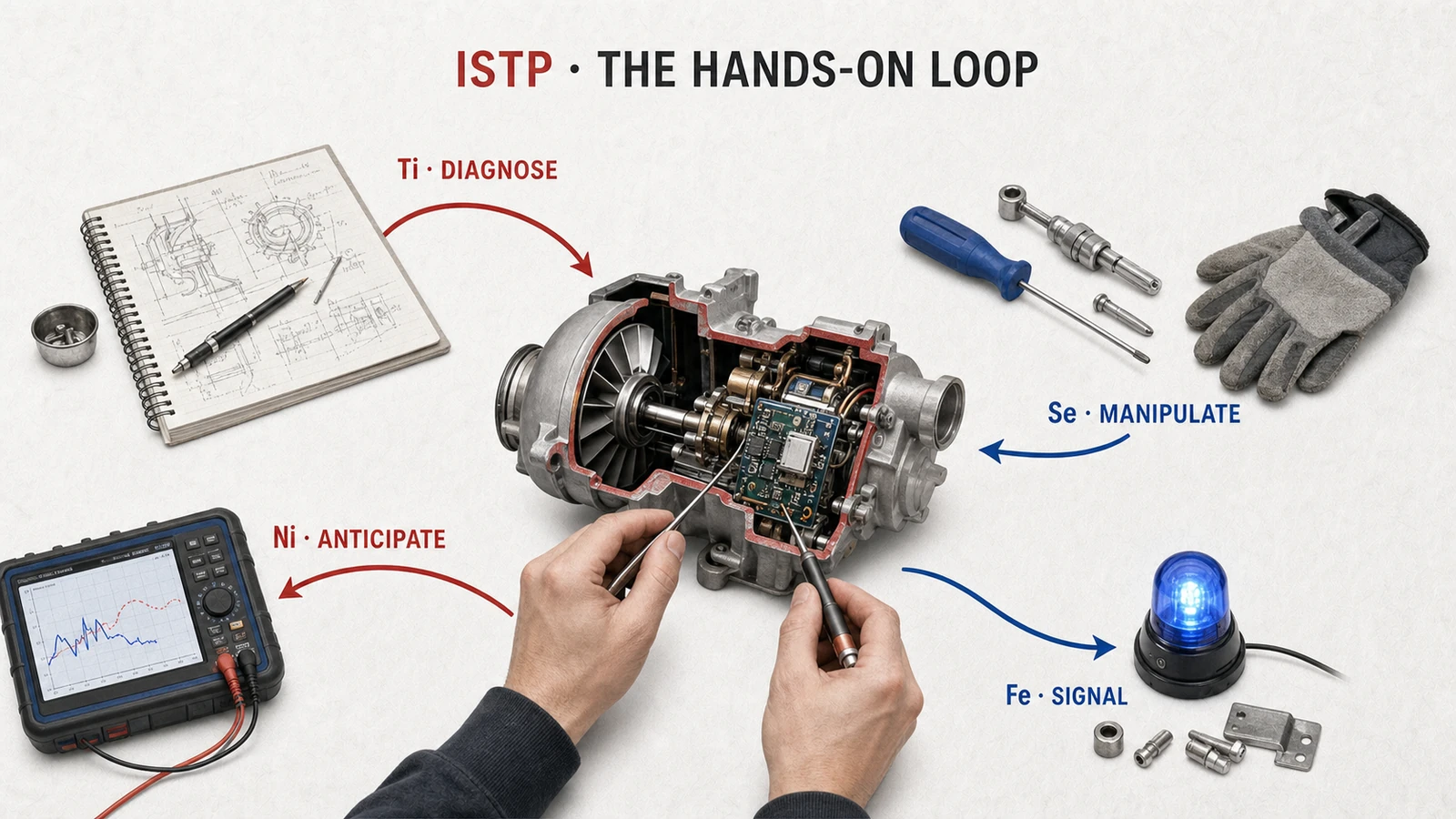
In cognitive-function language, the ISTP stack leads with introverted thinking (Ti) and backs it up with extraverted sensing (Se). Strip the jargon and here's roughly what that means: Ti is an internal mechanical model of how things actually work, not how they're described, that you prune ruthlessly for coherence. Se is a high-bandwidth intake valve for real-time physical data: the sound an engine actually makes, the give in a material, the lag in an interface, the tell in someone's posture.
Wire those two together and you get a troubleshooting loop. Act on the world, read the response, update the model, act again. Tighter and faster than almost any other configuration. That's why you learn by manipulation instead of explanation, why you trust a demonstration over a credential, and why a slideshow feels like being read a description of food while you're hungry.
Honesty checkpoint: the MBTI instrument itself has real psychometric problems. Types aren't stable categories, and the theory's roots are more literary than empirical. What keeps a profile like this useful is that its patterns map onto things that do replicate under research: Big Five trait combinations, arousal baselines, and the reward-sensitivity differences described in reinforcement sensitivity theory. Read "ISTP" as a compression of those measurable dials (low arousal baseline, sensation-responsive, autonomy-hungry), not as a fact about your soul. More on why that framing matters in the science of type-calibrated coaching.
Three of those dials explain most of your life.
A low arousal baseline. A long line of arousal research suggests some nervous systems idle low and need stronger input to reach their optimal alertness. Yours is one of them. Stillness plus abstraction, which is the exact recipe of a status meeting, drops you below the line where your brain actually works well. Meetings run below your minimum operating voltage, not because you're bad at them.
Reward wired to feedback, not to praise. Your motivation circuitry fires when an action returns real information: the weld holds, the test passes, the landing sticks. Social reward, gold stars, quarterly recognition emails barely register at all. That's why you can grind twelve hours on a real problem and can't fake twenty minutes on a performative one.
Flow through the body. Mihaly Csikszentmihalyi's research on flow kept finding its deepest examples in people doing skilled physical work under real stakes: surgeons, climbers, dancers. That's the ISTP home biome, challenge matched to skill, clear goals, immediate feedback. Your hands are a primary input device for your intelligence, not a side channel to it.
Design a life with autonomy and real feedback
Generic dream-life advice starts with visualization: journal your ten-year vision, build the vision board, define your why. This fails on contact for you, and it's worth being precise about why. Your wanting lives at the interface between your hands and the world. You don't discover what you want by imagining it. You discover it by doing something and noticing whether it feeds you. Asking an ISTP to journal their way to a life vision is asking someone to taste a recipe by reading it.
So design from ingredients instead of pictures. The wiring above implies five of them.
Tangible problems with fast grading. The core loop of your work has to be: problem arrives, you act, reality answers. Emergency medicine, trades, flying, incident response, surgery, machining, field engineering, hard debugging, cinematography: the industry varies wildly, but the shape stays constant. Reality is the referee, not a manager's opinion. Long-feedback work like strategy decks, brand building, or committee anything reads to your reward system as no work happening at all.
Autonomy over process. Self-determination theory names autonomy as one of three basic psychological needs, but few types have your particular dose-response curve. You'll accept hard constraints on the outcome, make it work by Friday, keep it under budget, while micromanagement of your method feels like someone grabbing the wheel. The dream job description contains a sentence like "we don't care how you do it."
Serial mastery, planned for on purpose. Here's the reframe that changes careers: the quit-at-mastery pattern isn't a defect to fix. Your brain is optimized for the steep part of the learning curve, where every rep returns new information. Research on deliberate practice describes experts who stay decades on one skill, but it also describes what keeps practice alive: operating right at the edge of your ability. When a skill plateaus and you leave, you're following the edge, not abandoning it. So stop building a life that assumes one forever identity. Build it in seasons instead: two or three years deep in a domain, extract the transferable core, rotate. Over twenty years, that's a skill stack nobody else can copy, not flakiness.
Escape hatches, everywhere. You count exits in rooms, contracts, relationships, and calendar weeks. Commitments with no exit trigger a claustrophobia that outsiders misread as fear of commitment, when really you'll commit ferociously to whatever keeps earning it. What you can't do is pre-commit your future self blind. So the dream life keeps slack built in: financial runway, skills that travel, a calendar with air in it. Paradoxically, you stay longest exactly where you know you could leave.
Low word-count environments. Your Ti compresses. By the time you speak, the reasoning is already done, and only the conclusion feels worth saying. Cultures that price contribution in airtime, big meetings, thought leadership, alignment calls, will systematically undervalue you, and worse, slowly convince you the problem is you. Find rooms where the work is the argument.
Run work as short field tests
Most productivity systems are built by and for people who enjoy operating systems about work. You don't. Every layer of process is overhead standing between you and the thing itself, and any system that needs daily maintenance will be dead within nine days. The right architecture for a Ti-Se stack is minimal, physical, and problem-shaped.
Plan in problems, not processes. The unit on your to-do list should be a solvable thing: find why the redirect loops, replace the fork seals, get the draft to say the true thing. Never "work on X for two hours." Time-shaped tasks give Se nothing to grip; problem-shaped tasks boot up the troubleshooting loop automatically. If a task can't be phrased as a problem, that's usually a sign it's someone else's process wearing a task costume.
One real problem a day. Your daily plan needs exactly one anchor: the problem you intend to beat today. Everything else is optional filler around it. Elaborate weekly reviews and cascading goal hierarchies are for other stacks. Your weekly planning should be a ten-minute triage: what's live, what's blocked, what deserves this week's edge.
The workbench rule. Never tidy up completely at the end of a session. Leave the work physically staged mid-move: the code open at the failing test, the part clamped, the paragraph ending mid-sentence. Re-entry is your expensive moment, and cold, abstract starts are where you stall. A staged bench turns tomorrow's start from a decision into a reach.
Two live problems, rotated at block points. Keep exactly two problems in flight at different stages. When one genuinely blocks, waiting on parts, waiting on people, waiting on a compile, switch to the other. This keeps dead air, your real enemy, near zero without paying the attention tax of constant task-switching. The discipline is to switch only at true block points, never at mere difficulty. Difficulty is the good part.
Results-based accountability only. Check-ins, standups, and body-doubling feel like surveillance to you and add nothing. What works is a deadline plus a demo: on Friday, the thing either works in front of someone or it doesn't. That converts social accountability into your native currency, reality-graded feedback, and lets you run dark in between, which is where your best work happens.
Motion as a state tool. Your cognition is embodied more literally than most people's. Stuck on abstract work? Don't push. Move. Ten hard minutes of physical effort raises the arousal baseline that abstraction just drained. Schedule desk blocks after physical blocks, not before.
Four experiments for boredom and lock-in
Five techniques tuned to your specific failure modes, with the mechanism attached.
1. The teardown start. When you're procrastinating on abstract work, the block is almost always that the task has no surface, not motivation. Manufacture one. Print the document and mark it up by hand. Whiteboard the system. Open the actual code and poke the actual behavior before reading any specs. Mechanism: converting symbols into manipulable objects recruits your Se channel, which is the ignition system Ti idles without.
2. Raise before you quit. Install one rule at the boredom point where mastery usually kicks in: raise the stakes once before you walk away. A harder variant, a tighter constraint, a timer, an audience, teaching it to someone else. Mechanism: boredom is a challenge-skill mismatch signal, and mismatches have two fixes, but most people only ever consider leaving. If it's still gray after the raise, quit with a clear conscience. The curve really is spent.
3. Pay the arousal toll. Before an unavoidable block of stillness plus abstraction, the long meeting, the planning doc, do something physically intense enough to notice: hill sprints, heavy carries, fast stairs. Mechanism: you're pre-loading the stimulation the meeting won't supply, so your under-aroused brain doesn't go hunting for it on your phone instead. Ten minutes of effort buys about ninety minutes of tolerable stillness.
4. One sentence of narration. Once a day, out loud or in writing, narrate a decision: "I rerouted the queue because the retry storm was starving the workers." That's the whole practice. Mechanism: your compression is efficient but socially expensive, because people can't distinguish silent competence from silent contempt. One sentence a day of shown reasoning is the cheapest possible purchase of trust, and it compounds.
5. Build your dopamine, don't rent it. Your low-baseline, sensation-responsive wiring is exactly the profile that modern stimulation loops (feeds, clips, gambling-shaped games) are engineered to capture. They deliver the spike without the skill. Defend your evenings with hands-based restoration instead: cook something technical, wrench, climb, tie flies, solder. Mechanism: mastery activities raise your dopamine baseline instead of spiking and crashing it, which is the difference between waking up hungry for your work and waking up numb.
Build a reversible experiment board
Long plans can feel fake because the useful information has not arrived yet. A reversible experiment board replaces distant certainty with evidence you can collect this week.
Use four columns:
| Question | Smallest live test | Stop rule | What happened |
|---|---|---|---|
| Can this workflow save time? | Use it on one real task | Stop after 45 minutes if setup keeps growing | Record minutes and friction |
| Would I enjoy this skill? | Complete one beginner project | Stop after three sessions if curiosity keeps falling | Note what held attention |
| Is this repair worth doing? | Diagnose and price the failure | Stop if parts exceed replacement value | Keep the diagnosis |
Every test needs contact with reality. Reading twelve reviews is research, not a test. Build the rough object, make the call, run the route, handle the tool, or put the process through one authentic case.
Give each experiment a fixed budget of time, money, or attempts. A budget keeps curiosity from turning into an open project and makes abandonment legitimate when the evidence is poor. Write the stop rule before starting so pride cannot move the line later.
At the end, choose one of three decisions: expand, modify, or archive. "Think about it" is not a fourth option. If you archive the test, record the reason in one sentence. That prevents the same idea from returning six months later with none of the earlier evidence attached.
For necessary work that offers little live feedback, manufacture a visible output every thirty minutes: one reconciled account, one working function, one cleared surface, one answered question. The output restores the signal that your effort changed something concrete.
This board respects an ISTP strength that conventional planning often suppresses: you make excellent decisions once the environment answers back. The system's job is to get you to that answer quickly and cheaply.
The shadow side: rust, not fire
Most burnout writing describes fire: overload, overwhelm, collapse. That's rarely your pattern. The ISTP burnout signature is rust, the slow gray corrosion of chronic understimulation, usually inside a life that looks perfectly fine from the outside. Decent job, decent pay, nothing to complain about. Nothing to grip, either.
Know the early markers, because rust is quiet.
Everything is "fine," and nothing is interesting. The flatness is global, not tied to one task. There's escalating stimulation-seeking you wouldn't quite defend out loud: riskier riding, impulse gear purchases for skills you never start, doomscrolling that functions like a slot machine. Irritability shows up specifically around talk: meetings, small talk, and process discussions produce disproportionate contempt. There's a withdrawal spiral, where you go quiet, people stop asking, and you read the not-asking as permission to disappear further. And there's competence without pride: you still do the work well, you just can't remember why that used to matter.
The trap is that your dominant function volunteers to fix it. Ti says: analyze the dissatisfaction, think it through, restructure. But you can't think your way out of an under-load problem, and an unoccupied Ti with nothing real to chew on will happily disassemble your own life instead, your relationship, your career, your worth, with the same detachment it brings to a gearbox. That's the ISTP two-in-the-morning failure mode: running diagnostics on yourself as if you were the broken machine, when the actual fault is that the machine has nothing to do.
The recovery move is embarrassingly concrete: reintroduce one real problem with real feedback, and let the body go first. Not a vacation, since rest treats fire, not rust. Take the unowned bug nobody else can crack. Rebuild the brakes. Book the course with an instructor better than you. Volunteer for the incident channel. Within a week or two of genuine grip, the grayness usually lifts enough for you to see whether anything bigger actually needs to change, and you'll make that call far better with a fed brain than a starved one.
If the rust keeps returning, stop treating episodes one at a time and read it as an architecture problem: an office-shaped life wrapped around a field-shaped brain. Your ESTP siblings tend to blow up an understimulating life loudly. Your instinct is to quietly endure it, which is more polite and much more corrosive. Endurance is a skill you have in surplus. Point it at problems, not at numbness.
The instrument is not broken
You've spent years absorbing a verdict assembled from other people's misreadings. Flaky, because you follow learning curves instead of sunk costs. Cold, because you compress. Unambitious, because your ambition points at mastery instead of visibility.
Run the diagnostics honestly and a different machine appears: a brain that hooks straight into reality with less interpretive padding than almost anyone gets, that learns at ferocious speed through the hands, stays calm exactly when circumstances stop being calm, and tells the truth about what works because it physically cannot care about what merely sounds good.
That's a precision instrument that's spent too long in the wrong shop, not a personality flaw with upsides attached.
You need problems worthy of the instrument, and the exits that let you keep choosing them, not to become more expressive, more long-term, more meeting-tolerant, more like the people grading you.
Reality grades your work. Let it grade your life the same way: by what happens when you get your hands on it.