You did it on time, correctly, and nobody said a word
Last quarter, someone in a meeting pitched, with enormous energy, an idea you had already quietly implemented eight months ago. They got applause. You got the follow-up tasks.
You didn't say anything. Of course you didn't. Pointing it out would feel undignified, and besides, the work mattered more than the credit. That's the official position. The unofficial one lives lower in your chest, and it sounds more like who noticed?
You'd never admit that ache out loud. Wanting recognition feels almost greasy to you, the kind of thing people who narrate their own work like sports commentators go looking for. So you do what you always do. You absorb it, file it away, and show up the next morning to do the job properly again, because that's simply what the job requires.
Here's what nobody tells you: you didn't choose reliability as a strategy. It's your default operating mode, not a value you picked up from the right book at the right time. When something needs doing, some process in your head has already assigned it to you before you've consciously weighed in. Duty is the factory setting for you, not a decision.
And here's the cruel physics of it: reliability is invisible by design. The bridge that holds gets no headlines. The system that never crashes generates no incident report. You've organized your whole life around preventing fires, in a world that only hands out medals for putting them out.
This piece is about the machine that makes you this way, and about designing a life where being load-bearing doesn't also mean being unseen.
Why comparison and completion feel safe
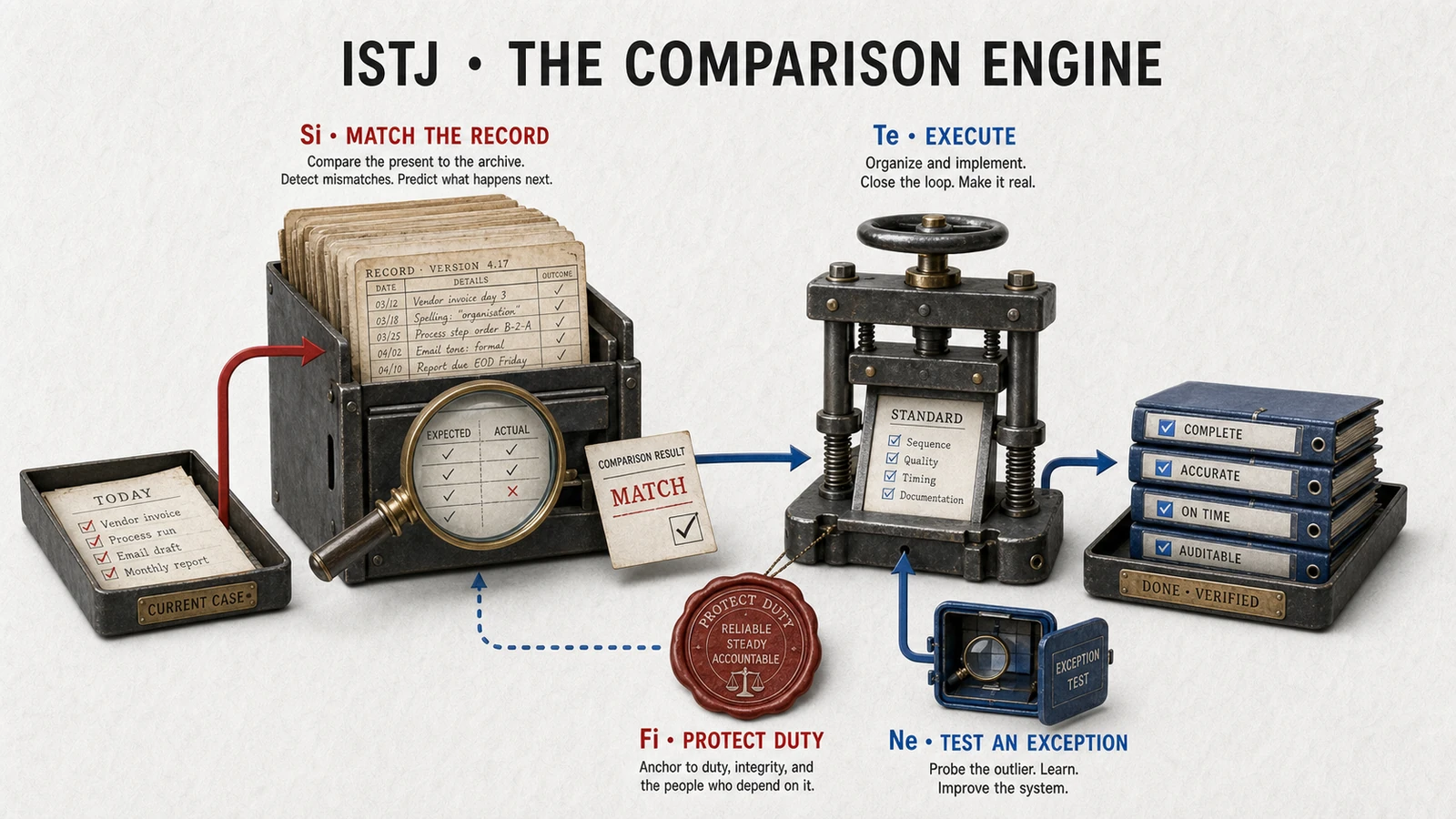
In MBTI terms, you run a Si-Te stack: dominant introverted sensing, backed by auxiliary extraverted thinking. Strip away the jargon and something genuinely interesting sits underneath it.
Si is a high-resolution comparison engine, not nostalgia. Your perception of the present moment gets continuously checked against a dense, detailed archive of precedent. Walk into a room, taste a dish, review a spreadsheet, watch a process run: your brain is quietly diffing it against every prior version on file. This is four percent off from last time. The tone of that email changed. This vendor's invoices used to arrive on the third. Other people find your recall a little spooky. It's a prediction system, not memory for its own sake, and the archive exists so you can know what happens next.
Modern cognitive science has a useful frame for this: the brain as a prediction machine, constantly building a model of the world and flagging mismatches between what it expected and what actually happened. Every brain does some version of this. Yours appears to weight the mismatch signal unusually heavily. That's why unannounced change registers as something being wrong, not mere annoyance, a low-grade alarm that won't clear until the map and the territory agree again. What looks like stubbornness from the outside is, from the inside, an error message that hasn't resolved yet.
Te is the execution drive. Where Si stores the map, Te organizes the world to match it: sequences, standards, deadlines, systems that run without drama. Te wants reality structured, measured, closed-loop. Together, the pair produces your signature move: quiet, complete, verifiable execution. Not fast and flashy. Finished.
In trait terms, this profile lines up with very high conscientiousness, both the industriousness side (get it done) and the orderliness side (get it done right), combined with lower openness to novelty and a steady, unexcitable baseline. Research on habit formation, including Phillippa Lally's study showing behaviors take around 66 days on average to become automatic, consistently finds that people with your trait profile lock in routines faster and hold onto them longer. Your basal ganglia, the brain's habit machinery, is your home-field advantage. What costs other people willpower costs you almost nothing once it's routine.
Honesty requires a caveat here. The MBTI instrument itself has real psychometric problems: the forced either/or categories, the mediocre test-retest reliability. Nobody should treat four letters as a biological fact. What makes this article useful is how reliably the ISTJ profile maps onto things that do replicate under research: Big Five conscientiousness and openness, and measurable differences in reward sensitivity. (The research case for calibrating advice to cognitive style is worth reading in full.) Treat the letters as a compression format for a real trait cluster, not a horoscope.
One more piece, because it explains your worst days. Your inferior function is extraverted intuition, the possibility-scanner. Underdeveloped and mostly offline, it shows up under stress as catastrophizing, not creativity: a sudden flood of worst-case "what ifs," each more improbable than the last, arriving in a brain that normally deals only in precedent. If you've ever spiraled at one in the morning about a scenario you'd dismiss as absurd by daylight, that's the machinery misfiring, your least-trained muscle cramping under load, not a character flaw.
Design a life that rewards stewardship
Generic dream-life advice is written by and for novelty-seeking brains, which is probably why it's always smelled faintly wrong to you. Quit your job and travel the world. Burn the boats. Reinvent yourself every five years. For your wiring, a heavy dose of novelty is a cost, not a reward. Every new environment means building a map from scratch, and map-building is expensive. You can do it. You just shouldn't be told it's the definition of a life well lived.
Here's what actually lights up a Si-Te system.
A domain you are definitively responsible for. Not a gig, not a rotating project, a territory. Operations, a codebase, a practice, a department, a farm, a body of law, a household that runs like a Swiss station. The dream is stewardship, not variety: something real that's better, sounder, and more trustworthy because you've held it for years. Institutions are secretly made of people like you. The dream life is one where that's said out loud instead of quietly relied on.
Long arcs with visible standards. You're built for compounding, not sprinting. Self-determination research names competence as a core psychological need, and your version of competence is depth: ten years of mastery, a reputation for work that never needs checking. Systems beat goals for every type, but for you the system is the pleasure. A well-run process is the reward itself, not just the means to it.
Few bad surprises, and the good ones chosen on purpose. You need novelty on your schedule, at your dose, rather than none at all: a new country every year, not a new city every week. Planned adventure reads as expansion. Ambushed adventure reads as threat.
A small number of old, proven relationships. You show love through logistics: the remembered appointment, the tire pressure checked, the paperwork handled before anyone even asked. The dream is a handful of people who've been stress-tested across years, not a wide network, who understand that your acts of maintenance are the love letter, and who, this part matters, say thank you out loud.
Notice what's missing from this picture: an audience. You genuinely don't need applause. But there's a real difference between not needing applause and never once hearing that the wall held because you were the wall. The dream life for an ISTJ includes, non-negotiably, people and structures that make the invisible work visible: seen, on the record, without needing to be celebrated for it.
A maintenance system with an exception budget
Here's the twist most productivity content misses about you: you probably don't need a new system. You already have one, and it mostly works. Every January the internet tries to sell you a fresh methodology, and switching would cost you more than any flaw in your current setup ever will. What your system needs is cartography, not replacement: regular, deliberate map updates.
Use the weekly review to update the map. Once a week, spend thirty minutes asking where reality diverged from your map. Avoid framing the review around failure because conscientiousness can turn that into self-prosecution. Where did the estimate miss, the process snag, or the assumption expire? Log the divergence, adjust the map, and close the file. This is a high-value habit for a Si-dominant brain because the main risk is flawlessly executing a plan built on last year's territory.
Version, don't replace. When a workflow underperforms, patch it and bump the version number. Your morning routine is v3 already, not broken, and v3.1 just moves the workout earlier. This preserves the automated habit circuitry you've spent months building instead of tearing it down for a full redesign.
Explicit scope and done-criteria on everything. Your danger is unbounded work, not unfinished work. Without a written definition of done, your own standards will quietly expand every task by forty percent. Locke and Latham's goal-setting research is unambiguous that specific beats vague; for you, the specificity that matters most is the ceiling, not the floor.
Implementation intentions for anything new. Peter Gollwitzer's when-then format ("when X happens, I will do Y") is practically native syntax for your brain, because it converts intention into precedent-shaped rules. Use it for exactly the behaviors that don't come naturally: when I finish a project, I will write two sentences about what I delivered. When someone asks me to take something on, I will say "let me check my commitments" before answering.
Protect one deep block daily. Your capacity for long, uninterrupted, distraction-resistant focus is elite: steady arousal, low novelty-seeking, high resistance to interruption. The threat is other people's emergencies colonizing your calendar, not your focus, because you're the one who always says yes. One block, ninety minutes, defended like infrastructure. Because it is.
Four experiments for procedural overload
1. The receipts file. Keep a running document, one line a week, of what you shipped, prevented, and maintained. Mechanism: prevented problems leave no trace, so your contribution literally doesn't exist in anyone's record, including your own. Writing it down does two things. It gives your Te a trusted evidence base against the two-in-the-morning "am I actually doing enough" spiral, and it means that when review season or resentment arrives, you're arguing from documentation instead of feeling. Pennebaker's expressive-writing research adds a bonus: putting experience into words measurably lowers its background emotional weight.
2. The assignment question. Before accepting any duty, ask: who actually assigned me this? You'll find a startling share of your load was assigned by nobody. You absorbed it because it was adjacent, undone, and you happened to be competent. Mechanism: your duty circuit fires automatically and doesn't distinguish between a real commitment and an ambient one. Self-determination research is blunt about the cost here: obligation without autonomy is one of the most depleting motivational states there is. The question inserts a single conscious checkpoint into an unconscious pipeline.
3. The changelog rule. You may never delete a working system, only version it. Write the change, date it, keep the history. Mechanism: habit automation takes months to lock in, and a full system replacement resets that clock to zero across every routine at once. Versioning updates the map while keeping the machinery warm. It also satisfies your Si need for continuity: v4 contains v1. Nothing you built gets wasted.
4. The map audit. Quarterly, list your ten most load-bearing assumptions, about your job, your methods, your key people, and ask of each: is this still true, or is it just still filed? Mechanism: Si's archive doesn't auto-expire. Precedents persist until forcibly contradicted, which is why territory can drift for years before the mismatch alarm finally fires, usually at the worst possible moment. Scheduled auditing turns big, ambush-style prediction errors into small, chosen ones. You already handle chosen change brilliantly. This just makes more of your change chosen.
5. The ten percent novelty dose. Deliberately spend about a tenth of your discretionary time on controlled newness: a technique, a route, a cuisine, a tool, before life forces novelty on you instead. Mechanism: exposure at low, self-paced doses keeps your threat response to unfamiliarity calibrated, the same way regular exercise keeps a cardiovascular system ready for the occasional sprint. It also feeds your archive. Every voluntarily acquired precedent is one less future situation with no file to check against.
6. The explicit ask. Once a quarter, tell your manager, partner, or collaborator in one plain sentence what you carried and what acknowledgment would look like. "I've kept X running without an incident for a year. I'd like that noted in the review." Mechanism: you operate an invisible ledger and assume others are reading it. They aren't. Recognition, for you, is confirmation that the record is accurate, not vanity, and the record mattering is the core of your whole motivational system. Asking feels unseemly for about eleven seconds and repairs roughly eleven months of quiet resentment.
Run a maintenance debt review
Reliable systems accumulate obligations. The weekly report you created once becomes your permanent job. The family task you handled during a crisis becomes your role for the next decade. Because you can carry the load, nobody sees the growing maintenance debt.
Audit recurring commitments with four labels:
- Required: the consequence of stopping is real and current.
- Useful: the work helps, but its frequency or standard can change.
- Inherited: you still do it because you did it last time.
- Ceremonial: the process survives even though the original reason is gone.
Pick one inherited or ceremonial item and suspend it for two cycles. Do not redesign it first. A pause gives you evidence. If nobody notices, you found dead weight. If someone notices, ask what outcome they actually need before restoring the old procedure.
Now create an exception budget. Choose one block each week where the normal rules may be bent on purpose: leave a low-risk task at 90 percent, take a route you did not research, or let somebody else complete a chore differently. The point is controlled flexibility, not chaos. You are training the ability to distinguish a useful standard from a reflexive one.
For a project, write the minimum acceptable condition before work begins. "The figures reconcile, the decision is documented, and the owner signs off" is testable. "Do it properly" expands forever. A visible finish condition protects quality while stopping extra polishing from consuming the next priority.
The review ends with one question: What am I maintaining that no longer maintains anything? Remove one answer per month. Reliability becomes more valuable when it is reserved for work that still deserves it.
The shadow side: grinding on past empty
Every type has a burnout signature. Yours is the quietest, and because of that, one of the most dangerous.
You grind down instead of flaming out. Other types burn out in a visible crisis; you burn out in perfect silence, still hitting deadlines, still answering emails, running on pure obligation long after the tank reads empty, because for you, stopping feels like a character failure, not rest. Duty is the factory setting, remember. There's no low-fuel warning light in a machine that never consults fuel level before executing.
So learn your actual warning lights, because they're behavioral, not emotional.
Pedantry spikes. You start correcting things that don't matter: formatting, phrasing, the way someone loads a dishwasher. That's resentment leaking through the only socially acceptable valve you allow yourself.
Routines go joyless. The morning sequence, the workout, the tidy desk, still executed flawlessly, but the quiet satisfaction is gone. You're maintaining the museum of a life instead of living inside one.
The sick-day fantasy. You catch yourself half-wishing for a legitimate, externally imposed reason to stop: an illness, a canceled project, a snowstorm. Read that signal precisely. You're so far past empty that only an order to rest feels permissible.
Ne static at night. The catastrophizing spiral shows up more often: worst-case scenarios about money, health, the people you're responsible for. Your least-trained function grabs the wheel the moment the trained ones run out of gas.
The recovery move is an obligation audit, not a vacation, since a vacation just relocates the obligation engine to a beach: list every duty you're currently carrying, mark who actually assigned it, then formally drop or renegotiate the ones you absorbed by default. Then, and this is the trick that actually works for your wiring, schedule rest as maintenance duty. You'd never run a machine you were responsible for at redline for years without service, and you are a machine you're responsible for. Put the downtime on the calendar with the same standing as any other commitment, because your brain honors calendars and mostly ignores feelings. Frame it in duty language, and for once, let the factory setting work in your favor.
The load-bearing wall
There's a category of things whose importance is exactly proportional to how rarely they get noticed. Foundations. Immune systems. Air-traffic control. The friend who has never once been late.
You've spent a lifetime being mistaken for boring by people who confuse noise with signal. But take the ISTJ out of any structure (the team, the family, the company, the country) and watch what happens. Not immediately. That's the point. Things degrade the way bridges do: invisibly, then suddenly. You're what stands between working systems and that suddenness.
So keep the receipts. Ask out loud. Version, don't replace. Audit the map, and audit the obligations. And the next time someone with better lighting collects applause for something you quietly made possible, let the ache register, note it in the file, and remember what you actually are.
You're the stage the show stands on. You're the reason the roof holds.
Load-bearing was never boring. It was just never loud.