The quietest person in the room notices everything first
You clocked the light in this room before you clocked a single face in it. That's just how you're built.
You know the exact minute an ordinary afternoon turns gold. You can hear the hairline crack under a friend's "I'm fine" before they've finished the sentence. You knew that font was wrong before you could explain why, so you just said "it feels off" and watched everyone wait for a reason that hadn't arrived yet, because it lives somewhere below language, not above it.
People assume you're easygoing. You've worked hard to give them that impression. "Either works for me," you say, while quietly holding preferences sharp enough to draw blood. You've said yes to plans you already knew, in the very act of agreeing, that you'd cancel. And once or twice you've walked away from something (a job, a relationship, an entire city) so abruptly that people swore it came out of nowhere. It didn't. It came out of eighteen months of you saying nothing.
Here's the one that actually stings. Someone asks where you see yourself in five years, and something in your chest goes flat and a little defensive. The question feels like being asked to lie in a language you never learned, not a sign that you lack ambition. And when someone compliments the thing you made, the piece you sanded and revised and secretly love, you hear yourself mumble something like "oh, it's just a little thing I was messing with."
It's a real thing. You are a contained person, not a casual one, and hardly anyone around you has noticed the difference.
This piece is about what's actually happening inside that container, and how to build a life around it instead of constantly working against it.
Why values and sensory detail steer the day
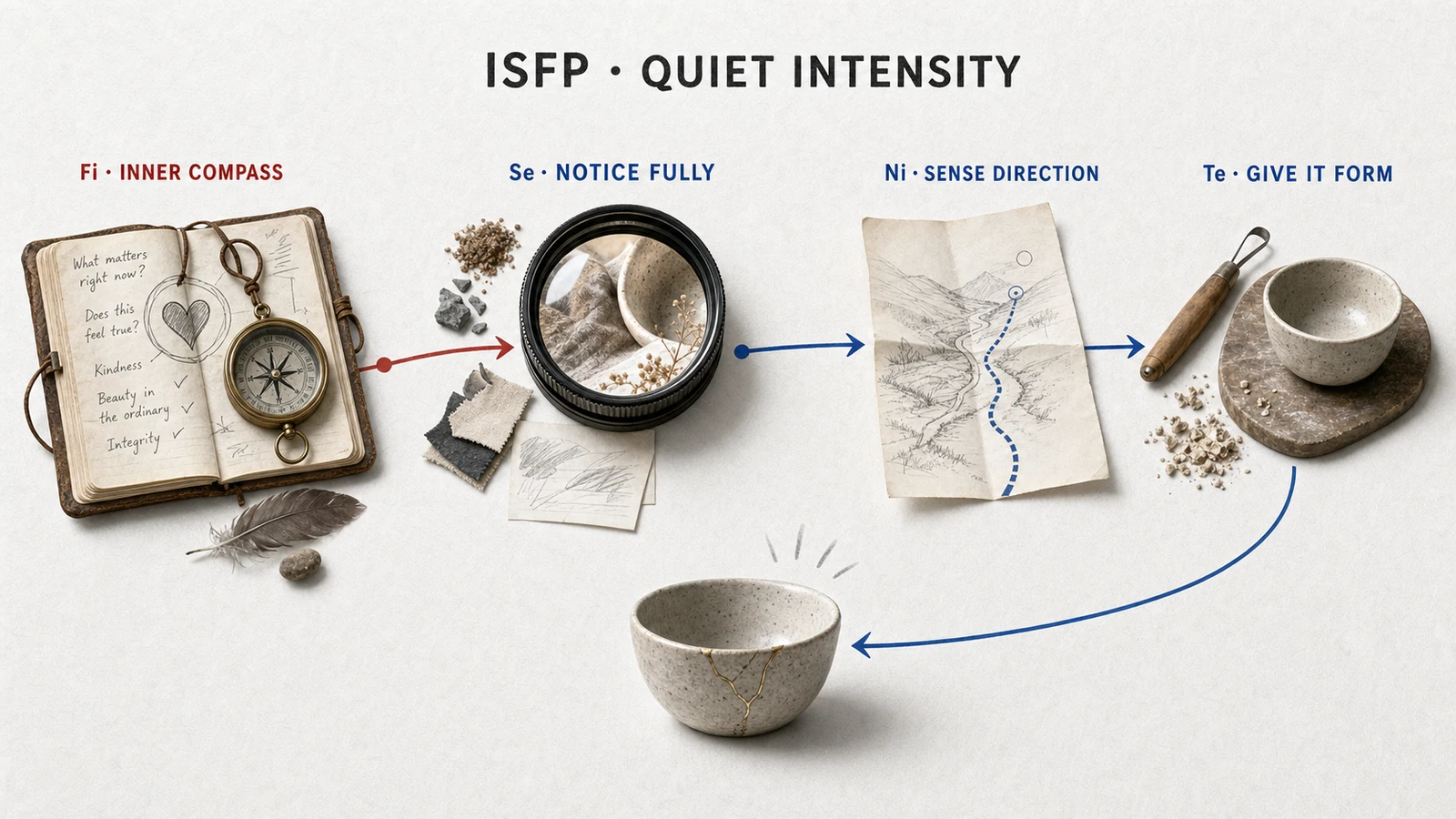
In cognitive-function terms, the ISFP runs on introverted feeling (Fi) in the lead, backed up by extraverted sensing (Se). Translated out of jargon: your first instinct is a private, high-resolution values system, and your second is a sensory channel that stays locked onto whatever is happening right now.
Fi is evaluative, not just "being emotional." It runs every situation, request, and person through a felt check, asking does this ring true, and it delivers a verdict before your verbal mind has even drafted a reason. Some people get very little signal from their body's internal state. You get a flood of it. That's why your "something feels off" is usually correct, and why being argued out of it with pure logic feels like someone insisting the smoke you can smell isn't really there.
Se is the part almost nobody credits you for, including you. Most brains aggressively filter the present moment to make room for planning and worry. Yours filters less. Texture, light, sound, the flicker of an expression crossing someone's face: you take in the room at a resolution most people never experience at all. That's a form of attention most people don't have access to, not distraction. It's also why momentum feels almost free once you're physically inside a task. Psychologist Jeffrey Gray's Reinforcement Sensitivity Theory, later refined by Philip Corr, describes nervous systems that respond most strongly to immediate, concrete feedback. Yours is one of them. Work you can touch pays your brain in real time. A plan sitting in a spreadsheet pays in a currency your brain won't accept.
Which explains the cage feeling. Ask you to commit emotionally to a five-year plan and your two strongest processes, felt values and live sensation, both come back with no data, because there's nothing to feel or sense in a simulation. Meanwhile the functions that would happily build you a ten-year roadmap (long-range abstraction and outward systems logic) sit third and fourth in line: usable, but about as natural as writing with the wrong hand.
One honest caveat before we go further. The MBTI itself has real scientific problems. Types aren't clean boxes, and people retest into a different one more often than the industry likes to admit. What makes "ISFP" useful here is that the pattern reliably maps onto things that do hold up under research: Big Five traits like introversion and high aesthetic openness, and documented differences in how strongly people respond to reward. Treat the label as a lens for real mechanisms, not a fact carved into your biology. Used that way, it earns its keep.
Design a life with room to notice
Most dream-life advice fails you in a specific way. It starts with the vision board, the letter to your future self, the big audacious ten-year goal. For a brain wired toward long-range abstraction, that's rocket fuel. For you, it's like asking a swimmer to describe the ocean from an airplane window. You know that ocean better than the person asking. Just not from up there.
So build from your actual wiring instead. A genuinely good ISFP life tends to have five ingredients in it.
Craft. Work where skill meets the senses: hands, eyes, ears, taste, a body in motion. Design, cooking, medicine, music, a trade, photography, coaching, growing things. Mihaly Csikszentmihalyi's research on flow found that deep absorption shows up when a concrete challenge meets a matched skill and immediate feedback, which is basically a clinical description of your best days already. You don't need to learn how flow works. You need a life that stops interrupting it.
Autonomy over method. Self-determination theory names autonomy, competence, and belonging as needs everyone shares, but they're not weighted the same in every brain. For you, autonomy carries the whole structure. You'll tolerate hard work, low pay, and long hours. You will not tolerate somebody standing over your shoulder dictating how. Micromanagement cancels your own verdict and replaces it with someone else's, which is a much deeper insult than plain demotivation.
A small circle, held tightly. Not networking. Four to eight people you'd drive across the state for at two in the morning. Your way of relating runs high-cost and high-fidelity. You can't fake warmth convincingly, so don't build a life that requires faking it at scale.
Environment as an instrument. Light, tools, texture, a window worth looking out of. For a brain running Se in the second seat, environment is infrastructure, not vanity or decoration. A workspace that actually feels good to be in changes how well you think inside it.
Direction, not destination. Here's the reframe that changes everything: you don't need a destination. You need a heading. "Toward work made with my hands, honesty in my relationships, mornings that start outside" is a completely legitimate life plan. Pick the next season, not the next decade. People who build systems instead of goals have been circling this same idea for years. Your wiring just makes it non-negotiable.
Name the invisibility problem. Your potential can go unnoticed because self-promotion feels like lying. Fi treats performed enthusiasm as counterfeit, and you would rather be underestimated than fake. Build a life where the work itself makes the case: a portfolio, finished pieces, results other people can point to, and people who vouch for you without being asked. Let the work talk.
Use visible choices instead of rigid schedules
Every system you've ever abandoned (the color-coded calendar, the Notion setup with forty-seven fields, the goal pyramid) failed for the same basic reason. It was designed to be operated by Te, and Te is your weakest, most expensive function. Running your life through it is like running a restaurant through the dishwasher. Technically possible. Exhausting in practice.
A system built for Fi-Se has one design principle: as little structure as possible, as much momentum as you can generate. Here's the shape of it.
Plan in seasons and days. Skip everything in between. Choose a seasonal heading, three months, one sentence, in values language ("the season of finishing things"). Each week, pick about three anchors. Each morning, pick exactly one: the task that would make today count. That's the whole hierarchy. Quarterly targets and Gantt charts get deleted, not postponed, because the season is close enough for Fi to feel and the day is close enough for Se to touch. Everything in the middle was administrative fiction anyway.
Engineer the first touch. Set the tools out the night before: the file already open, the shoes already by the door, the ingredients already on the counter. Your way into work should be physical, not a decision you have to keep making. More on exactly how below.
Use a person, not a dashboard. Your accountability should be a human being who's expecting the thing from you: a friend, a client, a training partner. Fi is loyal to people and mostly indifferent to metrics. A broken streak costs you nothing emotionally. A person who's mildly let down costs you sleep. Recruit that.
Track finished things, not streaks. A shelf. A folder. A camera roll of things you actually completed. Progress you can hold in your hand beats progress you can graph, because your reward system only really pays out on the tangible.
Run a weekly values check. Ten minutes, once a week, one pair of questions: what felt true this week, and what felt false? That's the entire review. It keeps your compass calibrated without turning your life into a performance report, which is the same reason your cousin type, the INFP, needs meaning checks more than metrics too.
Four experiments for sensory friction
Six tactics, each aimed at a specific ISFP failure mode, with the mechanism spelled out.
1. The first touch
How: Never start a work session by planning it. Start by physically touching the work for sixty seconds: open the file and fix one sentence, pick up the instrument and play one bar, put on the apron. Why: behavioral activation research shows that action comes before motivation, not the other way around, and for a Se-heavy brain that effect gets amplified. Physical contact with the task floods you with exactly the kind of immediate sensory feedback your reward system runs on. The planning stall is your brain refusing to pay attention to an abstraction, not laziness. So skip the abstraction entirely.
2. The 48-hour horizon
How: Use Peter Gollwitzer's if-then planning format (when X happens, I do Y), but only inside a two-day window. "Tomorrow, after coffee, I sand the edges." Never "every Tuesday for the next quarter." Why: if-then plans work by handing the job of starting to an environmental cue, which suits you well. But the cue has to feel close enough to be real. Inside 48 hours, Se believes it's happening. At 48 days, it's just another simulation, and the contract quietly dissolves.
3. The taste-gap release
How: You stall near the finish line because your taste has outrun your output. Fi can feel exactly how good the thing should be. So swap the shipping question. Instead of "is this flawless," ask "is this honest." If the work says something true at its current quality, ship it. Why: ISFP perfectionism is values protection, not fear of judgment. Releasing something below standard feels like lying. Reframing the bar as honesty keeps the value intact while unsticking the release. Flawless keeps moving. Honest you can check today.
4. The deadline proxy
How: Borrow a human deadline. Promise the finished thing to a specific person on a specific day: a client, a friend, your sister's birthday. Why: this puts your strongest motivator (loyalty to actual people) to work doing the job your weakest function can't do for you, which is impose structure. A deadline sitting in an app is a suggestion. A person waiting on you is a fact.
5. The sensory reset
How: When you're stuck or spiraling, don't push through. Change the sensory field instead. Walk outside, shower, cook, move to a different room. Fifteen minutes minimum, phone left behind. Why: rumination runs on the brain's default mode network, and that network quiets down when attention gets captured by rich input from outside your head. Most people have to force that switch. With a Se channel as wide open as yours, you get it almost for free, which makes it the cheapest emotional-regulation tool you own. Use it on purpose instead of by accident.
6. The quiet portfolio
How: Build one place where finished work piles up publicly with zero commentary attached. No captions arguing for its worth, no launch posts explaining yourself. Just the pieces, dated, in a row. Send the link instead of describing who you are. Why: this routes around the block where self-promotion feels like lying. You're never making a claim, so nothing about it feels counterfeit. The evidence makes the claim for you. It's the same show-don't-tell instinct that runs the ISTP, pointed at your career instead of a workbench.
Map the environment before blaming motivation
The same task can feel easy at one table and impossible at another. Before treating that difference as inconsistency, map the sensory conditions around it.
Pick one task you keep avoiding. Rate its current setting from zero to two on five dimensions:
| Dimension | 0 | 1 | 2 |
|---|---|---|---|
| Sound | intrusive | tolerable | supportive |
| Light | harsh or dim | neutral | comfortable |
| Space | crowded | usable | inviting |
| Body | tense or hungry | adequate | settled |
| Meaning | disconnected | partly relevant | personally clear |
Change only the lowest score and try the task for fifteen minutes. Headphones may matter more than a new planner. Moving the materials into sight may matter more than a deadline. A short note about who benefits may restore meaning when the work has become abstract.
For creative work, prepare a choice tray instead of a fixed sequence. Put three ready actions in view: edit one paragraph, collect three references, or sketch the opening. All three move the same project forward. You retain autonomy without paying the cost of inventing the next step from nothing.
Use a minimum artifact to finish. Decide what must exist when the session ends: a rough photo series, a playable thirty-second recording, a planted container, or a draft somebody can react to. An artifact keeps taste from floating above the work as an unreachable standard.
Close with an environment note: What made starting easier today? Keep answers concrete. "Blue light off, tools already out, no conversation nearby" gives you a reusable setup. "Felt inspired" does not.
Your surroundings are part of the system. Designing them is practical work, especially when attention is strongly shaped by texture, noise, light, and emotional tone.
The shadow side: the shrinking life
Every type has its own burnout signature. Yours is unusual because it doesn't look like burnout at all: you contract instead of collapsing.
It starts out looking like wisdom. You're tired, so you decline an invitation, and the cancellation feels like a sip of cold water. You drop a commitment. You let a friendship go quiet. You stop pitching, stop sharing, stop signing up for things. Each individual no is defensible on its own. Each one buys a little relief. And because every external demand gets run through Fi as a full values negotiation, which is expensive every single time, a nervous system running a deficit starts avoiding demands the same way someone broke avoids opening the mail.
Then one day, eight months later, you look up and your life is the size of a hallway. And here's the cruelest part: you grieve it. You mourn the friendships you muted, the skills you shelved, the bigger version of your life you used to have, all while feeling too depleted to reverse any of it. The shelter turned into the cell, and you built it yourself, one reasonable no at a time.
Catch it earlier than that. Here are the tells, roughly in order of appearance: relief consistently beating regret when plans fall through. Hobbies that stop producing anything finished. Irritation at requests that are completely reasonable. And the quietest signal of all: you stop noticing light. When the world goes visually flat, when golden hour stops registering as anything special, your Se channel is closing down, and that's the smoke alarm going off.
The way back is deliberately small, and the smallness is the entire point. Do not try to rebuild the whole life at once. Rebuilding is itself a demand, and demands are exactly what you're allergic to right now. Instead: one sensory, values-true action inside the next 24 hours. Cook a real meal. Walk somewhere green with your phone left at home. Twenty minutes with the craft, no output required. Then expand one room at a time, and add people back before you add projects back, starting with whichever person makes the fewest demands on you. Your energy has always returned through the senses and through safety. It has never once returned through a plan.
You were never behind
Here's the truth to carry out of this: you're a present-tense person living inside a culture that only knows how to praise the future tense, not an unambitious person who somehow failed to develop a vision.
Most of the five-year-plan people are guessing, and you already know it. You've watched their plans dissolve on contact with reality just like everyone else's does. The real difference is that you refuse to perform a certainty you don't feel, and you've been quietly paying a reputational tax on that honesty for most of your life.
Stop paying it. The values engine that won't lie to you. The sensory channel that takes in the world at full resolution. The momentum that shows up the second your hands touch real work. None of that is a rough draft of somebody else's operating system. A life built from true days and aimed by a compass instead of coordinates is yours, not a lesser life plan. It always was.
The light is doing something interesting right now, somewhere in whatever room you're sitting in. You've probably already noticed. That is the instrument, not a distraction from your real work.