You know everyone's coffee order. You don't know what you want for your birthday.
You know your coworker's daughter has a recital on Thursday, which is exactly why you didn't schedule the meeting then. You know your mother's new medication makes her tired in the afternoons, so you've started calling in the mornings instead. You know which friend is quietly not okay, because she used a period instead of an exclamation point.
And when someone asks what you actually want for your birthday, your mind goes white. Not modest. Genuinely blank, like being asked to describe a room you've never once stood in.
Here's the part that will feel like getting caught: you rehearsed saying no to something for days. You wrote the text. You softened it, added an exclamation point so it wouldn't sound cold, deleted the exclamation point so it wouldn't sound fake. Then the person asked you in person, smiling, and you heard yourself say "of course, happy to," while some interior accountant quietly logged another entry in a ledger nobody else even knows exists.
You're probably an ISFJ. The problem was never that you care too much. It's that you're running the world's most detailed database with exactly one table missing: your own.
Why other people's needs stay easy to remember
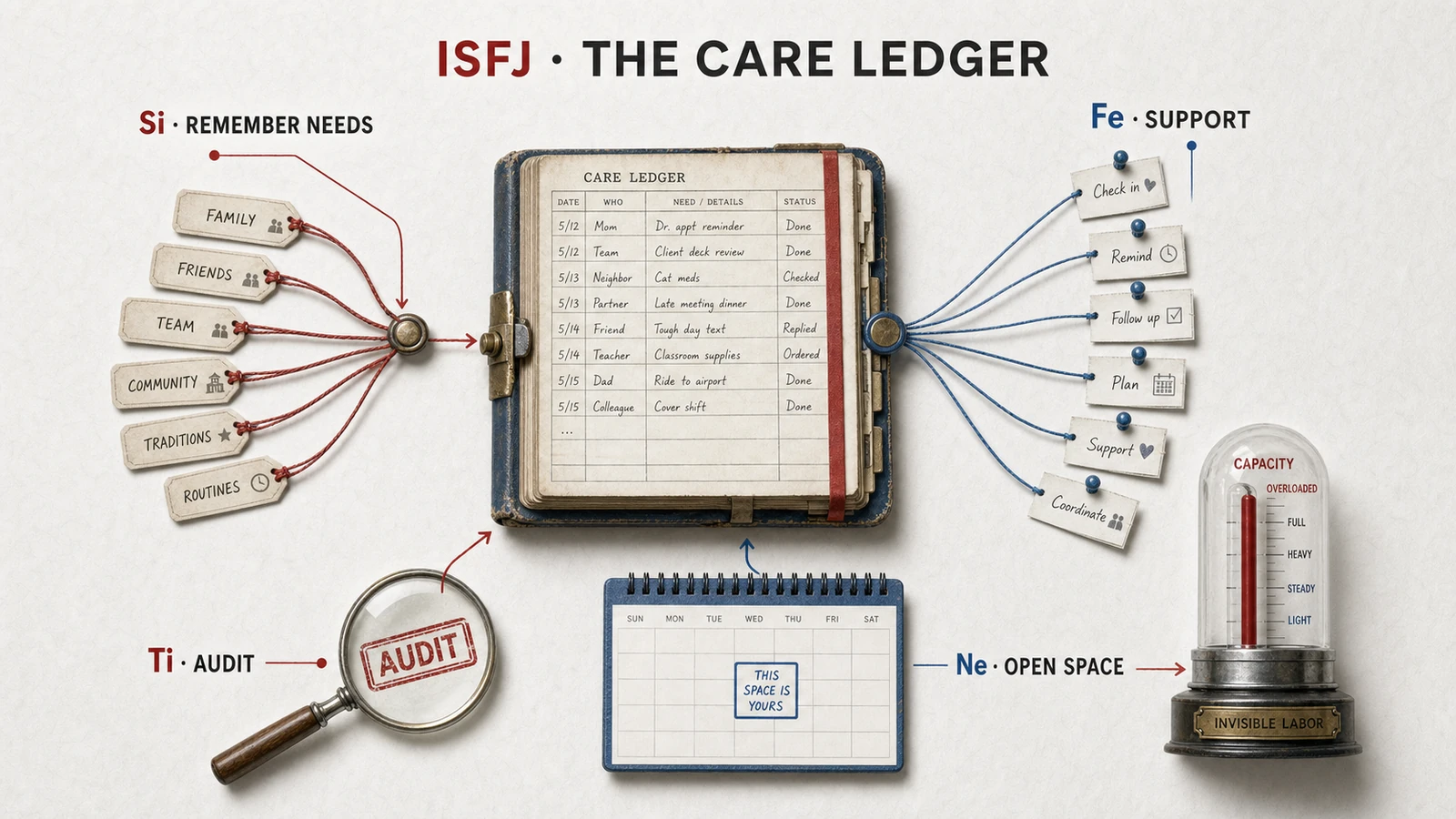
In cognitive-function terms, the ISFJ runs on Si-Fe: introverted sensing, supported by extraverted feeling. Strip away the jargon and you get two genuinely extraordinary instruments.
Si is a precision archive. It stores fine-grained, body-anchored records of how things have gone before: the exact way a person's face changes right before they claim they're fine, the tradition done the right way, the one detail that made last year's version actually work. Where an intuitive type sees a hazy overall impression, you retrieve the timestamped file. You're the one who remembers, the person institutions quietly run on without ever quite acknowledging it.
Fe is a live sensor array for other people's states. It continuously samples the emotional temperature of the room and registers any deviation, someone's discomfort, someone's unspoken need, as an action item. Not an observation. An assignment.
Now put those two together and notice what's missing. The archive records everything about everyone, and almost nothing about you. The sensor array has exquisite resolution on external emotional states and static on the internal channel. Researchers who study interoception, the brain's ability to perceive its own body's signals, find that people vary enormously in how well they read their internal states, and attention is a limited resource: a system trained relentlessly outward gets very little practice reading inward. You have near-total recall for everyone else's needs and something close to amnesia for your own, not out of saintly selflessness, just attention that was never pointed at you long enough to take notes.
There's a second layer worth understanding. Jeffrey Gray's reinforcement sensitivity theory, later refined by Philip Corr, shows that brains differ in how strongly they respond to reward versus threat. The ISFJ profile is classically punishment-sensitive: conflict, disapproval, and the mere possibility of having let someone down all register as genuine threat signals. That's why saying no doesn't feel like a preference to you, it feels like danger. And why saying yes produces instant relief, the alarm just stops, even when that yes is a loan you'll be repaying with interest for months.
An honest aside, because you'd distrust this piece without one: the MBTI instrument itself has well-documented psychometric problems, inconsistent retest results, forced binaries laid over traits that are actually continuous. What makes type-based advice useful isn't that "ISFJ" is some biological fact. It's that this profile maps onto validated constructs: high agreeableness and conscientiousness in Big Five terms, threat-sensitive reinforcement processing in Gray's framework. The research on why calibrated advice beats generic advice rests on those mechanisms, not on the letters themselves. Hold the label loosely. Take the mechanisms seriously.
The economics of invisible labor
Before we get to the dream life, we need to name the thing that quietly eats it.
There's a category of work that only becomes visible once it stops. The birthday that gets remembered every year. The supplies that never run out. The team friction that never escalates because you absorbed it in a hallway conversation nobody ever logged. Sociologists call this maintenance work or emotional labor. Every ISFJ just calls it Tuesday.
Invisible labor has a brutal market failure built into it: work that's only noticed in its absence gets priced at zero while it's actually being done. Nobody thanks the bridge for standing. And here's the sharper cut: you price it at zero too. Ask an ISFJ what they did today and they'll say "nothing much," having quietly regulated the emotional climate of an office, a household, and two group chats before noon.
This is exactly why the standard productivity conversation misses you entirely. Your problem was never doing too little. It's doing enormous amounts of unlogged, unpriced work, and then trying to squeeze your own life into whatever's left as a rounding error.
Every conflict-avoidant yes makes this worse, because the costs compound over time. Yeses are structural: organize the event once and you're the organizer forever. Cover for a colleague twice and it silently becomes your job. Each yes raises the baseline of what people expect from you, which raises the social cost of the next no, which makes the next yes even more likely. Six months later you're carrying a load nobody formally assigned, nobody sees, and, here's the trap, nobody would even believe you didn't want, because you never once said otherwise.
Build a life where continuity includes you
Generic dream-life advice fails you in a specific way: it's written by and for novelty-seekers. Disrupt yourself. Chase the unknown. Burn the boats. For a Si-Fe system, none of that is inspiring, it's a threat briefing. So you quietly conclude that you must not be very ambitious. That's wrong. Your ambition just takes a different shape.
You're built for stewardship, not conquest. The deepest ISFJ satisfaction comes from taking something that already matters, a team, a craft, a family, a body of knowledge, and making it genuinely thrive over years. Depth over breadth. Refinement over reinvention. In Deci and Ryan's terms, your dominant need channel is relatedness backed by competence: being genuinely good at something in a way that tangibly serves people you're attached to. There's nothing small about this. Civilization runs mostly on maintenance, and the people who do it well are rarer than visionaries and far more load-bearing.
The dream life, concretely, looks like this:
Work with a face on it. You wilt in abstraction. You need to see who's actually helped, patients, students, clients, readers, a team you've known long enough to remember their kids' names. Long-arc relationships beat transactional churn every time.
A stable base with chosen depth. You don't need constant novelty. You need a secure home base, physical, financial, relational, from which you go deep on a small number of things. Everyone's dream life is really a formula with personal coefficients, and yours weights security and belonging honestly high. Stop apologizing for that.
Visible maintenance. The non-negotiable environmental feature is a context where the keeping-things-running work actually gets seen. A culture that rewards only flashy launches can exploit an ISFJ's quiet maintenance because the work looks effortless and never arrives with an invoice.
One protected thing that's only yours. Choose a craft, a study, or a physical practice with no beneficiary at all. Constant service can consume the reserves you need when other people leave, grow up, or simply get better on their own.
The failure mode to actually design against isn't laziness. It's erosion, the slow conversion of every hour into someone else's infrastructure.
Make care visible and capacity finite
Most systems assume the problem is starting. Yours assumes the opposite: you'll reliably do whatever you've promised anyone else, and just as reliably deprioritize whatever you've only promised yourself. So the architecture here has one job: make your own goals structurally indistinguishable from obligations to other people.
Pay yourself first, the calendar version. Every week, before anything else lands on it, place one 90-minute block for your protected personal goal. Not "if time allows." First. ISFJs don't lack discipline, you have plenty. You lack standing: an internal sense that your goal is even allowed to displace someone else's request. Placed first, in ink, saying yes to others now requires moving your own commitment, which triggers the same loss-aversion machinery that currently only guards other people's stuff.
Run a care ledger. Once a week, ten minutes: write down the invisible work you actually did. The coverage, the emotional triage, the remembering. Not to bill anyone for it, to see it. Self-perception runs on evidence, and unlogged work generates none, which is exactly how you end a fully spent day believing you did nothing. The ledger turns invisible labor into data, and data changes decisions: you can't keep insisting "I have room" once you can see, in writing, that you demonstrably don't.
Install a 24-hour buffer on all requests. New default sentence, rehearsed until it's automatic: "Let me check my week and get back to you tomorrow." No exceptions for smiling people. The conflict-avoidant yes happens in the moment, under a live social threat cue. Remove the moment and you remove most of the hijack. Tomorrow, with the requester's face absent and your calendar in front of you, you get to decide with your actual judgment instead of your alarm system.
Pre-load your no's with implementation intentions. Gollwitzer's if-then planning works because it moves the decision out of the pressured moment and into calm preparation, which happens to be exactly where your brain performs best. "If I'm asked to take on a task that lands during my protected block, then I say: I can't take that one, but I could do X instead." Scripted, rehearsed, done. You already rehearse conversations obsessively. This just points the habit at the right target for once.
Weekly close, not daily audit. Si's archive plus a threat-sensitive temperament means daily self-review tends to curdle into rumination, replaying the one interaction that felt slightly off. Review weekly instead: the ledger, your wins (including maintenance wins), one boundary held, next week's block already placed. Then close the book. The review exists to finish the week, not re-litigate it.
Four experiments for overloaded caretakers
Six tools tuned to your specific failure modes, each with the mechanism attached.
The Resentment Flag. Reframe resentment as telemetry, not a character flaw. For a system with weak interoception, the first readable signal of overload is usually a flicker of bitterness while doing something you "gladly" agreed to. When it shows up, don't suppress it, log it: what was the task, who asked, what did the yes actually cost you? Resentment is your unpaid-invoice alert. Read the alert. Don't shoot the messenger for delivering it.
Permission by Proxy. You keep promises made to people, so give your goal a person. Tell a friend to expect the chapter on Friday. Book the class that takes attendance. Get a training partner who's stranded if you skip the session. This isn't a workaround for a character flaw. It's routing your goal through the motivational circuitry that already runs at full power in your brain, interpersonal obligation, instead of the one that doesn't, pure self-assertion.
The Graduated No Ladder. Threat responses shrink through repeated safe exposure, not through insight alone. So train the no like a lift, ascending in weight: decline a store loyalty card. Send back a wrong order. Tell a friend the restaurant doesn't work for you. Push back on a small deadline. Each survived no, where the relationship visibly doesn't end, recalibrates the alarm a little. You're not learning that no is comfortable. You're teaching your nervous system that it's survivable, and that turns out to be enough.
Three Interoception Minutes. Three times a day, sixty seconds each: attention off the room, onto the body. Jaw, shoulders, stomach, breath. Hungry? Tired? Braced for something? This feels absurdly small. It isn't. You're rebuilding the missing table in the database, training the inward channel that years of outward vigilance left starved. ISFJ burnout tends to announce itself through the body precisely because the body was the one channel nobody was ever reading. Start reading it while the messages are still small.
The Pennebaker Pressure Valve. Fifteen minutes of private expressive writing about whatever you're carrying, a few days running, no audience, no editing, burn it after if that helps. You spend enormous energy managing what you show other people. Suppression is expensive, and the expressive-writing literature consistently links unloading it, even just onto a page, with measurable improvements in stress and health. The page is the one relationship where your Fe finally gets to stand down completely.
Say the Ask Out Loud. Once a week, make one small, explicit request for yourself: "Can you take the dishes tonight, I'm wiped." The mechanism runs two ways at once: it gives the people who love you an actual chance to show up, since they can't read minds the way you quietly assume everyone can, and each fulfilled request becomes evidence against the core false belief that your needs are a burden. Connection compounds in both directions. You've only ever been running one side of the exchange.
Price invisible labor before volunteering
Invisible labor feels small because each act takes only a minute: remembering the prescription, replacing the empty item, checking the route, sending the birthday reminder. The weight comes from keeping hundreds of open loops active at once.
For one week, record care work in three categories:
- Execution: doing the visible task.
- Monitoring: noticing when the task will be needed.
- Recovery: fixing the consequences when somebody forgets.
Most household and team discussions count only execution. Monitoring is the part that follows you into the shower and wakes you at 2 a.m. Recovery is the part that turns another person's missed task into your emergency.
Choose one recurring responsibility and transfer all three layers, not only the visible action. "You cook on Tuesday" still leaves you planning the meal, checking ingredients, and rescuing dinner. A complete transfer sounds more like: "Tuesday dinner belongs to you, including the plan and groceries. If it changes, choose the backup."
Create a service ceiling for the week. Pick a number of discretionary favors you can offer without compromising sleep, health, or your own important work. When the number is reached, new requests receive a later date, a smaller offer, or a clear no. Capacity becomes a fact you manage rather than a moral judgment about whether you are kind enough.
Then reserve one block for preference retrieval. Do something small without polling anyone else: choose the restaurant, set the room temperature, play your music, or spend an hour on a private project. If choosing feels difficult, list three acceptable options and pick the first one that creates even mild interest. Preferences grow easier to hear when they are used.
The goal is a fairer operating model. Care remains one of your strengths, but the full cost becomes visible enough to distribute.
The shadow side: quiet martyrdom and the body's invoice
Every type has a burnout signature. Yours is the quietest, which is exactly what makes it dangerous.
It starts with doing more and mentioning less. The requests keep arriving because your yeses trained everyone that you have the capacity, and admitting you do not now feels like betraying the person you advertised yourself as. Output stays high while the lights slowly go out behind it. "Fine" gets flatter every time you say it. You start fantasizing about being sick enough that stopping would finally be legitimate, or about everyone somehow knowing without being told.
Sit with how revealing that fantasy actually is: you're so starved for permission to rest that your imagination routes it through illness, the one excuse nobody can argue with.
Then the body files the invoice. Crying in the car over a song, over nothing, tears that seem to arrive from nowhere because the channel that would have warned you earlier was the one you never monitored. Or the flu that lands on the first day of a long-planned vacation, the back that seizes right after the big push is finally over. Stress research knows this pattern well: symptoms tend to surface the moment obligations pause. The load was there the whole time. The body just waited for a gap in the schedule to deliver the bill.
Early detection, roughly in order of appearance: the resentment flicker during "gladly" performed tasks. The martyrdom fantasy ("if I got sick, I could finally..."). Score-keeping thoughts you'd be embarrassed to say out loud. A flatter voice, more "fine." Sleep going shallow while your performance stays polished on the surface.
The recovery move is stop first, explain later. Your instinct runs the opposite direction, keep everything running while you search for a graceful, nobody-inconvenienced way to eventually step back, which is really a plan for never stepping back at all. Instead: drop one visible thing this week, imperfectly, with one plain sentence, "I can't do this one this month." No essay required. Someone will be surprised, and the surprise itself is diagnostic, proof of exactly how completely you'd hidden the load. Then let at least one person see you not coping, on purpose. The martyrdom loop runs on concealment. Visibility breaks the circuit. And when the unexplained tears show up anyway, treat them as the backlog finally clearing, not a malfunction. That's months of unread messages downloading all at once.
If your closest cousins in the type system interest you, the ISTJ runs a similar archive with duty swapped in for attunement, and the ESFJ runs your same sensor array at extraverted volume, both share pieces of this burnout signature, just expressed louder.
The keeper, kept
Here's the reframe to leave with.
You've been telling yourself the options are binary: keep being the person everyone relies on, or become someone colder, and since you'd rather do almost anything than become the second thing, you've quietly accepted unlimited liability as the price of being you.
But the actual failure mode was never caring. It was unpriced caring, the encyclopedic attention paid to everyone in the room minus one. The ledger that tracks every need in sight except the one sitting in your own chair.
You don't need to be less kind. You need to be included in your own kindness, one protected block, one rehearsed no, one request said out loud, one entry in the ledger with your name actually on it.
The people worth keeping don't want the martyred version of you. They want the one who's still standing in ten years. Put yourself on the list. You're the only one who knows it exists, and the only one who can add the missing name to it.