You Already Solved It. That's Why You Can't Finish It.
There's a specific moment you probably know better than almost anyone else alive, and you've never heard a single person describe it out loud.
You're 90 percent done with a project. The architecture works. The hard question that made you start in the first place, the one that kept you up past 2am sketching diagrams nobody else will ever see, has been answered. And in the exact instant you understand the solution completely, something in you powers down. What's left is typing. Formatting. Emailing someone about it. The remaining 10 percent contains no unknowns, and to your brain, a task with no unknowns is a chore wearing a task's clothes.
So the project joins the others. The half-built app that proved the concept and stopped there. The essay that exists only as a flawless outline. The business idea you researched so thoroughly you could write the competitor's onboarding flow from memory, and never once registered the domain. Each one was The One, briefly. Each one got abandoned not at the hard part but right after it, which is the detail that makes the shame so confusing. You quit right after it stopped being difficult, not because it got difficult.
And here's the second thing you've never said out loud: you don't procrastinate by resting. You procrastinate by researching. Forty browser tabs, three of them Wikipedia articles two hops removed from anything actually relevant. "I'll just check one thing" is the most expensive sentence in your entire vocabulary. You've avoided a two-hour task by doing six hours of harder, more interesting, entirely unassigned intellectual work, and felt guilty the whole time, because some part of you knew exactly what was happening.
This is a wiring pattern, not a discipline problem, and it has a recognizable shape.
Your Wiring: A Precision Engine Bolted to a Possibility Engine
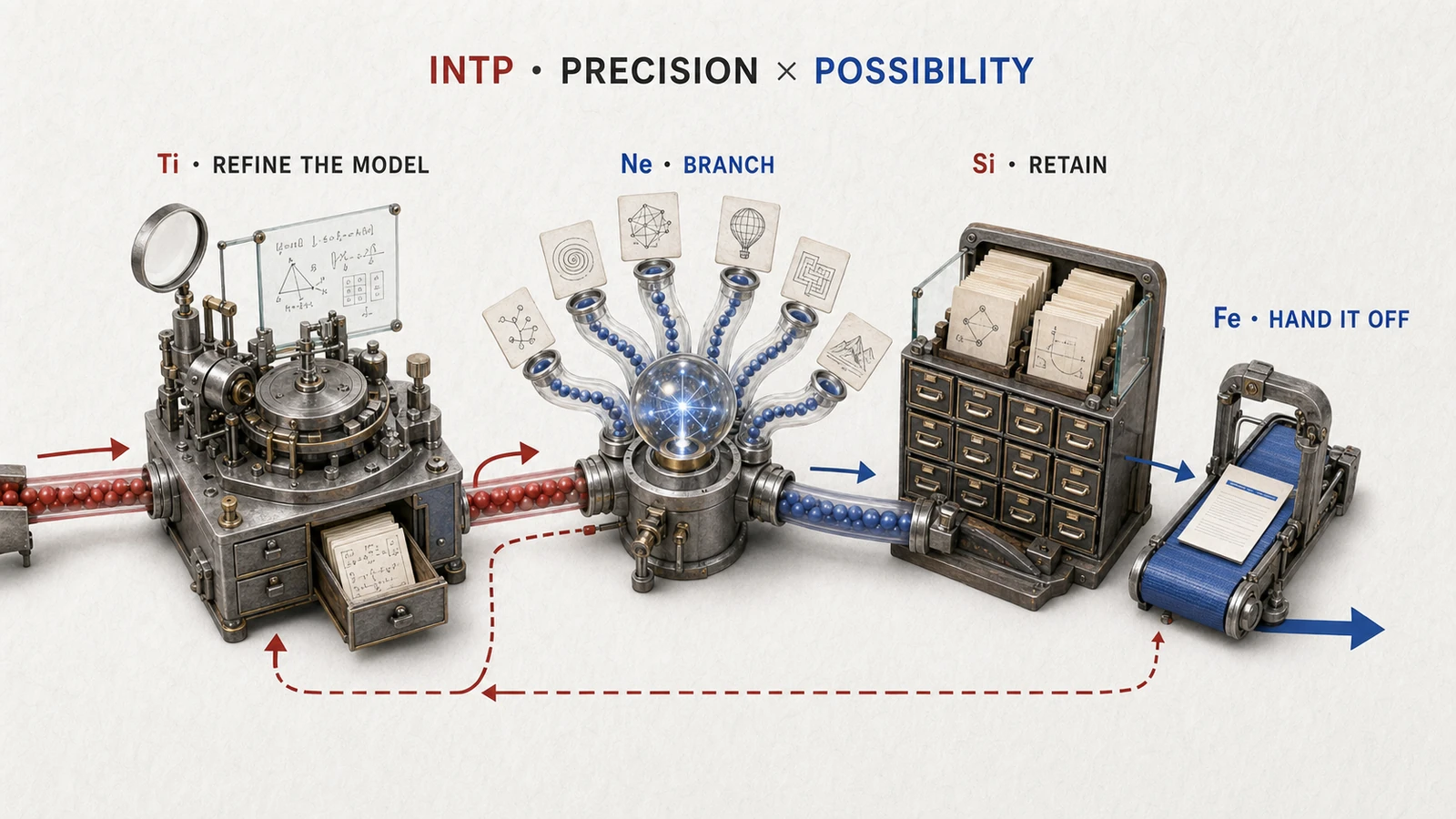
In MBTI terms, the INTP runs on introverted thinking, supported by extraverted intuition. Ti is a precision engine: it builds internal models of how things work and audits every incoming claim against them, relentlessly, including claims made by your own boss, your own plans, and your own previous conclusions. Ne is a possibility engine: it takes whatever's in front of you and fans it out into six adjacent ideas, four of which are more interesting than whatever you were actually doing.
Run together, they produce the signature INTP experience: an addiction to getting it exactly right, fed by an endless supply of new directions where "right" might be hiding.
Worth saying plainly: the MBTI instrument itself has real psychometric problems. Types aren't categories nature carved out, test-retest reliability is shaky, and the four dichotomies are better understood as continuous traits than hard boxes. What makes a profile like this one useful is that it maps onto constructs that do replicate: the Ti-Ne pattern corresponds to very high Big Five openness combined with modest conscientiousness, and to a reward system tuned toward information and insight rather than completion and status. Treat the four letters as a compression format for that profile, not a birth certificate.
The underlying mechanics show up in the research. Work on insight and problem solving suggests the brain's reward circuitry fires specifically for resolving uncertainty, so the aha moment behaves like an actual payout. While a problem stays open, every increment of understanding pays you something. The moment it closes, payment stops, but the invoice for the remaining execution still shows up in your inbox. That's the neurochemistry behind the 90 percent abandonment: you're being asked to work unpaid.
Meanwhile, the default mode network, the brain system Marcus Raichle's group identified as most active when you're not focused on an external task, appears to run unusually loud in people with your profile. It's the source of your best ideas in the shower and your worst spirals at 1am. The same machinery that connects distant concepts also generates the recursive self-audit: why haven't I done more with my abilities? You're running an idea generator with no off switch and a quality inspector with zero mercy, sharing one skull, not a broken attention system.
One more mechanism worth knowing: the Zeigarnik effect, Bluma Zeigarnik's old observation that unfinished tasks occupy memory more insistently than finished ones do. For most people that creates pressure to finish. For you it creates the 2am carousel, because you're not carrying three open loops, you're carrying thirty, and your Ne can reopen any one of them at any moment just by finding a new angle on it.
The Dream Life You're Actually Built For
Generic dream-life advice fails you in a specific way: it's almost always a picture of outcomes, the beach, the passive income, the title, and your Ti immediately audits the picture, finds it arbitrary, and files it under "other people's mythology." You can't be motivated by a poster. You can only be motivated by a problem.
So here's the reframe: the INTP dream life is a supply chain, a life arranged so interesting open problems arrive on a regular basis, with everything standing between you and them minimized.
Concretely, the wiring points at four requirements.
A portfolio of open problems. Not one grand mission, a rotation. Deci and Ryan's self-determination theory identifies autonomy, competence, and relatedness as the load-bearing walls of motivation. For your profile, autonomy is the non-negotiable one, and competence gets felt almost exclusively as understanding deepening over time. A life with one closed, fully-specified job starves you no matter how well it pays. Two or three live questions, one professional, one amateur, one absurd, keeps the reward system fed.
Ruthlessly low overhead. Every unit of administrative friction costs you more than it costs other types, because your Ti audits it ("this meeting has no function") and then resents it, and resentment is expensive to run in the background all day. The dream is zero performative work, not zero work. Small teams. Asynchronous communication. Deliverables judged on quality, not visible busyness. If you're an INTJ-adjacent reader wondering why this list contains no empire: that's the actual difference between the two types. The INTJ wants the system built. You want the problem understood. Plan accordingly.
Permission to ship imperfect. Structurally, not just as an aspiration. The environments where INTPs flourish, research groups, engineering cultures with real code review, editorial pipelines, all share one feature: someone else owns "done." Your internal standard will never sign off on its own, because Ti can always find one more inconsistency and Ne can always find one more approach worth trying. Externalize the verdict to someone else.
A small circle that values precision. You don't need many people. You need a few where conversation is a joint investigation rather than a status exchange. One friend who says "wait, go back, that doesn't follow" is worth forty who just say "sounds great." Relatedness, for you, is co-thinking.
Notice what's absent from this list: prestige, scale, visibility. Not because you're above wanting them, but because they're Ne bait wrapped around Ti poison. They look interesting from a distance and turn into meetings up close.
A Productivity System That Fits Your Brain
Most productivity systems get built by and for high-conscientiousness finishers, and they fail you at the same joints every time: daily granular plans (your interest doesn't run on a schedule), streaks (miss one day and Ti declares the whole ledger corrupt), arbitrary deadlines (audited, found illegitimate, ignored). Here's a protocol shaped to the actual wiring, a system built on process over outcome, because your outcomes stay hostage to your interest, but your process doesn't have to.
Plan weekly, not daily. Once a week, pick the three things that must ship and the one problem you're allowed to chase freely. Daily plans fail because you can't predict which day the interest will actually show up. Weekly plans give the interest room to land somewhere useful instead. The free-chase slot is a pressure-release valve that keeps Ne from hijacking the shipping slots, not indulgence.
Write the definition of done before you start. One paragraph: "this is finished when X, Y, and Z are true." Do it while the problem is still open and your judgment is still honest. This is the single highest-leverage change an INTP can make, because it converts "done" from an aesthetic judgment, which your Ti will never grant, into a checkable fact instead. When you hit the spec, you ship. The spec decided, not your standards. Your standards were never going to.
Deadlines need a face. You're nearly immune to dates on a calendar and nearly helpless in front of a specific person expecting a specific thing on Thursday. That's reinforcement architecture, not weakness. A calendar deadline is an arbitrary claim (audited, rejected). A person waiting is a real constraint. Manufacture one on purpose: a collaborator, an editor, a friend who gets sent the draft Friday at 5pm regardless of its actual state.
Batch the admin into one contemptuous hour. You will never respect administrative work, so stop trying to force yourself to. One timeboxed weekly block, invoices, forms, emails, done to a deliberately mediocre standard, ideally with something pleasant playing alongside it. Scattering admin across the week lets it contaminate every single day with low-grade dread. Corralling it into one hour concedes the battle to win the war.
Protect one long block for the real problem. Cal Newport's deep work case is stronger for you than for almost any other type, because your Ti needs long, uninterrupted runway to load the full model into working memory before it can do anything interesting with it. Two hours minimum. Task switching doesn't just cost you time, it evicts the model entirely, and reloading it is the single most expensive operation you run.
And one meta-rule: you're allowed exactly one system rebuild per quarter. You already know why this rule exists. The new tool, the new schema, the migration weekend, it feels like work because it's genuinely cognitively hard, but it's the purest form of INTP procrastination there is: optimizing the machine instead of running it.
Neuro Hacks for the INTP
Six techniques tuned to your specific failure modes, each with the mechanism attached, because you won't run anything you don't actually understand.
1. The 90% Handoff. The moment you notice the "it's solved, the rest is just typing" feeling, name it, then immediately do one shipping action (send the draft, book the demo, push the branch) before your reward system finishes powering down. Why it works: motivation decays fast once uncertainty resolves, but it doesn't vanish instantly. There's a short window where residual momentum can carry a commitment your future self will be socially bound to. Spend the window on lock-in, not on more polish.
2. The Rabbit-Hole Budget. Before any research session, write down the exact question you're answering and set a timer for the honest amount of time it deserves. When the timer ends, you must either produce a decision or explicitly schedule round two. Why it works: rabbit holes exploit the open-loop reward drip, each new tab pays out a micro-insight. A pre-committed stopping rule is a Gollwitzer-style implementation intention ("when the timer fires, then I write the decision"), which moves the exit off your willpower budget and into automation instead.
3. The Curiosity Ledger. Keep one running file for every fascinating tangent that shows up mid-task. Log it in under ten seconds, a single line, not a paragraph, and return to what you were doing. Why it works: Ne interrupts because it's afraid the idea will be lost, and the Zeigarnik pull of an unfiled thought is stronger than the thought actually deserves. Writing it down closes the loop without chasing it. Most entries, reviewed on Friday, turn out to be nothing. The ledger's real product is the ability to find that out later instead of right now.
4. Explain It to Ship It. When a project stalls right after being solved, write a plain-language explanation of what you built and why, as if to a smart friend in a completely different field. Why it works: it re-opens the problem. Explaining exposes gaps and compressions you hadn't noticed, which re-engages the insight circuit, and the explanation itself usually turns out to be 80 percent of the documentation, pitch, or paper you were avoiding. You finish almost by accident.
5. Body-Double the Boring. For admin and finishing work, sit near another working human: a cowork call, the library, the kitchen table while someone else reads nearby. Why it works: mild social presence raises arousal just enough to carry intrinsically unrewarding tasks, without the audit-triggering demands of real collaboration or the performance anxiety of direct oversight. It's accountability with no claims for Ti to reject.
6. Interest Surfing. When you have flexibility in ordering your work, match tasks to your current cognitive state instead of forcing a fixed sequence: solved-but-unshipped work when your energy is low, open problems when it's high. Why it works: flow lives at the meeting point of challenge and skill, and which challenges you're actually facing shifts hour to hour as problems open and close throughout the day. Fighting your interest costs willpower. Steering it costs nothing. The whole system above exists precisely so that wherever the interest lands, something on the list can actually move.
The Shadow Side: The Analysis Loop
Your burnout doesn't look like other people's: it starts with recursion, not exhaustion.
The work stalls, so you think about the work. Thinking about the work is genuinely more comfortable than doing it, so the thinking elaborates: a better plan, then a critique of the plan, then a meta-question about whether the whole project is even the right project, then, quietly, around week three, whether you're the kind of person who finishes anything at all. The default mode network hums along. The browser fills with research about productivity itself. From the outside you look calm. From the inside, you're running a tribunal, and the defendant is your own unrealized potential.
That phrase, unrealized potential, is the INTP's specific poison. Most types feel guilty about what they did. You feel guilty about what you can clearly see you could do, in permanent high resolution, forever. The gap between your mind's output and the world's evidence of it becomes proof of some essential defect, and the tribunal treats that as new material to work with.
Catch it early with two tells: you're reorganizing instead of producing, and you feel tired after days that contained no external work at all. Rumination is metabolically expensive. A day of looping analysis can leave you more drained than a day of actually shipping things.
The recovery move is deliberately anticlimactic, which is exactly why it works: ship one small, imperfect, finished thing within 24 hours. A two-paragraph email. A rough sketch sent to one person. Not the stalled project, anything. The loop feeds on the gap between your internal standard and your external output. A single completed artifact, however minor, breaks the recursion with evidence instead of argument. Your tribunal responds to data, not reassurance.
Then, and only then, go back to the stalled thing, reread its definition of done, and cut the spec by a third. Burnout for you is nearly always a scope problem wearing a character-flaw costume.
The Reframe
You've spent years grading yourself with someone else's rubric, finisher, executor, closer, and coming up short every time. Consider the alternative reading: you're running a mind optimized for the rarest part of the value chain. Anyone can be taught to finish. Almost no one can be taught to see the actual structure of a problem, audit it without flinching, and find the door nobody else noticed.
The abandoned projects were tuition, not failures of character. Every one of them upgraded the model you carry, and the model is the actual asset, the thing every future problem gets measured against.
Your work is to build a thin, boring layer of scaffolding, a spec, a face on the deadline, a ledger for the tangents, around the extraordinary machine you already run, not to become a different kind of mind. The machine solves. The scaffolding ships.
You were 100 percent of a solver, missing 10 percent of a system, never 90 percent of a finisher. Build the system. Keep the mind.