You Solved the Meeting Before It Started
You knew exactly how the meeting would go before anyone even joined the call. You knew who'd derail it, what the objection would be, and roughly what everyone would land on agreeing to, forty minutes after you could have decided the whole thing alone. So you sat there watching reality slowly catch up to your simulation, taking notes just to look appropriately present.
Here's what nobody sees: you live mostly in the future tense. When a friend pitches you their new business idea, you involuntarily fast-forward it, spotting the supply problem in month four and the co-founder conflict in year two, and then you have to decide, in real time, whether saying so makes you helpful or simply insufferable. Somewhere on your hard drive is a document named some version of "Master Plan." It's on version seven. Version seven is genuinely, measurably better than version six. None of them has shipped.
And here's the confession underneath that confession: the strategizing isn't just how you work. It's where you hide. As long as the plan is still being perfected, it can't fail yet. As long as nothing has shipped, the vision stays intact, flawless, private, safely superior to anything reality could actually produce.
If you're an INTJ, you didn't need that third paragraph. You needed the first one, and then you started scanning to decide whether the rest of this piece deserves your time. Fair enough. Let's earn it.
Your Wiring: A Prediction Engine With a Shipping Problem
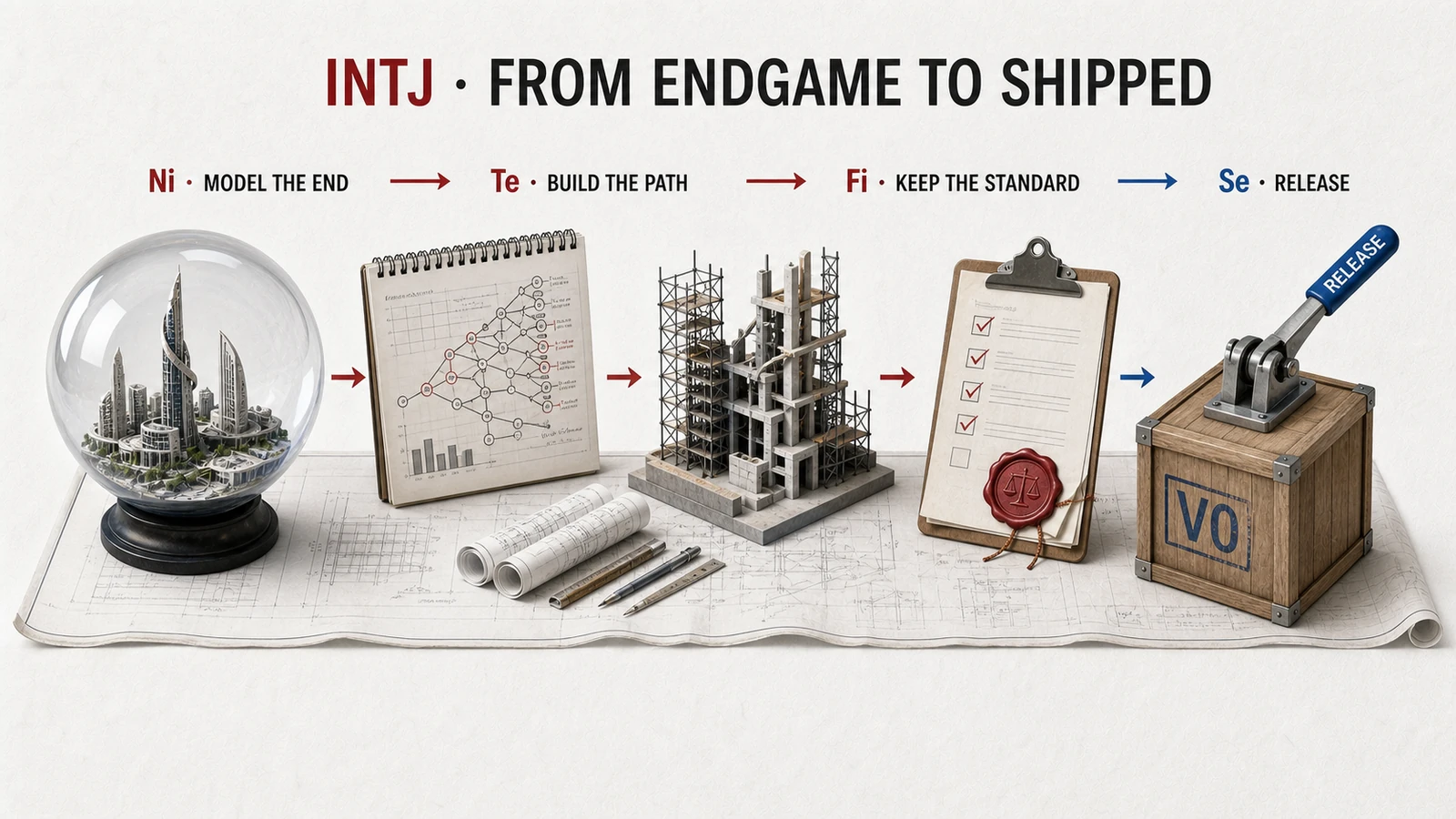
In cognitive-function terms, INTJ runs on introverted intuition, backed by extraverted thinking. Strip away the jargon and it describes something real: a mind that compresses scattered observations into one converging pattern, an endgame, and then works backward, reverse-engineering the moves that get there. Most people plan forward from today. You plan backward from a future you've already visited.
Modern cognitive science offers a less mystical frame for this. The brain is increasingly understood as a prediction machine. It doesn't passively receive the world, it continuously forecasts it and updates on error. Marcus Raichle's research on the default mode network showed that the brain's "resting" state is anything but restful: it simulates, remembers, and projects constantly. Where many people's default network replays social scenes, who said what, what it meant, yours disproportionately runs prospection instead: forward simulations, scenario trees, contingency branches. Your daydreams come with Gantt charts attached. (If your simulations ever turn on you and become 2am loops, it's worth understanding the actual mechanics behind how the default mode network fuels rumination.)
The Te half of the stack is what wants those simulations operationalized: metrics, systems, sequences, resource plans. It's also why sloppy execution physically irritates you. A meeting with no agenda isn't just inefficient to you, it feels like watching someone misuse an expensive instrument.
Two honest caveats before we go further. First, on MBTI itself: the original instrument has real psychometric problems, forced either-or categories laid over what are actually continuous traits, and mediocre test-retest reliability. Its value here is that the INTJ profile maps onto well-validated dimensions, in Big Five terms that's high openness, high conscientiousness, low extraversion, plus Jeffrey Gray's reinforcement sensitivity research on how differently brains weigh reward against threat. We're using the type here as a compression format for a real trait cluster, not claiming your brain carries a four-letter serial number. (The full argument is in why MBTI-calibrated coaching beats generic advice.)
Second, on the wiring itself: a prediction engine this strong has a characteristic bug. Internal simulation is cheap and safe. External contact is expensive and it bruises. So the system, left unsupervised, keeps choosing simulation over contact. It refines. It re-architects. It reorganizes the notes about the plan. And because refinement genuinely produces a better plan each time, it never quite feels like avoidance, which is exactly what makes it such an effective place to hide.
The Dream Life You're Actually Built For
Generic dream-life advice misfires on you in a specific way: almost all of it is aimed at people who lack a vision. Vision boards, "find your why," guided imagination exercises. You've never once been short on vision. You've been short on collision with reality. Advising an INTJ to visualize the future is a bit like advising a fish to consider swimming.
So what does a life that actually fits this wiring look like? Edward Deci and Richard Ryan's self-determination theory, one of the most replicated frameworks in motivation science, says humans need autonomy, competence, and relatedness. Every type needs all three, but your wiring weights the first two unusually hard, and routes the third through an unusual door. (The research behind autonomy, competence, and relatedness is worth reading in full, because you'll want to argue with it, and it'll win.)
Autonomy, for you, means authority over method. You can tolerate demanding goals, brutal deadlines, even difficult clients. What you can't tolerate is someone standing over your shoulder dictating the how. The real dream-life test isn't "do I love this work?" It's "who controls the method?" A prestigious job with a micromanager is, for your nervous system, a well-paid cage. A modest job with a long leash is a launchpad.
Mastery isn't optional equipment. It's the engine. Anders Ericsson's research on deliberate practice describes improvement through sustained effort at the edge of current ability, and that edge is exactly where your brain quietly stops simulating and starts being present. INTJs report their happiest hours not on vacations but deep inside a hard problem that's finally starting to yield. Design for that: a career with a visible mastery curve, work structured in long protected blocks of deep focus, and at least one craft outside work with no deadline and no audience at all.
Relatedness comes in through the side door. Here's a pattern you may not have named yet: you say you hate small talk, true, and over the years that hardens into an unexamined policy of avoiding the contexts where small talk happens, which happen to be the on-ramps to nearly all human connection. The result is a loneliness you rarely admit to, partly because admitting it feels like confessing a design flaw. It isn't a design flaw. It's a routing difference. You bond shoulder to shoulder, not face to face, through shared projects, shared problems, shared craft. Competence is your love language in both directions: you show care by making things work for people, and you feel most loved when someone takes your work seriously. A dream life for you includes two or three relationships built on dense mutual respect, built around building. Not a network. A workshop.
The composite: ownership of a hard, meaningful problem, authority over method, a visible mastery curve, a small circle that treats competence as intimacy, and, this is the part your plan always omits, regular scheduled collisions between your vision and the world.
A Productivity System That Fits Your Brain
Most productivity systems fail you from one of two directions. They're either too shallow (motivational, streak-driven, celebratory, you feel patronized by day three) or rigid at the wrong altitude (prescribing your hours while ignoring your strategy, which is exactly backward). Here's a cadence built for Ni-Te specifically.
Quarterly: the premise review. One half-day, four questions. What was the premise of the current plan? What evidence has arrived since? Is the premise still true? What would I build if I were starting today with what I now know? This targets your single most expensive failure mode directly: executing brilliantly on an assumption that quietly expired months ago. Daniel Kahneman's work on the planning fallacy shows how reliably we protect our forecasts from incoming evidence. You're not exempt from that. You're just better at defending the forecast than most people.
Weekly: one decision, then translation. A single planning session with two outputs. First, one strategic decision, not ten. Your appetite for re-architecting everything on a weekly basis is a bug wearing a suit. Second, translate the vision into next physical actions. This matters more for you than for most types, because your plans live at high altitude ("build the platform," "restructure the team"), and altitude is exactly where procrastination breeds. A step you can start in two minutes, "draft the schema for the users table," gives Te something to execute instead of giving Ni something new to re-imagine.
Daily: deep blocks plus one visible move. Two or three protected deep-work blocks in your peak hours, Cal Newport's core argument that rare and valuable output comes from long, undistracted stretches could have been written with your wiring as the reference case. Then one hard rule: every day produces at least one externally visible artifact. A sent email, a pushed commit, a shared draft. Not because output equals worth, but because visibility is your forcing function against the simulation loop. Visible progress is consistently one of the strongest daily drivers of motivation at work, and for you, "visible" is the operative word, since invisible progress is exactly what version seven of the master plan consists of.
Accountability: data review, not cheerleading. Streaks, badges, and "you've got this" messaging actively repel you. What works is a monthly review with one person whose competence you respect, structured as an examination of evidence: here's what I predicted, here's what happened, here's the delta. You'll prepare rigorously for it, not because you fear judgment, but because being found imprecise by a reviewer you respect is the one social consequence your brain treats as genuinely real.
Neuro Hacks for the INTJ Brain
Six techniques, each aimed at a specific failure mode in this wiring.
1. The Version-Zero Rule
How: every project ships a deliberately rough version at 70 percent of your internal standard, on a date set before work even begins. Why it works: after the first few passes, internal refinement stops generating new information. You're polishing against a model of reality instead of reality itself. Only external contact produces genuine prediction errors, and prediction errors are the only thing that actually improves the model. Shipping early isn't lowering the bar. It's buying data your simulation can't manufacture on its own.
2. Scheduled Disconfirmation
How: a recurring 15-minute weekly slot with one job, try to falsify the current plan's core premise. Use Peter Gollwitzer's implementation-intention format to make it automatic: "when my Friday review begins, then I write one piece of evidence against my current plan." Why it works: if-then plans delegate initiation to the cue itself, bypassing the motivational fight, which matters here because no INTJ ever feels like attacking their own premise voluntarily. You're institutionalizing the one conversation you'd otherwise always avoid.
3. Externalize the Cache
How: write the entire vision down, fully, ugly, exhaustively, in one document, then close it. Why it works: an unexternalized vision behaves like an open loop, continuously re-rendered in working memory and quietly burning attention you experience as mental load. Once it's trapped in text, the vision stops demanding rehearsal, and the strange side effect is that its flaws finally become visible on the page in a way they never were inside your head.
4. Shoulder-to-Shoulder Scheduling
How: engineer one recurring block per week of working next to someone, co-building, pair problem-solving, a shared project with a friend. Not networking. Not catching up. Building. Why it works: your bonding channel runs through shared attention on a third thing, not through face-to-face disclosure. This gives you the relational maintenance your wiring quietly starves for, without requiring you to perform a warmth style that was never yours to begin with.
5. The 80% Delegation Test
How: if someone can do a task 80 percent as well as you, hand it off, and forbid yourself from silently redoing it afterward. Why it works: Te's hunger for control masquerades as a quality standard, and it caps everything you build at the size of one person. The 20 percent quality gap on delegated tasks is the price of scale. Refusing to pay it is exactly why the vision stays a solo operation stuck at version seven.
6. Contempt as a Dashboard Light
How: track one signal, the day your baseline judgment of other people's competence turns to contempt. Treat it as a depletion alarm, not an insight about them. Why it works: for this wiring, rising contempt is one of the earliest and most reliable overload indicators. It shows up weeks before you'd ever describe yourself as burned out. When the light comes on, the correct response is recovery and a premise review, not doubling down.
The Shadow Side: Grinding a Flawed Plan Alone
Every type has a burnout signature. Yours has a plot.
It starts when the premise quietly changes, the market shifts, the relationship changes shape, the assumption under the five-year plan expires. You notice. You're far too perceptive not to notice. But saying it out loud feels indistinguishable from admitting incompetence, because your identity is fused to being the one who saw it coming. So instead of updating the plan, you compensate: more hours, tighter systems, harder grinding on a foundation you no longer actually believe in. You cut what social contact remains, because people cost energy and the plan needs all of it. Contempt rises, for colleagues, for the industry, for people who seem happy with less rigor than you demand of yourself. Sleep gets colonized by strategizing. And when the collapse finally arrives, you rebrand it as a pivot, so that even the failure ships with a narrative attached.
The cruelest part: from the inside, every step of this feels like virtue. Persistence. Rigor. Self-reliance. The INTP next door abandons flawed premises too easily; the ENTJ burns out loudly, taking a whole team down with them. You burn out silently and alone, which means nobody intervenes, which is exactly how your wiring prefers it, and exactly why it's dangerous.
Early detection, roughly in order of appearance: the contempt spike. Planning at bedtime. Canceling the last standing social commitments on your calendar. A new version number on the master plan within days of the previous one. Irritation at anyone who asks how you're actually doing.
The recovery move is almost insultingly simple, which is probably why you haven't done it yet: say the sentence "the premise changed" out loud, to one person whose mind you genuinely respect. Not "I failed." Not "I'm tired." The premise changed. That sentence converts what your brain has filed as incompetence into what it actually is, an update, the exact operation your prediction engine exists to perform. Strategists who can't update aren't strategists. They're monuments. The willpower you've been spending to protect a dead premise comes back the moment you stop.
The Endgame Was Never the Deliverable
Here's the identity-level reframe, and then you can go back to your document.
You've spent your life believing your gift is the vision, the finished future you can see before anyone else can. But the vision was never the deliverable. It's the navigation system. Its entire value is only realized in contact with terrain: shipped, tested, corrected, rebuilt. A map that never touches ground isn't strategy. It's fantasy with better formatting.
The people who eventually built the things you envisioned first weren't smarter than you. They were simply willing to be publicly wrong earlier than you were.
You already know what version eight of the plan would say. Don't write it. Ship version zero of the thing instead, this week, at 70 percent, to someone real. Your endgame has been patient with you for years.
It's waiting on the moves.