You Have a Graveyard of Beautiful First Pages
Somewhere in your home there's a drawer, a shelf, or a box you don't open on purpose. Inside it: the notebooks. The one with the linen cover you bought before the year you were finally going to change everything. The bullet journal with eleven gorgeous pages and two hundred blank ones after it. The planner with your best handwriting on January 3rd and nothing at all after January 14th.
You don't throw them out. That would mean admitting something. You just stop looking at them.
Here's the part almost nobody knows: each of those systems was a covenant, not a purchase. You sat down with it that first night and you meant it, the novel finally written, the mornings finally yours, the person you are at 2am finally visible in daylight. For a week or two, the system actually held. Then one morning something had quietly drained out of it. The boxes and streaks just sat there looking like someone else's religion. Your hand, genuinely, would not move toward the pen.
So you closed it gently, the way you'd close a door on a conversation that was already over. Then came the familiar third act: the quiet, corrosive verdict. Other people can do this. Something must be wrong with me.
Nothing is wrong with you. But something very specific is happening inside you, and once you can see the shape of it, the whole graveyard of planners reads completely differently.
Your Wiring: Every Task Passes Through a Values Gate First
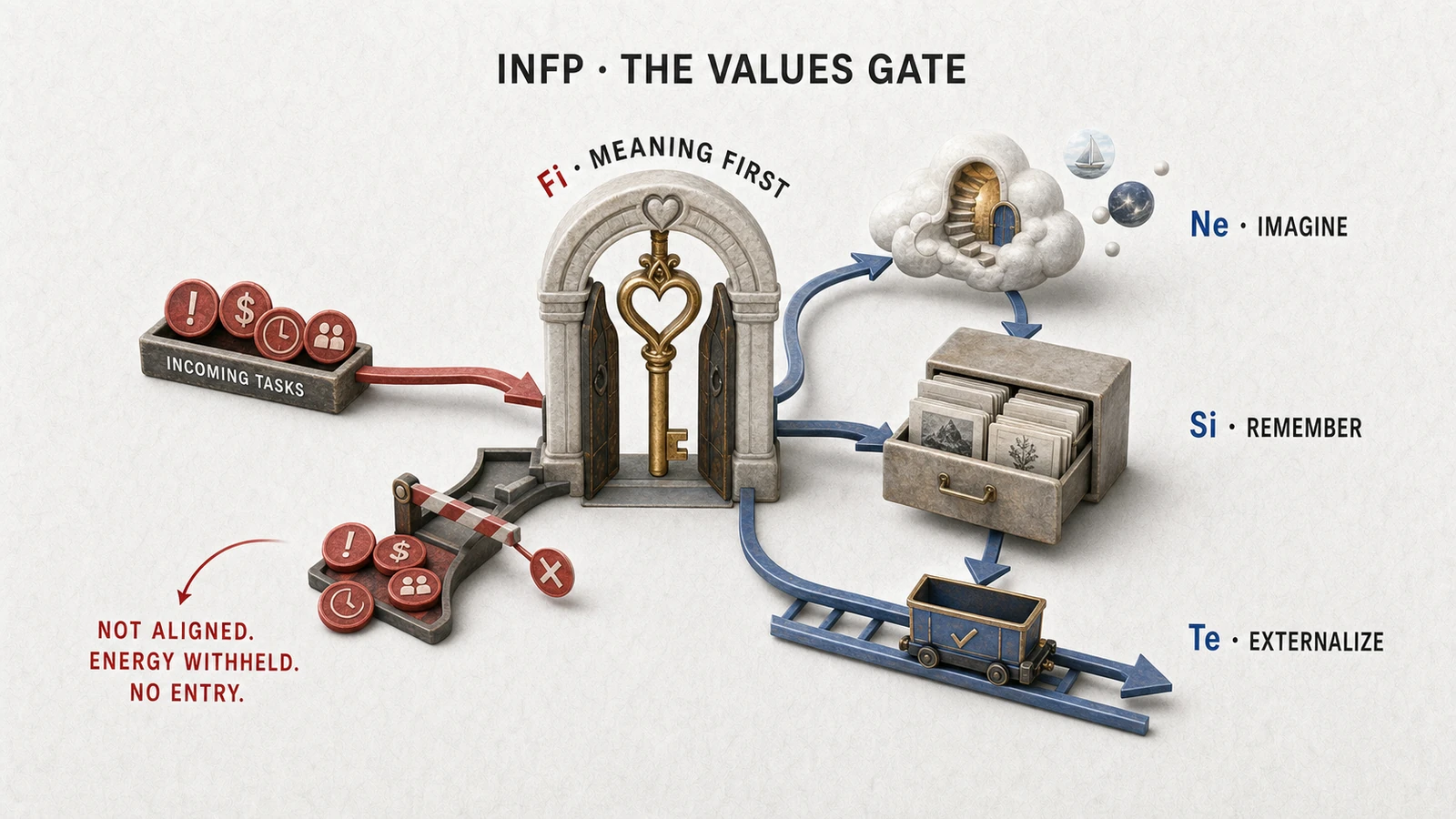
In MBTI terms, the INFP runs on Fi-Ne: dominant introverted feeling, backed up by extraverted intuition. Strip away the jargon and here's what it means in practice: before your hands will move on anything, the task passes through an inner checkpoint asking a single question. Does this actually align with what I care about? Not urgent. Not lucrative. Not promised to someone. Aligned. And that checkpoint can't be bribed, threatened, or reasoned with, because it doesn't run on language at all. It runs on felt sense.
That's why you can work twelve hours straight on something that matters to you and can't force twenty minutes on something that doesn't. The energy isn't missing. It's being withheld, by you, from tasks that already failed the check. For an INFP, procrastination is usually a veto you just haven't translated into words yet.
Modern psychology gives this real scaffolding. Edward Deci and Richard Ryan's self-determination theory shows that the quality of your motivation depends heavily on how internalized a goal actually is: imposed goals produce fragile, resentful effort, while identity-integrated goals produce durable drive that doesn't need to be forced. Your Fi gate is an unusually strict internalization auditor. It refuses to run tasks on external justification alone. Meanwhile, Marcus Raichle's research on the default mode network, the brain system active during rest, imagination, and self-referential thought, explains the other half of your experience: the vivid futures you build without even trying to. High trait openness, where INFPs reliably land on Big Five measures, correlates with rich, spontaneous imagery. Your Ne is a possibility engine that never fully idles.
Honesty requires a caveat here. The MBTI instrument itself has well-documented psychometric problems. Types aren't stable categories, and the theory's origins predate modern measurement by decades. Its value in this piece comes from the fact that the INFP profile maps onto validated constructs: high openness, high agreeableness, and a threat-sensitive temperament that reinforcement sensitivity research would describe as a strong behavioral-inhibition response. The four letters are a doorway here, not a diagnosis.
That threat sensitivity matters more than it sounds like it should. A brain with a reactive inhibition system responds more strongly to potential loss, criticism, and self-betrayal than it does to potential reward. Which means shiny streaks and gold stars do very little for you, but the prospect of violating your own standards, writing something false, doing work you find hollow, lands like a physical brake. Your gate isn't decoration. It's a loss-prevention system built for protecting the self.
The real tragedy is the misdiagnosis. A values gate paired with a possibility engine produces a person with an enormous, detailed inner life and lumpy, inconsistent outer output. And because the world grades output, you've spent years calling the gap between them by the wrong name: laziness, flakiness, lack of discipline. The gap has a truer name. It's grief, the private ache of containing more than you've yet managed to show anyone.
The Dream Life You Are Actually Built For
Every generic dream-life blueprint fails you in the exact same way: it's built on scale, and you run on depth.
The standard script, bigger audience, bigger numbers, passive income, personal brand, reads to your Fi gate as a life spent performing instead of a life spent being. Force yourself down that road and you'll produce a specific, hard-to-explain misery: outwardly fine, inwardly starving, guilty because nothing is technically wrong. Viktor Frankl diagnosed this decades ago: a life can be comfortable and still be meaning-starved, and the second problem doesn't care how well the first one is going.
What your wiring actually calls for rests on three load-bearing walls.
Autonomy over optics. Not "be your own boss" as a status symbol, autonomy as the literal precondition for your motivation system to even function. Self-determination theory is blunt about this: autonomy-supportive contexts produce intrinsic motivation, while controlling ones kill it outright. For most types that's a preference. For a brain that vetoes non-internalized tasks, it's closer to a dietary requirement. The dream job isn't defined by the field so much as by the ratio of hours spent on work you've genuinely, inwardly consented to.
A craft that deepens. INFPs get mislabeled constantly as dreamers who can't commit to anything, but watch one who's found their actual medium, writing, therapy, design, teaching, code that helps somebody, and you'll see shocking endurance. Mihaly Csikszentmihalyi's flow research explains why: flow needs clear feedback and a challenge that stretches your skill, but for you there's a third precondition the textbooks tend to underweight. The activity has to be expressive. When the craft carries your values outward into the world, practice stops feeling like discipline and starts feeling like articulation.
A small circle at full resonance. You don't want a thousand acquaintances. You want six people who get the unabridged version of you. Your dream life isn't a stage. It's a long table.
Notice what's missing from all of this: no cottage, no book deal, no year abroad required. Those are set dressing your Ne generates around the real requirements underneath. The 2am futures aren't lies. They're compressed messages. The cottage means autonomy. The novel means expression. The nonprofit means impact aligned with values. Decode the imagery down to its actual conditions, and you can start building the real dream life this Tuesday.
A Productivity System That Fits Your Brain
Every system you've ever abandoned shared one hidden assumption: that motivation follows structure. Build the grid, and the energy will show up. For your wiring, the causality runs backward: energy follows meaning, and structure only survives as long as meaning keeps flowing through it. So we build the system around the gate, instead of pretending the gate isn't there.
The weekly why-ladder, twenty minutes, once a week. Before planning a single task, list your active projects and write one sentence for each: this matters to me because... If the sentence comes easily, schedule the project. If you catch yourself writing a sentence you don't actually believe, stop. You've just found the week's real problem, and no amount of scheduling will fix it. This ritual heads off the silent drift where your calendar fills up with tasks your gate already vetoed weeks ago.
Three-item days, not time-blocked grids. A rigid hour-by-hour plan is a promise to your future self, and you experience broken promises to yourself as moral events, not logistics. So make fewer, softer promises instead: one meaningful task, one maintenance task, one tiny task. Done by 2pm? Everything after that is bonus. This isn't lowered ambition. It's matching the size of your commitments to the psychological cost you pay when a commitment breaks.
Entry bars set below the perfectionism threshold. Your Fi doesn't just judge whether work is worth doing. It judges whether the work is worthy of the vision. That second judgment is where projects actually die, because page one of the real novel can never match the novel already living in your head. The counter-move borrows from Peter Gollwitzer's implementation intentions research, bent to fit your wiring: the when-then plan targets an action so small it sits beneath your inner critic's jurisdiction entirely. Not "when I finish dinner, I write the chapter" but "when I finish dinner, I open the file and write two ugly sentences." The gate inspects cathedrals. It waves pebbles straight through.
One warm witness, zero dashboards. Public accountability, leaderboards, and streak-shaming read as surveillance to this temperament, and they trigger the exact inhibition system you're trying to calm down. What actually works is one trusted person who knows the project and asks about it kindly. You'll move mountains to avoid disappointing someone who believes in you gently, the same sensitivity that makes criticism wound you also makes warm attention genuinely propulsive.
A review that's a journal, not a scorecard. End the week with ten minutes of freewriting: what pulled me in, what repelled me, where did the week actually touch my values. James Pennebaker's expressive writing research shows that translating felt experience into language measurably aids emotional regulation, and for you it doubles as system telemetry, because your feelings about tasks are the data.
Neuro Hacks for the INFP
Five tactical moves, each aimed at a specific failure mode in this wiring.
1. The Meaning Tag
Next to every task you plan, add three words of why: "invoice client (fund the studio)," "gym (be here at 80)." The how: never let a bare imperative sit on your list unexplained. The why: your gate doesn't read task names, it reads significance. A three-word tag pre-loads the values check so the veto never gets a chance to fire. Tasks that resist tagging entirely are telling you something. Renegotiate them or delete them outright.
2. Draft Zero Protocol
Officially designate the first version of anything as "draft zero, not for judgment," ideally in a genuinely ugly font. The how: put creation and evaluation into separate sessions, on separate days. The why: your perfectionism is really pre-emptive self-protection from the pain of falling short of your own vision. Splitting the two modes means the inhibition system is off duty while you're generating, and by the time the critic shows up there's already something on the page for it to improve instead of prevent.
3. Action Before Mood
When you feel too flat to start, do the physical opening move anyway: open the document, put on the shoes, set out the paints. The how comes straight from behavioral activation: schedule contact with the activity, not the feeling that's supposed to come before it. The why: you tend to treat motivation as a prerequisite, and its absence as a message. Sometimes it is. But mood follows engagement more often than it precedes it, and five minutes of contact is the cheapest way to find out which one today actually is.
4. The System Funeral
When a planner or app finally dies, retire it on purpose: one page on what it gave you, what starved it, and one element worth carrying forward, then close it without apology. The how takes about ten minutes. The why: the real damage of the abandoned-planner cycle was never the lost productivity, it's the shame narrative that compounds with each corpse and makes the next attempt heavier than the last. A funeral converts every dead system from evidence against you into data for you. (ENFPs, your cousins in Ne, need this same rite for the same reason.)
5. The Sacred Hour
Give the project that's actually yours, not owed to anyone else, the first workable hour of the day, before email, before other people's needs get a vote. The how: protect it structurally, phone elsewhere, door shut, not through sheer willpower. The why: your agreeableness means that in any open time slot, other people's needs win by default, and the day's meaning-budget gets spent on everyone but you. An hour of values-aligned work early doesn't just produce output. It changes the felt tone of the entire day. You've noticed this before. Now actually schedule it.
The Shadow Side: Meaning-Starvation That Wears Laziness as a Mask
INFP burnout doesn't look like burnout, which is exactly why it goes untreated for so long.
The classic picture, the overworked executive, the 80-hour weeks, isn't you. Yours arrives quietly, inside a life that looks perfectly manageable from the outside. The signature: every task feels heavy regardless of its actual size. The escape fantasies stop being fun and start feeling urgent. You feel a low revulsion toward your own to-do list, the way food looks wrong when you're nauseous. You cancel on the people you love most, because they're the ones you can't perform for. And here's the tell that separates it from depression's close cousin: somewhere in you, one specific thing still glows. You just can't justify doing it, because you're "behind on everything else."
Here's the actual mechanism. You've been running on external justification, obligations, other people's timelines, tasks that pass everyone's check but your own, and the Fi gate has been quietly vetoing for weeks. The vetoes accumulate as friction. The friction reads as fatigue. Then comes the misdiagnosis, delivered by your own inner voice in its most reasonable tone: you're just lazy. So you respond the way a conscientious person responds to laziness, more pressure, stricter systems, harsher self-talk, which starves the gate even further and deepens the spiral. You're treating a famine with a whip.
There's also a signature relapse behavior worth naming: the great system rebuild. Three weeks into the heaviness, you decide the problem must be architectural, and you spend a gorgeous, absorbed Saturday building a new setup, new app, new categories, new color scheme. For one day it even feels meaningful, because designing an ideal life is itself values-aligned work. Then Monday asks you to actually live inside it, the tasks are still the same unaligned tasks, and the new cathedral joins the graveyard. The rebuild was never the fix. It was the symptom, wearing the fix's clothes.
The recovery move is embarrassingly specific: restore values contact before restoring output. Take the one thing that still glows and give it an hour, unearned, ahead of the backlog. Not as a reward for catching up. As the treatment itself. Then do a ruthless audit of the load: for every obligation, ask whose value does this actually serve? Some tasks will survive the question by being honestly renegotiated ("this one is hollow, but it funds the work that isn't, and I'm choosing it"). Choosing a task, even a dull one, moves it through the gate. Being ambushed by it doesn't. The distinction sounds cosmetic. To your motivation system, it's everything.
And one more thing, for the drawer of dead planners: you were never lazy. You were running the most demanding quality-control system a psyche can install, one that refuses to spend a life on things that don't matter, in a world that mostly pays people regardless of whether their work does. That refusal has cost you plenty. It's also protected the thing about you most worth protecting. INFJs will recognize pieces of this pattern from the other side of the idealist coin, but the Fi version is uniquely private: nobody ever sees the gate. They only ever see the output gap.
The Closing Reframe
You've spent years measuring yourself with an instrument built for a different machine, counting completed tasks as if yours didn't have to pass through a soul first.
Here's the truer accounting. You're not a broken productive person. You're a meaning-driven person, and meaning-driven isn't a deficiency waiting to be systematized away. It's the feature the whole design runs on. The inner worlds were never procrastination's hiding place. They're the workshop. The abandoned planners weren't failures of character. They were experiments that returned real data: this one didn't carry meaning.
The work now isn't to finally become disciplined. It's to build a life where the gate says yes more often: smaller doors, tagged tasks, one sacred hour, six real people, a craft that deepens. Do that, and the discipline you've envied in others will show up on its own, unannounced, wearing your handwriting.
The person you visit at 2am has been waiting a long time. They don't need you to be someone else. They need you to start smaller than feels worthy of them.
Two ugly sentences. Tonight.