You Knew How That Friendship Would End Three Years Before It Did
You never said anything, of course. You just watched the small pattern build: the way they only called when they needed something, the flicker of dismissal whenever you shared something that actually mattered to you. Some quiet part of your mind extended the line into the future and rendered the ending in full color, in advance. Then you spent three more years being warm and generous to someone you'd already grieved.
Here's the other thing you don't mention to people: you walked into a room last Tuesday and knew, before anyone said a word, that two people in it had argued earlier that day. You felt the residue on your skin. By the time you left, their tension had somehow become your tension, and you spent the whole drive home processing a conflict you weren't even part of.
And the project, the one that actually matters, the book or the practice or the thing you're privately convinced you were put here to do, has been "almost ready to start" for four years, while you casually finish a hundred things you don't even care about.
If you're an INFJ, none of that reads as description. It reads like surveillance.
Consider this a field guide to that wiring: why it behaves the way it does, what a life built for it actually looks like, and how to get the one thing that matters out of your head and into the world without burning yourself down along the way.
Your Wiring: A Prophecy Engine Strapped to an Emotional Antenna
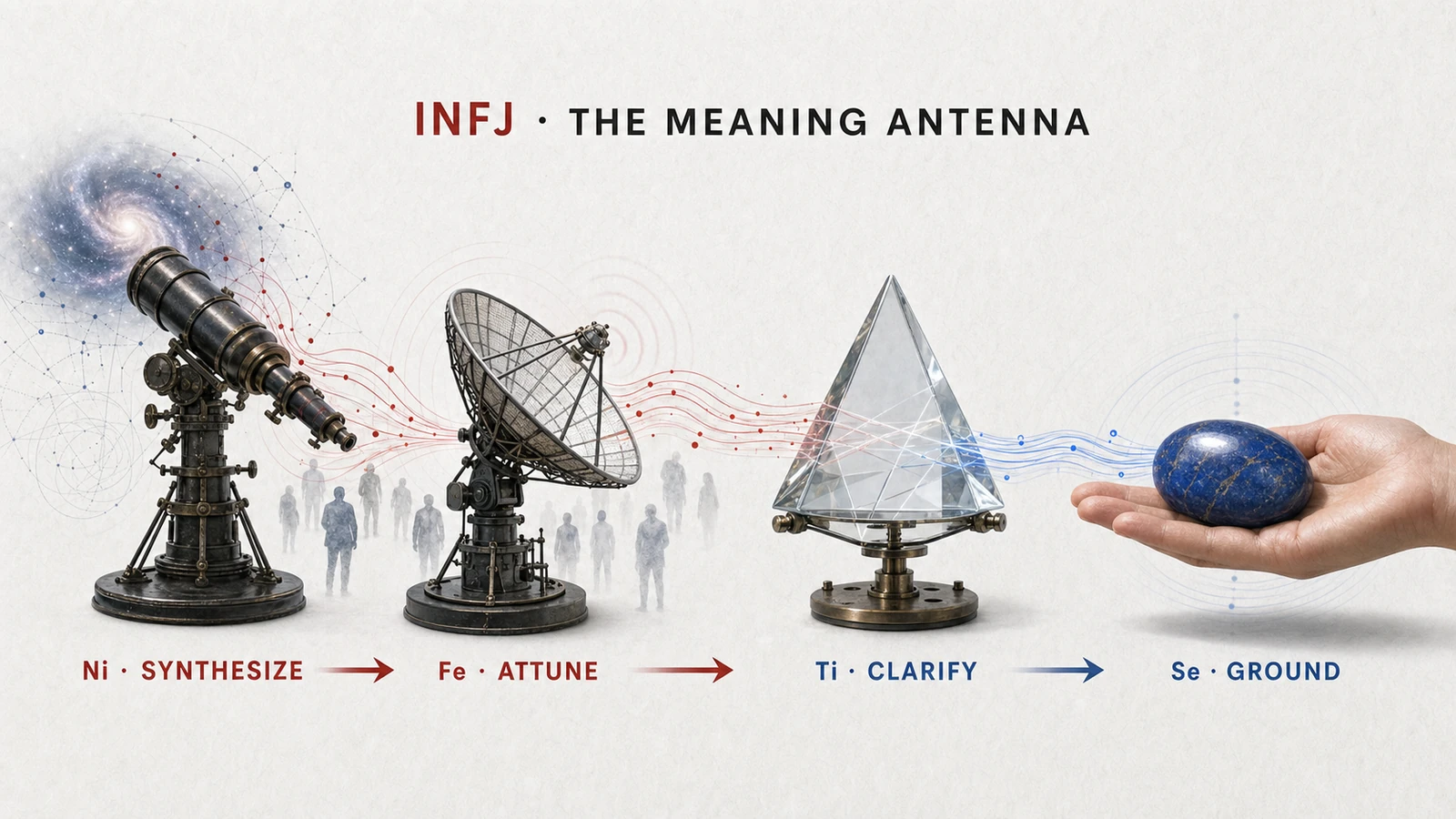
In cognitive-function terms, INFJs lead with introverted intuition, supported by extraverted feeling. Strip away the jargon and you're left with two machines running in parallel.
The first is a pattern-synthesis engine. It takes in observations constantly and compresses them into trajectories: where this relationship is headed, what this organization will look like in five years, what this person is about to say next. Neuroscience offers a plausible mechanism here. Marcus Raichle's work on the default mode network, the brain system active during inward-directed thought, shows it's heavily involved in mental simulation, autobiographical projection, and modeling other people's minds. Introverted intuition looks a lot like a default mode network that runs hot, long, and unusually well integrated: less idle daydreaming, more constant background rendering of futures. That's why your insights tend to arrive fully formed, with no visible working shown. The working happened offline, while you were in the shower.
The second machine is an outward-facing emotional radar. Extraverted feeling continuously reads the states of the people around you, and it doesn't stop at observing: it treats group harmony as a variable to actively manage, the way a thermostat manages temperature. Research on emotional contagion by Elaine Hatfield and colleagues shows that people automatically mimic others' expressions, postures, and vocal tones, and that this mimicry produces a genuine convergence of feeling. Everyone does this to some degree. You do it faster, deeper, and with far less ability to tell whose feeling it originally was. Other people's emotional states enter you like secondhand smoke: you didn't light the cigarette, you never consented to the exposure, and you're the one coughing at midnight.
A fairness note, because you'd be suspicious of this piece without one: the MBTI instrument itself has real psychometric problems. Types aren't stable categories, and the underlying traits are continuous, not binary. What's described here maps onto well-validated constructs instead: Big Five openness and agreeableness, trait sensitivity to other people's affect, and reinforcement-sensitivity differences in how brains weigh reward against threat. The four letters are a compression format, not a biological fact, useful mainly for what they let you compress.
Put the two machines together and the strangest parts of the INFJ experience stop being mystical and start being mechanical.
The "too much and not enough" feeling. Your Ni goes deeper than most conversations allow, so you get called "too intense," "too serious," "too much." Meanwhile your Fe reads exactly how much of you each room can actually tolerate, so you serve a trimmed version of yourself, and privately conclude the full version must be "not enough," or someone would have asked for it. Both signals come from the same wiring. Neither one is a verdict on you.
Perfection paralysis, on exactly the wrong things. Your intuition renders the finished, ideal version of anything you care about: vivid, complete, luminous. Then you sit down to start and produce, inevitably, a rough first pass. For low-stakes work, that gap is trivial. But for work that's fused with your identity, the gap between the rendered ideal and the messy reality registers as evidence about your worth. So the trivial stuff gets done, and the thing that matters most stays pristine and unstarted. You're not lazy. You're protecting the ideal from contact with reality.
The door slam. From the outside it looks like sudden cruelty: years of warmth, then a wall. It's neither sudden nor cruel. It's delayed boundary enforcement. Fe suppresses each small objection to preserve the peace, a skipped no here, a swallowed correction there, and every unspoken boundary accrues interest. By year three, the debt is so large that the only payment you can still afford is a full exit. The slam isn't the boundary itself. It's the bankruptcy filing after years of never sending an invoice.
The Dream Life You're Actually Built For
Generic dream-life advice fails you in a very specific way: it's written for breadth. Bigger network, more income streams, more experiences, more optionality. Your wiring converts breadth directly into noise. Every added commitment is another emotional field to stand in, another set of expectations for Fe to manage, another thread stealing cycles from the one deep synthesis Ni is actually trying to run.
The INFJ-shaped life optimizes for depth, resonance, and one contribution.
Work: one meaningful thing, not many good ones. Most productivity culture assumes you want more output. You don't. You want one output that matters: one body of work, one practice, one institution, one set of people genuinely changed for the better. This isn't a preference, it's how your motivation system gets fueled. Viktor Frankl argued that humans are driven less by pleasure than by meaning, a tension toward a worthy task, and INFJs are close to the extreme case of that claim. A portfolio of impressive but hollow wins will leave you inexplicably low right at the moment everyone's congratulating you. Design your career as a filter that keeps narrowing toward the one thing, not a funnel that keeps adding more.
Environment: low ambient emotion, high signal. Open offices, high-conflict teams, back-to-back video calls: for you, that's the equivalent of working inside a smoking lounge. You'll absorb the room all day and wonder why you're wiped out by 2pm having done nothing especially hard. The dream setup is a small number of emotionally steady collaborators, generous asynchronous communication, and physical or scheduled walls around your thinking time. This isn't self-indulgence. It's dosimetry.
Relationships: few, deep, and mutual. The INFJ social trap has a precise shape: you're the person everyone confides in, and nobody thinks to ask how you're doing, partly because you've perfected an "I'm fine" that closes the topic while you privately catalog everyone else's micro-expressions. The dream life contains three to five people where disclosure runs both directions. One friend who asks the second question, "okay, but how are you actually?", is worth forty who simply adore your listening.
Solitude: structural, not whatever's left over. Extraverts recharge in company. You don't just recharge alone, you think alone. The Ni synthesis that produces your best work only finishes in unobserved time. A life where solitude is what's left after everyone else's needs are met is a life where your core faculty never fully runs. Schedule it like dialysis.
A Productivity System That Fits Your Brain
Standard systems are built for people who need stimulation, external accountability, and volume metrics. You need the opposite on all three counts. Here's the shape that actually works.
Plan by resonance first, logic second. On Sunday, before any task list, ask one question: what would make this week feel like it served the one thing? Your motivation is meaning-gated, and a perfectly logical plan that doesn't connect to the deeper thread will get quietly sabotaged by your own system within 48 hours. Write one sentence linking the week to the long arc. Then, and only then, schedule the tasks.
One deep block, daily, before exposure. Cal Newport's deep work research applies to everyone, but the ordering matters uniquely for you: your first 90 minutes should touch the meaningful project before email, messages, or any human contact. Not for focus reasons, for contagion reasons. Once you've absorbed other people's states, part of your working memory stays occupied processing them for the rest of the day. Pre-exposure hours are the only hours that are fully yours.
Task granularity: shrink only the sacred. Here's the counterintuitive part: for routine work you don't need tiny tasks, you're conscientious enough to just do things. Save the aggressive task-shrinking for the identity-fused project, where the paralysis actually lives. "Work on book" will lose to laundry every single day for a decade. "Type one bad paragraph about the ferry scene" can actually happen, because it's too small to threaten the ideal.
Accountability: one witness, not a scoreboard. Public metrics and leaderboards read to your Fe as more people to manage the perceptions of, pure cost, no benefit. But one trusted person who knows what you're building and asks about it gently each week works with your wiring instead of against it. You'll move mountains to avoid quietly disappointing one specific person you respect.
A hard people-budget. Track emotionally exposed hours, meetings, hard conversations, social events, the way other people track calories. You have a real daily limit, and going over it doesn't feel like anything in the moment, since Fe performs beautifully right up until the tank is actually empty. The cost arrives on a 24-hour delay. Budget the exposure itself, not the fatigue that shows up later.
A weekly closing ritual. Ni keeps every open loop rendering quietly in the background: unresolved conversations, half-finished thoughts, someone's unexplained coldness on Thursday. Give it twenty minutes on Friday to write down every open loop and either close it, schedule it, or explicitly release it. This is maintenance for the simulation engine, and it's the difference between an actual weekend and a 48-hour background process.
Neuro Hacks for the INFJ
Six techniques, each aimed at a specific failure mode in this wiring, each with the mechanism made visible.
1. The Contagion Audit. For one week, note your emotional state in two words before and after every significant interaction. The mechanism: emotional contagion operates below conscious awareness, so you can't block the absorption, but labeling the delta ("entered calm, left anxious, whose anxiety was that?") engages the affect-labeling process that reduces reactivity when you name feelings precisely. You stop metabolizing other people's smoke as your own weather.
2. The Ugly First Pass. For the identity-fused project only: commit, out loud, to producing a deliberately bad version. Not "a rough draft," a bad one, on purpose, with a timer running. The mechanism: your paralysis is stakes-driven, not skill-driven. A version that's bad by design can't function as evidence about your worth, which disarms the threat response guarding the ideal. Quality comes back in at revision, where your Ni is genuinely excellent.
3. The Ten-Gram No. Once a day, decline something trivially small: a call that could be an email, a favor you'd normally auto-absorb, using a pre-loaded sentence like "I can't take that on this week." The mechanism: Peter Gollwitzer's implementation intentions research shows that pre-deciding the when-then removes the in-the-moment deliberation where your Fe always sides with the other person. Boundaries enforced in ten-gram increments never build up into the kiloton debt that ends in a door slam.
4. The Externalized Ni. Every evening, spend ten minutes on unfiltered writing: insights, dreads, half-formed predictions, the thing you noticed about your colleague's tone. The mechanism: James Pennebaker's expressive writing research found that translating internal states into language measurably reduces their physical grip. For you there's a second payoff: Ni's output is pre-verbal and evaporates if it's never recorded. Paper gives the prophecy engine an external hard drive, and stops it from re-rendering the same futures at 3am.
5. The One-Contribution Filter. Write a single sentence describing your one meaningful contribution, and tape it where you plan your week. Every new opportunity gets one question: does this feed the sentence? The mechanism: goal-setting research from Edwin Locke and Gary Latham shows specific commitments outperform vague intentions largely by making rejection easier, since a clear yes generates automatic no's. Your Fe can't argue with a sentence the way it argues with a feeling.
6. The Quarter-Tank Rule. List your own three personal early-warning lights, common INFJ ones include canceling small plans you'd normally enjoy, fantasizing about moving somewhere nobody knows you, answering "how are you?" with logistics instead of an actual answer. When any two light up, you're at a quarter tank, and solitude gets scheduled that week, before empty, not after. The mechanism: your depletion is masked by Fe's public performance, so a subjective "I'm fine" is a lagging indicator. Behavioral tells are the leading ones. Instrument the behavior, not the feeling.
The Shadow Side: Give Until Empty, Then Vanish
Every type has a burnout signature. Yours is the most theatrical, precisely because the buildup stays invisible for so long.
Act one: overextension that looks like virtue. You absorb more, hold more, smooth more. Everyone around you experiences this as generosity and steadiness. Internally, resentment accrues in an account nobody, including you, is actually auditing, because acknowledging it would conflict with the identity of being the person who holds things together.
Act two: the quiet withdrawal. Responses get shorter. You stop offering the perceptive observations that are basically your love language. You're present in body, gone in bandwidth. Nobody notices, which your exhausted brain files as further proof that people only ever wanted the function, not the person.
Act three: the vanish. Canceled plans, unanswered messages, sometimes a full door slam on a relationship or a job. From the outside: shocking, out of nowhere. From the inside: the most predictable event of the year, one you watched approaching for months with the same Ni clarity you bring to everything except your own maintenance.
The recovery move isn't more insight. You have plenty of that already. It's earlier honesty, at smaller amplitudes. The whole cycle runs on one deferral: the belief that you can absorb one more emotion, swallow one more no, and settle the account later. There is no later. There's only compounding.
So: solitude scheduled before depletion, not after it. No's issued in grams, not kilotons. One person who gets the unperformed truth on a weekly basis. And a gentler lesson worth borrowing from your INFP cousins: your values are allowed to protect you, not just everyone standing near you.
The Contribution Is Allowed to Be Imperfect
Here's the reframe to leave with.
You've spent your life half-apologizing for the intensity: softening the insight, trimming the depth, running the "too much" calculation in every room you enter. At the same time, you've believed the one thing you're here to do has to be flawless before it's even allowed to exist, which is exactly why it still lives safely inside your head.
Both habits guard the same door. The world doesn't need the trimmed version of you, or the perfect version of your work. It needs the actual contribution, at full depth, in imperfect form, delivered by someone whose tank isn't empty.
You've always been able to see how things end. Point that engine at your own story for once, and build the ending on purpose.